

1 3
Top Curr Chem (Z) (2018) 376:10
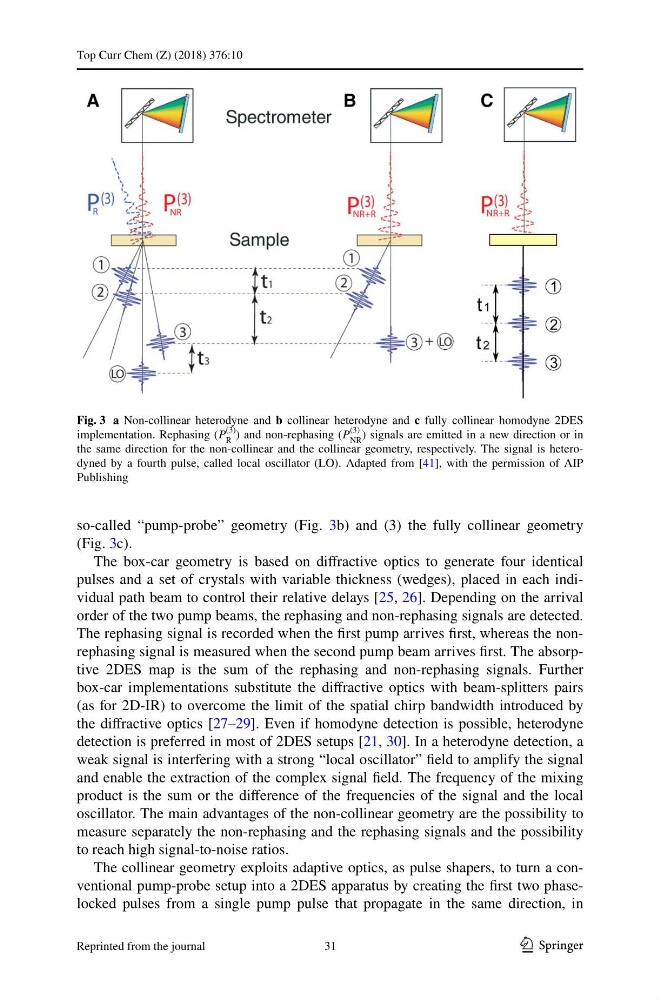
so-called “pump-probe” geometry (Fig. 3b) and (3) the fully collinear geometry
(Fig. 3c).
The box-car geometry is based on diffractive optics to generate four identical
pulses and a set of crystals with variable thickness (wedges), placed in each individual path beam to control their relative delays [25, 26]. Depending on the arrival
order of the two pump beams, the rephasing and non-rephasing signals are detected.
The rephasing signal is recorded when the first pump arrives first, whereas the nonrephasing signal is measured when the second pump beam arrives first. The absorptive 2DES map is the sum of the rephasing and non-rephasing signals. Further
box-car implementations substitute the diffractive optics with beam-splitters pairs
(as for 2D-IR) to overcome the limit of the spatial chirp bandwidth introduced by
the diffractive optics [27–29]. Even if homodyne detection is possible, heterodyne
detection is preferred in most of 2DES setups [21, 30]. In a heterodyne detection, a
weak signal is interfering with a strong “local oscillator” field to amplify the signal
and enable the extraction of the complex signal field. The frequency of the mixing
product is the sum or the difference of the frequencies of the signal and the local
oscillator. The main advantages of the non-collinear geometry are the possibility to
measure separately the non-rephasing and the rephasing signals and the possibility
to reach high signal-to-noise ratios.
The collinear geometry exploits adaptive optics, as pulse shapers, to turn a conventional pump-probe setup into a 2DES apparatus by creating the first two phaselocked pulses from a single pump pulse that propagate in the same direction, in
Fig. 3 a Non-collinear heterodyne and b collinear heterodyne and c fully collinear homodyne 2DES
implementation. Rephasing ( P
(3)
R
) and non-rephasing ( P
(3)
NR
) signals are emitted in a new direction or in
the same direction for the non-collinear and the collinear geometry, respectively. The signal is heterodyned by a fourth pulse, called local oscillator (LO). Adapted from [41], with the permission of AIP
Publishing
31
Reprinted from the journal
Top Curr Chem (Z) (2018) 376:10
so-called “pump-probe” geometry (Fig. 3b) and (3) the fully collinear geometry
(Fig. 3c).
The box-car geometry is based on diffractive optics to generate four identical
pulses and a set of crystals with variable thickness (wedges), placed in each individual path beam to control their relative delays [25, 26]. Depending on the arrival
order of the two pump beams, the rephasing and non-rephasing signals are detected.
The rephasing signal is recorded when the first pump arrives first, whereas the nonrephasing signal is measured when the second pump beam arrives first. The absorptive 2DES map is the sum of the rephasing and non-rephasing signals. Further
box-car implementations substitute the diffractive optics with beam-splitters pairs
(as for 2D-IR) to overcome the limit of the spatial chirp bandwidth introduced by
the diffractive optics [27–29]. Even if homodyne detection is possible, heterodyne
detection is preferred in most of 2DES setups [21, 30]. In a heterodyne detection, a
weak signal is interfering with a strong “local oscillator” field to amplify the signal
and enable the extraction of the complex signal field. The frequency of the mixing
product is the sum or the difference of the frequencies of the signal and the local
oscillator. The main advantages of the non-collinear geometry are the possibility to
measure separately the non-rephasing and the rephasing signals and the possibility
to reach high signal-to-noise ratios.
The collinear geometry exploits adaptive optics, as pulse shapers, to turn a conventional pump-probe setup into a 2DES apparatus by creating the first two phaselocked pulses from a single pump pulse that propagate in the same direction, in
Fig. 3 a Non-collinear heterodyne and b collinear heterodyne and c fully collinear homodyne 2DES
implementation. Rephasing ( P
(3)
R
) and non-rephasing ( P
(3)
NR
) signals are emitted in a new direction or in
the same direction for the non-collinear and the collinear geometry, respectively. The signal is heterodyned by a fourth pulse, called local oscillator (LO). Adapted from [41], with the permission of AIP
Publishing
31
Reprinted from the journal