

Schro ¨dinger’s equation using a Gaussian ansatz under such conditions [46, 47]. The
trajectory shown in Fig. 11c indicates that turning points along triiodide’s
symmetric stretching coordinate are reached near delay times of 170 and 325 fs.
Each revolution of the spiral represents a cycle of the symmetric stretching mode of
triiodide, which possesses a 300-fs period. Vibrational dephasing causes the spiral to
focus inward as time increases. Most importantly, the orientation of the spiral
reflects positive correlation between the bond lengths of triiodide and the vibrational
coherence frequency of diiodide.
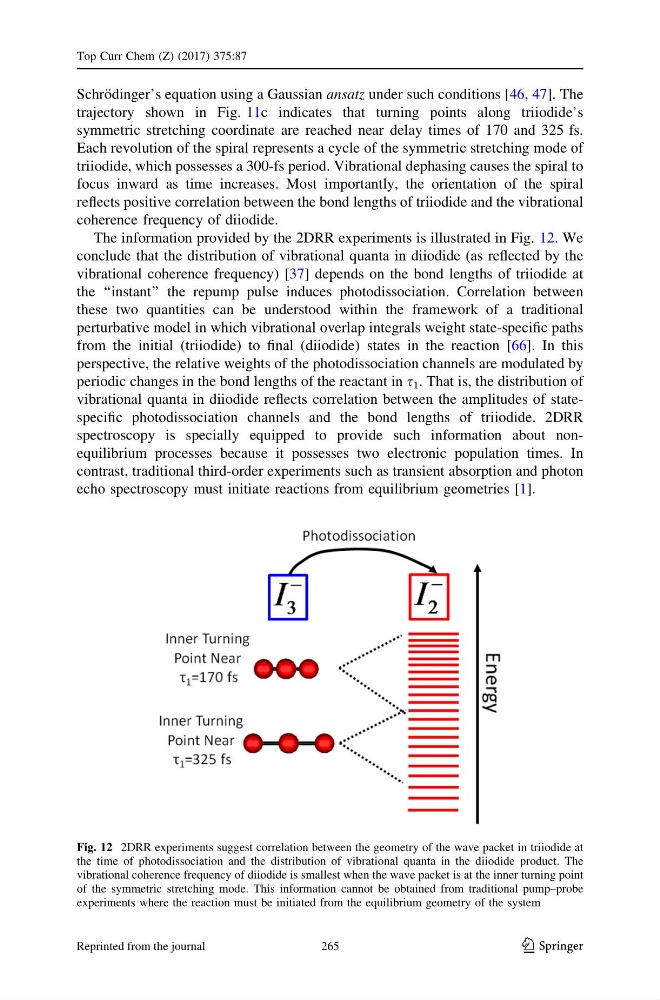
The information provided by the 2DRR experiments is illustrated in Fig. 12. We
conclude that the distribution of vibrational quanta in diiodide (as reflected by the
vibrational coherence frequency) [37] depends on the bond lengths of triiodide at
the ‘‘instant’’ the repump pulse induces photodissociation. Correlation between
these two quantities can be understood within the framework of a traditional
perturbative model in which vibrational overlap integrals weight state-specific paths
from the initial (triiodide) to final (diiodide) states in the reaction [66]. In this
perspective, the relative weights of the photodissociation channels are modulated by
periodic changes in the bond lengths of the reactant in s 1 . That is, the distribution of
vibrational quanta in diiodide reflects correlation between the amplitudes of statespecific photodissociation channels and the bond lengths of triiodide. 2DRR
spectroscopy is specially equipped to provide such information about nonequilibrium processes because it possesses two electronic population times. In
contrast, traditional third-order experiments such as transient absorption and photon
echo spectroscopy must initiate reactions from equilibrium geometries [1].
Fig. 12 2DRR experiments suggest correlation between the geometry of the wave packet in triiodide at
the time of photodissociation and the distribution of vibrational quanta in the diiodide product. The
vibrational coherence frequency of diiodide is smallest when the wave packet is at the inner turning point
of the symmetric stretching mode. This information cannot be obtained from traditional pump–probe
experiments where the reaction must be initiated from the equilibrium geometry of the system
Top Curr Chem (Z) (2017) 375:87
123
265
Reprinted from the journal
trajectory shown in Fig. 11c indicates that turning points along triiodide’s
symmetric stretching coordinate are reached near delay times of 170 and 325 fs.
Each revolution of the spiral represents a cycle of the symmetric stretching mode of
triiodide, which possesses a 300-fs period. Vibrational dephasing causes the spiral to
focus inward as time increases. Most importantly, the orientation of the spiral
reflects positive correlation between the bond lengths of triiodide and the vibrational
coherence frequency of diiodide.
The information provided by the 2DRR experiments is illustrated in Fig. 12. We
conclude that the distribution of vibrational quanta in diiodide (as reflected by the
vibrational coherence frequency) [37] depends on the bond lengths of triiodide at
the ‘‘instant’’ the repump pulse induces photodissociation. Correlation between
these two quantities can be understood within the framework of a traditional
perturbative model in which vibrational overlap integrals weight state-specific paths
from the initial (triiodide) to final (diiodide) states in the reaction [66]. In this
perspective, the relative weights of the photodissociation channels are modulated by
periodic changes in the bond lengths of the reactant in s 1 . That is, the distribution of
vibrational quanta in diiodide reflects correlation between the amplitudes of statespecific photodissociation channels and the bond lengths of triiodide. 2DRR
spectroscopy is specially equipped to provide such information about nonequilibrium processes because it possesses two electronic population times. In
contrast, traditional third-order experiments such as transient absorption and photon
echo spectroscopy must initiate reactions from equilibrium geometries [1].
Fig. 12 2DRR experiments suggest correlation between the geometry of the wave packet in triiodide at
the time of photodissociation and the distribution of vibrational quanta in the diiodide product. The
vibrational coherence frequency of diiodide is smallest when the wave packet is at the inner turning point
of the symmetric stretching mode. This information cannot be obtained from traditional pump–probe
experiments where the reaction must be initiated from the equilibrium geometry of the system
Top Curr Chem (Z) (2017) 375:87
123
265
Reprinted from the journal