

phase-mismatch was induced in third-order signals [53, 55]. In contrast, the choice
of 2DRR beam geometry is primarily governed by convenience because of
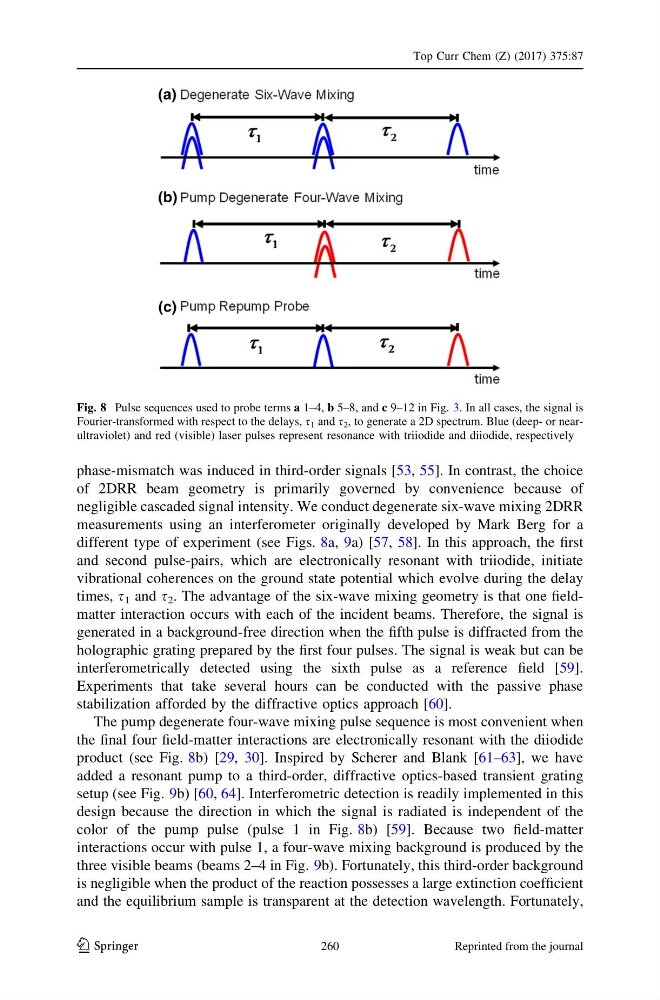
negligible cascaded signal intensity. We conduct degenerate six-wave mixing 2DRR
measurements using an interferometer originally developed by Mark Berg for a
different type of experiment (see Figs. 8a, 9a) [57, 58]. In this approach, the first
and second pulse-pairs, which are electronically resonant with triiodide, initiate
vibrational coherences on the ground state potential which evolve during the delay
times, s 1 and s 2 . The advantage of the six-wave mixing geometry is that one fieldmatter interaction occurs with each of the incident beams. Therefore, the signal is
generated in a background-free direction when the fifth pulse is diffracted from the
holographic grating prepared by the first four pulses. The signal is weak but can be
interferometrically detected using the sixth pulse as a reference field [59].
Experiments that take several hours can be conducted with the passive phase
stabilization afforded by the diffractive optics approach [60].
The pump degenerate four-wave mixing pulse sequence is most convenient when
the final four field-matter interactions are electronically resonant with the diiodide
product (see Fig. 8b) [29, 30]. Inspired by Scherer and Blank [61–63], we have
added a resonant pump to a third-order, diffractive optics-based transient grating
setup (see Fig. 9b) [60, 64]. Interferometric detection is readily implemented in this
design because the direction in which the signal is radiated is independent of the
color of the pump pulse (pulse 1 in Fig. 8b) [59]. Because two field-matter
interactions occur with pulse 1, a four-wave mixing background is produced by the
three visible beams (beams 2–4 in Fig. 9b). Fortunately, this third-order background
is negligible when the product of the reaction possesses a large extinction coefficient
and the equilibrium sample is transparent at the detection wavelength. Fortunately,
Fig. 8 Pulse sequences used to probe terms a 1–4, b 5–8, and c 9–12 in Fig. 3. In all cases, the signal is
Fourier-transformed with respect to the delays, s 1 and s 2 , to generate a 2D spectrum. Blue (deep- or nearultraviolet) and red (visible) laser pulses represent resonance with triiodide and diiodide, respectively
Top Curr Chem (Z) (2017) 375:87
123
260
Reprinted from the journal
of 2DRR beam geometry is primarily governed by convenience because of
negligible cascaded signal intensity. We conduct degenerate six-wave mixing 2DRR
measurements using an interferometer originally developed by Mark Berg for a
different type of experiment (see Figs. 8a, 9a) [57, 58]. In this approach, the first
and second pulse-pairs, which are electronically resonant with triiodide, initiate
vibrational coherences on the ground state potential which evolve during the delay
times, s 1 and s 2 . The advantage of the six-wave mixing geometry is that one fieldmatter interaction occurs with each of the incident beams. Therefore, the signal is
generated in a background-free direction when the fifth pulse is diffracted from the
holographic grating prepared by the first four pulses. The signal is weak but can be
interferometrically detected using the sixth pulse as a reference field [59].
Experiments that take several hours can be conducted with the passive phase
stabilization afforded by the diffractive optics approach [60].
The pump degenerate four-wave mixing pulse sequence is most convenient when
the final four field-matter interactions are electronically resonant with the diiodide
product (see Fig. 8b) [29, 30]. Inspired by Scherer and Blank [61–63], we have
added a resonant pump to a third-order, diffractive optics-based transient grating
setup (see Fig. 9b) [60, 64]. Interferometric detection is readily implemented in this
design because the direction in which the signal is radiated is independent of the
color of the pump pulse (pulse 1 in Fig. 8b) [59]. Because two field-matter
interactions occur with pulse 1, a four-wave mixing background is produced by the
three visible beams (beams 2–4 in Fig. 9b). Fortunately, this third-order background
is negligible when the product of the reaction possesses a large extinction coefficient
and the equilibrium sample is transparent at the detection wavelength. Fortunately,
Fig. 8 Pulse sequences used to probe terms a 1–4, b 5–8, and c 9–12 in Fig. 3. In all cases, the signal is
Fourier-transformed with respect to the delays, s 1 and s 2 , to generate a 2D spectrum. Blue (deep- or nearultraviolet) and red (visible) laser pulses represent resonance with triiodide and diiodide, respectively
Top Curr Chem (Z) (2017) 375:87
123
260
Reprinted from the journal