

1 3
Topics in Current Chemistry (2018) 376:35
coherent light–matter interactions to prepare vibrational wavepackets in one (or two)
electronic states and to probe their spectroscopic signatures either in the spectral
domain or in the time domain. The examples discussed in this contribution portrayed how such stimulated Raman spectra are acquired by Multi-VCS and used to
(1) map structural dynamics along a photoreaction, (2) identify transient molecular species, and (3) reveal chemical/structural heterogeneity of complex molecular
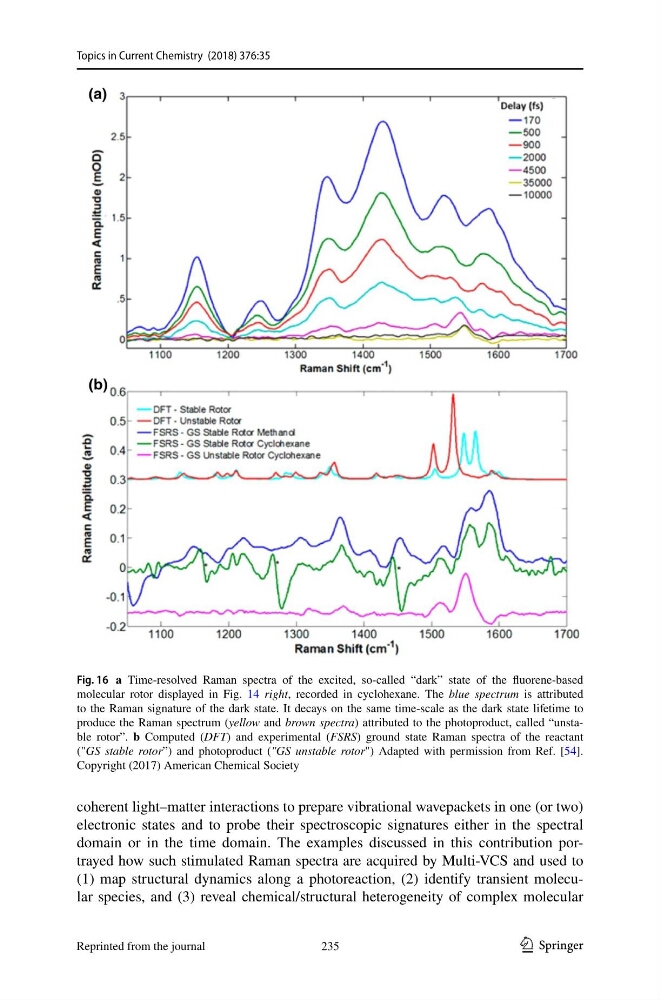
Fig. 16 a Time-resolved Raman spectra of the excited, so-called “dark” state of the fluorene-based
molecular rotor displayed in Fig. 14 right, recorded in cyclohexane. The blue spectrum is attributed
to the Raman signature of the dark state. It decays on the same time-scale as the dark state lifetime to
produce the Raman spectrum (yellow and brown spectra) attributed to the photoproduct, called “unstable rotor”. b Computed (DFT) and experimental (FSRS) ground state Raman spectra of the reactant
("GS stable rotor”) and photoproduct ("GS unstable rotor") Adapted with permission from Ref. [54].
Copyright (2017) American Chemical Society
235
Reprinted from the journal
Topics in Current Chemistry (2018) 376:35
coherent light–matter interactions to prepare vibrational wavepackets in one (or two)
electronic states and to probe their spectroscopic signatures either in the spectral
domain or in the time domain. The examples discussed in this contribution portrayed how such stimulated Raman spectra are acquired by Multi-VCS and used to
(1) map structural dynamics along a photoreaction, (2) identify transient molecular species, and (3) reveal chemical/structural heterogeneity of complex molecular
Fig. 16 a Time-resolved Raman spectra of the excited, so-called “dark” state of the fluorene-based
molecular rotor displayed in Fig. 14 right, recorded in cyclohexane. The blue spectrum is attributed
to the Raman signature of the dark state. It decays on the same time-scale as the dark state lifetime to
produce the Raman spectrum (yellow and brown spectra) attributed to the photoproduct, called “unstable rotor”. b Computed (DFT) and experimental (FSRS) ground state Raman spectra of the reactant
("GS stable rotor”) and photoproduct ("GS unstable rotor") Adapted with permission from Ref. [54].
Copyright (2017) American Chemical Society
235
Reprinted from the journal