

Topics in Current Chemistry (2018) 376:35
1 3
to the high spectral overlap of the respective absorption bands, the ultrashort time
scales involved, but also due to the couplings [130–131] between these states.
Multi-VCS has been applied to carotenoids to assist in the elucidation of the
excited state manifold. In general, the excited-state active vibrations of carotenoids
are typical of polyenes consisting of strong high-frequency modes like methyl deformation (~ 1000 cm
−1
), C–C stretching (~ 1140–1200 cm
−1
), and C=C stretching
(~ 1500–1550 cm
−1
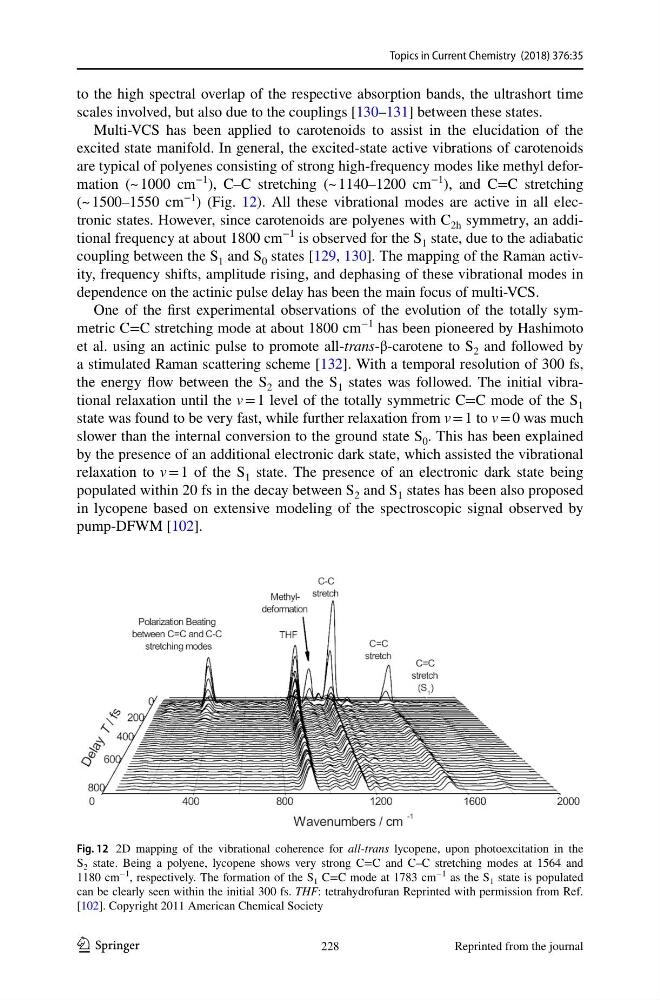
) (Fig. 12). All these vibrational modes are active in all electronic states. However, since carotenoids are polyenes with C 2h symmetry, an additional frequency at about 1800 cm
−1
is observed for the S 1 state, due to the adiabatic
coupling between the S 1 and S 0 states [129, 130]. The mapping of the Raman activity, frequency shifts, amplitude rising, and dephasing of these vibrational modes in
dependence on the actinic pulse delay has been the main focus of multi-VCS.
One of the first experimental observations of the evolution of the totally symmetric C=C stretching mode at about 1800 cm
−1
has been pioneered by Hashimoto
et al. using an actinic pulse to promote all-trans-β-carotene to S 2 and followed by
a stimulated Raman scattering scheme [132]. With a temporal resolution of 300 fs,
the energy flow between the S 2 and the S 1 states was followed. The initial vibrational relaxation until the v = 1 level of the totally symmetric C=C mode of the S 1
state was found to be very fast, while further relaxation from v = 1 to v = 0 was much
slower than the internal conversion to the ground state S 0 . This has been explained
by the presence of an additional electronic dark state, which assisted the vibrational
relaxation to v = 1 of the S 1 state. The presence of an electronic dark state being
populated within 20 fs in the decay between S 2 and S 1 states has been also proposed
in lycopene based on extensive modeling of the spectroscopic signal observed by
pump-DFWM [102].
Fig. 12 2D mapping of the vibrational coherence for all-trans lycopene, upon photoexcitation in the
S 2 state. Being a polyene, lycopene shows very strong C=C and C–C stretching modes at 1564 and
1180 cm
−1 , respectively. The formation of the S 1 C=C mode at 1783 cm
−1 as the S 1 state is populated
can be clearly seen within the initial 300 fs. THF: tetrahydrofuran Reprinted with permission from Ref.
[102]. Copyright 2011 American Chemical Society
228
Reprinted from the journal
1 3
to the high spectral overlap of the respective absorption bands, the ultrashort time
scales involved, but also due to the couplings [130–131] between these states.
Multi-VCS has been applied to carotenoids to assist in the elucidation of the
excited state manifold. In general, the excited-state active vibrations of carotenoids
are typical of polyenes consisting of strong high-frequency modes like methyl deformation (~ 1000 cm
−1
), C–C stretching (~ 1140–1200 cm
−1
), and C=C stretching
(~ 1500–1550 cm
−1
) (Fig. 12). All these vibrational modes are active in all electronic states. However, since carotenoids are polyenes with C 2h symmetry, an additional frequency at about 1800 cm
−1
is observed for the S 1 state, due to the adiabatic
coupling between the S 1 and S 0 states [129, 130]. The mapping of the Raman activity, frequency shifts, amplitude rising, and dephasing of these vibrational modes in
dependence on the actinic pulse delay has been the main focus of multi-VCS.
One of the first experimental observations of the evolution of the totally symmetric C=C stretching mode at about 1800 cm
−1
has been pioneered by Hashimoto
et al. using an actinic pulse to promote all-trans-β-carotene to S 2 and followed by
a stimulated Raman scattering scheme [132]. With a temporal resolution of 300 fs,
the energy flow between the S 2 and the S 1 states was followed. The initial vibrational relaxation until the v = 1 level of the totally symmetric C=C mode of the S 1
state was found to be very fast, while further relaxation from v = 1 to v = 0 was much
slower than the internal conversion to the ground state S 0 . This has been explained
by the presence of an additional electronic dark state, which assisted the vibrational
relaxation to v = 1 of the S 1 state. The presence of an electronic dark state being
populated within 20 fs in the decay between S 2 and S 1 states has been also proposed
in lycopene based on extensive modeling of the spectroscopic signal observed by
pump-DFWM [102].
Fig. 12 2D mapping of the vibrational coherence for all-trans lycopene, upon photoexcitation in the
S 2 state. Being a polyene, lycopene shows very strong C=C and C–C stretching modes at 1564 and
1180 cm
−1 , respectively. The formation of the S 1 C=C mode at 1783 cm
−1 as the S 1 state is populated
can be clearly seen within the initial 300 fs. THF: tetrahydrofuran Reprinted with permission from Ref.
[102]. Copyright 2011 American Chemical Society
228
Reprinted from the journal