

Topics in Current Chemistry (2018) 376:35
1 3
of another Raman band has been identified as the signature of anharmonic vibrational coupling between the two corresponding modes [88]. Information on how
vibrational energy redistributes can be retrieved from the width as well as frequency
changes of Raman bands. Strong coupling between molecular vibrations leads to
strong dephasing and damping of specific bands and can be exploited to record how
e.g., intramolecular vibrational relaxation (IVR) and vibrational cooling—e.g., solute–solvent interaction—take place in complex systems [97–98]. Initially, very fast
photoreactive systems evolve within few tens or hundreds of femtoseconds away
from the Franck–Condon region, leaving very broad multi-VCS bands in the Raman
spectrum.
Also, the ability of multi-VCS to extract information on the molecular dynamics
is enhanced when the evolution of Raman bands is combined with other techniques
[99]. This is particularly interesting when methods sensitive to other molecular
degrees-of-freedom are considered, like transient absorption and the detection of the
electronic population dynamics. For example, rise or decay times of specific Raman
bands can be correlated to respective times observed in the electronic population
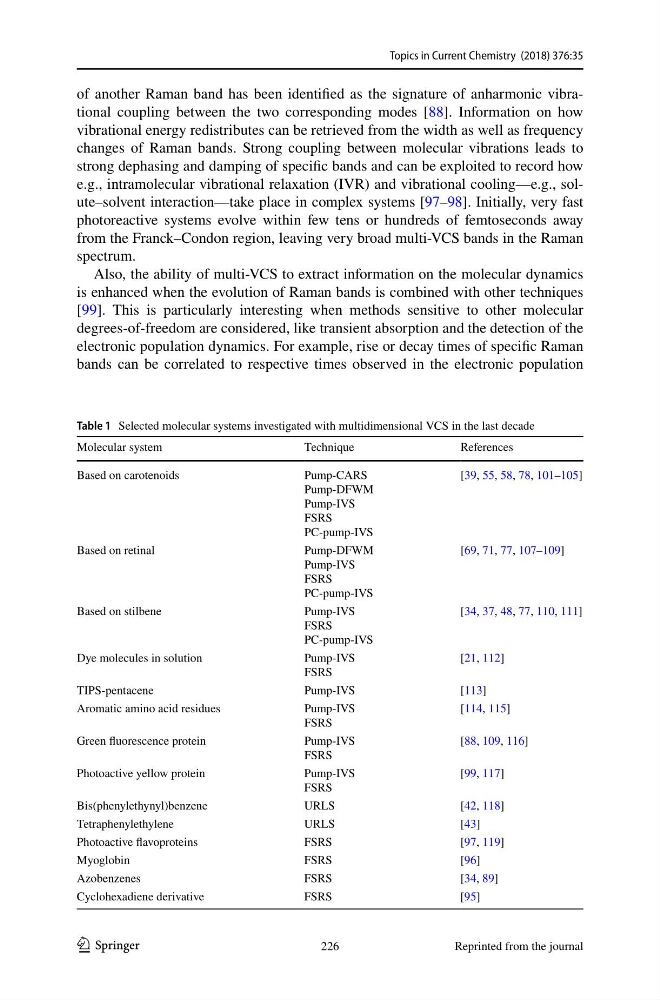
Table 1 Selected molecular systems investigated with multidimensional VCS in the last decade
Molecular system
Technique
References
Based on carotenoids
Pump-CARS
Pump-DFWM
Pump-IVS
FSRS
PC-pump-IVS
[39, 55, 58, 78, 101–105]
Based on retinal
Pump-DFWM
Pump-IVS
FSRS
PC-pump-IVS
[69, 71, 77, 107–109]
Based on stilbene
Pump-IVS
FSRS
PC-pump-IVS
[34, 37, 48, 77, 110, 111]
Dye molecules in solution
Pump-IVS
FSRS
[21, 112]
TIPS-pentacene
Pump-IVS
[113]
Aromatic amino acid residues
Pump-IVS
FSRS
[114, 115]
Green fluorescence protein
Pump-IVS
FSRS
[88, 109, 116]
Photoactive yellow protein
Pump-IVS
FSRS
[99, 117]
Bis(phenylethynyl)benzene
URLS
[42, 118]
Tetraphenylethylene
URLS
[43]
Photoactive flavoproteins
FSRS
[97, 119]
Myoglobin
FSRS
[96]
Azobenzenes
FSRS
[34, 89]
Cyclohexadiene derivative
FSRS
[95]
226
Reprinted from the journal
1 3
of another Raman band has been identified as the signature of anharmonic vibrational coupling between the two corresponding modes [88]. Information on how
vibrational energy redistributes can be retrieved from the width as well as frequency
changes of Raman bands. Strong coupling between molecular vibrations leads to
strong dephasing and damping of specific bands and can be exploited to record how
e.g., intramolecular vibrational relaxation (IVR) and vibrational cooling—e.g., solute–solvent interaction—take place in complex systems [97–98]. Initially, very fast
photoreactive systems evolve within few tens or hundreds of femtoseconds away
from the Franck–Condon region, leaving very broad multi-VCS bands in the Raman
spectrum.
Also, the ability of multi-VCS to extract information on the molecular dynamics
is enhanced when the evolution of Raman bands is combined with other techniques
[99]. This is particularly interesting when methods sensitive to other molecular
degrees-of-freedom are considered, like transient absorption and the detection of the
electronic population dynamics. For example, rise or decay times of specific Raman
bands can be correlated to respective times observed in the electronic population
Table 1 Selected molecular systems investigated with multidimensional VCS in the last decade
Molecular system
Technique
References
Based on carotenoids
Pump-CARS
Pump-DFWM
Pump-IVS
FSRS
PC-pump-IVS
[39, 55, 58, 78, 101–105]
Based on retinal
Pump-DFWM
Pump-IVS
FSRS
PC-pump-IVS
[69, 71, 77, 107–109]
Based on stilbene
Pump-IVS
FSRS
PC-pump-IVS
[34, 37, 48, 77, 110, 111]
Dye molecules in solution
Pump-IVS
FSRS
[21, 112]
TIPS-pentacene
Pump-IVS
[113]
Aromatic amino acid residues
Pump-IVS
FSRS
[114, 115]
Green fluorescence protein
Pump-IVS
FSRS
[88, 109, 116]
Photoactive yellow protein
Pump-IVS
FSRS
[99, 117]
Bis(phenylethynyl)benzene
URLS
[42, 118]
Tetraphenylethylene
URLS
[43]
Photoactive flavoproteins
FSRS
[97, 119]
Myoglobin
FSRS
[96]
Azobenzenes
FSRS
[34, 89]
Cyclohexadiene derivative
FSRS
[95]
226
Reprinted from the journal