

Topics in Current Chemistry (2018) 376:35
1 3
A major challenge in FSRS is the separation of the stimulated Raman spectrum
from the non-coherent background spectrally overlapping with the signal. The lack
of automatic methods to extract the excited-state Raman spectrum from the groundstate Raman spectrum, probe background, and transient absorption signal has been
a major obstacle in the practical development of FSRS as an analytical tool. Several
experimental and numerical approaches have been developed in this regard. Since
FSRS is usually performed with kHz laser sources, the chopping of the actinic and
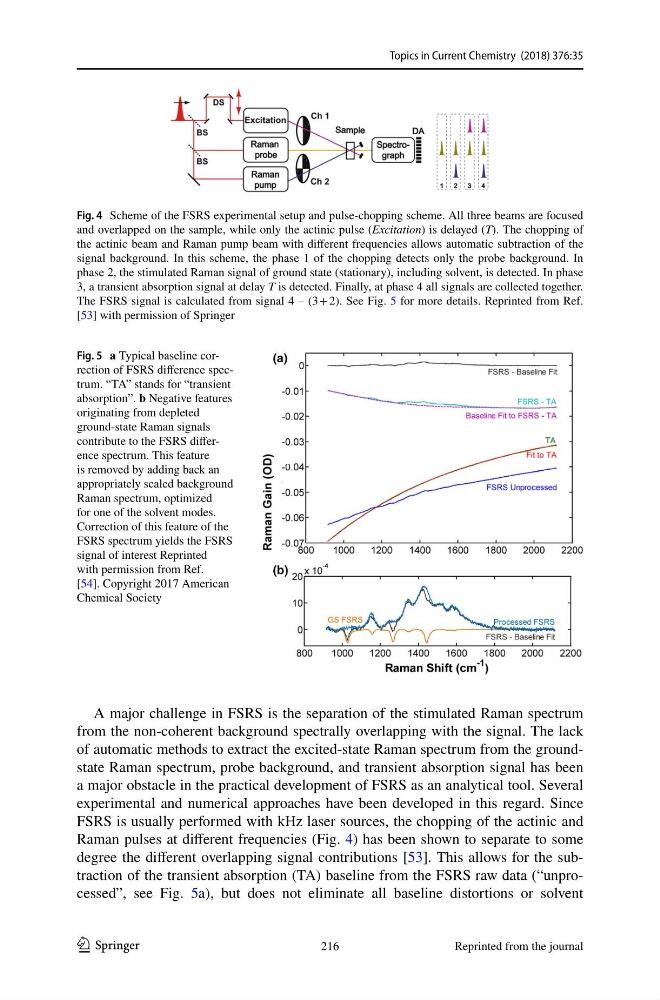
Raman pulses at different frequencies (Fig. 4) has been shown to separate to some
degree the different overlapping signal contributions [53]. This allows for the subtraction of the transient absorption (TA) baseline from the FSRS raw data (“unprocessed”, see Fig. 5a), but does not eliminate all baseline distortions or solvent
Fig. 4 Scheme of the FSRS experimental setup and pulse-chopping scheme. All three beams are focused
and overlapped on the sample, while only the actinic pulse (Excitation) is delayed (T). The chopping of
the actinic beam and Raman pump beam with different frequencies allows automatic subtraction of the
signal background. In this scheme, the phase 1 of the chopping detects only the probe background. In
phase 2, the stimulated Raman signal of ground state (stationary), including solvent, is detected. In phase
3, a transient absorption signal at delay T is detected. Finally, at phase 4 all signals are collected together.
The FSRS signal is calculated from signal 4 – (3 + 2). See Fig. 5 for more details. Reprinted from Ref.
[53] with permission of Springer
Fig. 5 a Typical baseline correction of FSRS difference spectrum. “TA” stands for “transient
absorption”. b Negative features
originating from depleted
ground-state Raman signals
contribute to the FSRS difference spectrum. This feature
is removed by adding back an
appropriately scaled background
Raman spectrum, optimized
for one of the solvent modes.
Correction of this feature of the
FSRS spectrum yields the FSRS
signal of interest Reprinted
with permission from Ref.
[54]. Copyright 2017 American
Chemical Society
216
Reprinted from the journal
1 3
A major challenge in FSRS is the separation of the stimulated Raman spectrum
from the non-coherent background spectrally overlapping with the signal. The lack
of automatic methods to extract the excited-state Raman spectrum from the groundstate Raman spectrum, probe background, and transient absorption signal has been
a major obstacle in the practical development of FSRS as an analytical tool. Several
experimental and numerical approaches have been developed in this regard. Since
FSRS is usually performed with kHz laser sources, the chopping of the actinic and
Raman pulses at different frequencies (Fig. 4) has been shown to separate to some
degree the different overlapping signal contributions [53]. This allows for the subtraction of the transient absorption (TA) baseline from the FSRS raw data (“unprocessed”, see Fig. 5a), but does not eliminate all baseline distortions or solvent
Fig. 4 Scheme of the FSRS experimental setup and pulse-chopping scheme. All three beams are focused
and overlapped on the sample, while only the actinic pulse (Excitation) is delayed (T). The chopping of
the actinic beam and Raman pump beam with different frequencies allows automatic subtraction of the
signal background. In this scheme, the phase 1 of the chopping detects only the probe background. In
phase 2, the stimulated Raman signal of ground state (stationary), including solvent, is detected. In phase
3, a transient absorption signal at delay T is detected. Finally, at phase 4 all signals are collected together.
The FSRS signal is calculated from signal 4 – (3 + 2). See Fig. 5 for more details. Reprinted from Ref.
[53] with permission of Springer
Fig. 5 a Typical baseline correction of FSRS difference spectrum. “TA” stands for “transient
absorption”. b Negative features
originating from depleted
ground-state Raman signals
contribute to the FSRS difference spectrum. This feature
is removed by adding back an
appropriately scaled background
Raman spectrum, optimized
for one of the solvent modes.
Correction of this feature of the
FSRS spectrum yields the FSRS
signal of interest Reprinted
with permission from Ref.
[54]. Copyright 2017 American
Chemical Society
216
Reprinted from the journal