

Topics in Current Chemistry (2018) 376:35
1 3
photoreaction, prior to the IVS or DFWM third-order scheme introduced in the previous section. This should not confound the reader with the pump pulse present in
the IVS or DFWM techniques themselves, which triggers the vibrational coherence
to be probed.
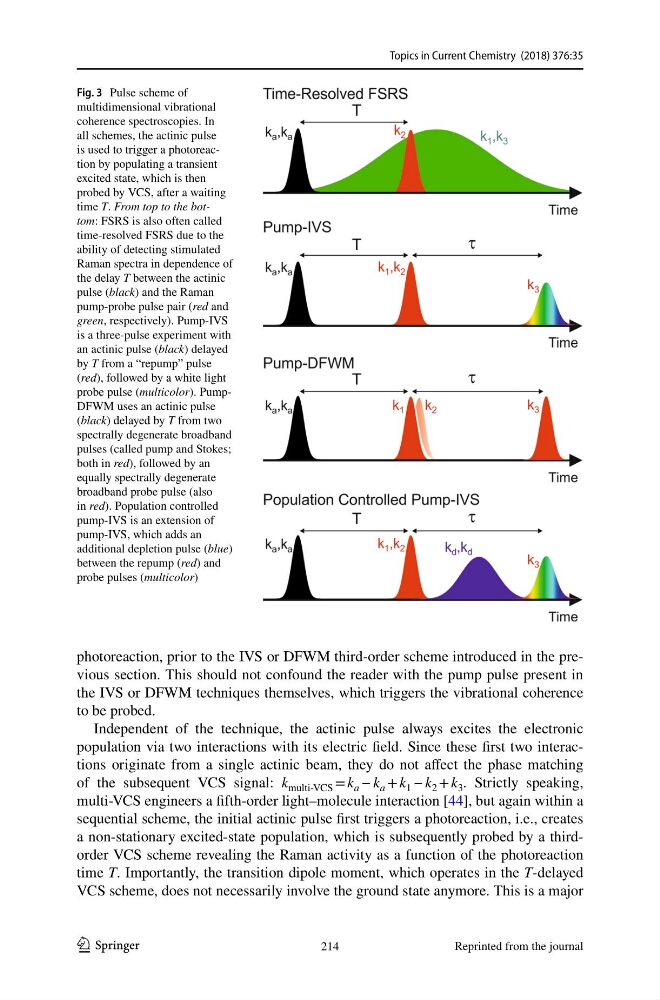
Independent of the technique, the actinic pulse always excites the electronic
population via two interactions with its electric field. Since these first two interactions originate from a single actinic beam, they do not affect the phase matching
of the subsequent VCS signal: k multi-VCS = k a − k a + k 1 − k 2 + k 3 . Strictly speaking,
multi-VCS engineers a fifth-order light–molecule interaction [44], but again within a
sequential scheme, the initial actinic pulse first triggers a photoreaction, i.e., creates
a non-stationary excited-state population, which is subsequently probed by a thirdorder VCS scheme revealing the Raman activity as a function of the photoreaction
time T. Importantly, the transition dipole moment, which operates in the T-delayed
VCS scheme, does not necessarily involve the ground state anymore. This is a major
Fig. 3 Pulse scheme of
multidimensional vibrational
coherence spectroscopies. In
all schemes, the actinic pulse
is used to trigger a photoreaction by populating a transient
excited state, which is then
probed by VCS, after a waiting
time T. From top to the bottom: FSRS is also often called
time-resolved FSRS due to the
ability of detecting stimulated
Raman spectra in dependence of
the delay T between the actinic
pulse (black) and the Raman
pump-probe pulse pair (red and
green, respectively). Pump-IVS
is a three-pulse experiment with
an actinic pulse (black) delayed
by T from a “repump” pulse
(red), followed by a white light
probe pulse (multicolor). PumpDFWM uses an actinic pulse
(black) delayed by T from two
spectrally degenerate broadband
pulses (called pump and Stokes;
both in red), followed by an
equally spectrally degenerate
broadband probe pulse (also
in red). Population controlled
pump-IVS is an extension of
pump-IVS, which adds an
additional depletion pulse (blue)
between the repump (red) and
probe pulses (multicolor)
214
Reprinted from the journal
1 3
photoreaction, prior to the IVS or DFWM third-order scheme introduced in the previous section. This should not confound the reader with the pump pulse present in
the IVS or DFWM techniques themselves, which triggers the vibrational coherence
to be probed.
Independent of the technique, the actinic pulse always excites the electronic
population via two interactions with its electric field. Since these first two interactions originate from a single actinic beam, they do not affect the phase matching
of the subsequent VCS signal: k multi-VCS = k a − k a + k 1 − k 2 + k 3 . Strictly speaking,
multi-VCS engineers a fifth-order light–molecule interaction [44], but again within a
sequential scheme, the initial actinic pulse first triggers a photoreaction, i.e., creates
a non-stationary excited-state population, which is subsequently probed by a thirdorder VCS scheme revealing the Raman activity as a function of the photoreaction
time T. Importantly, the transition dipole moment, which operates in the T-delayed
VCS scheme, does not necessarily involve the ground state anymore. This is a major
Fig. 3 Pulse scheme of
multidimensional vibrational
coherence spectroscopies. In
all schemes, the actinic pulse
is used to trigger a photoreaction by populating a transient
excited state, which is then
probed by VCS, after a waiting
time T. From top to the bottom: FSRS is also often called
time-resolved FSRS due to the
ability of detecting stimulated
Raman spectra in dependence of
the delay T between the actinic
pulse (black) and the Raman
pump-probe pulse pair (red and
green, respectively). Pump-IVS
is a three-pulse experiment with
an actinic pulse (black) delayed
by T from a “repump” pulse
(red), followed by a white light
probe pulse (multicolor). PumpDFWM uses an actinic pulse
(black) delayed by T from two
spectrally degenerate broadband
pulses (called pump and Stokes;
both in red), followed by an
equally spectrally degenerate
broadband probe pulse (also
in red). Population controlled
pump-IVS is an extension of
pump-IVS, which adds an
additional depletion pulse (blue)
between the repump (red) and
probe pulses (multicolor)
214
Reprinted from the journal