

Topics in Current Chemistry (2018) 376:35
1 3
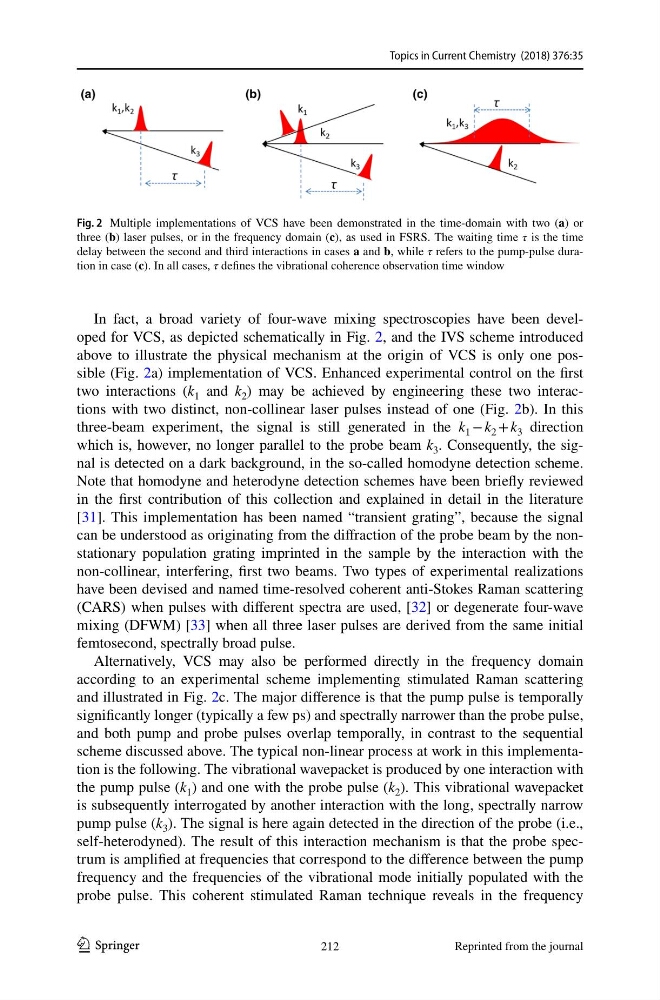
In fact, a broad variety of four-wave mixing spectroscopies have been developed for VCS, as depicted schematically in Fig. 2, and the IVS scheme introduced
above to illustrate the physical mechanism at the origin of VCS is only one possible (Fig. 2a) implementation of VCS. Enhanced experimental control on the first
two interactions (k 1 and k 2 ) may be achieved by engineering these two interactions with two distinct, non-collinear laser pulses instead of one (Fig. 2b). In this
three-beam experiment, the signal is still generated in the k 1 − k 2 + k 3 direction
which is, however, no longer parallel to the probe beam k 3 . Consequently, the signal is detected on a dark background, in the so-called homodyne detection scheme.
Note that homodyne and heterodyne detection schemes have been briefly reviewed
in the first contribution of this collection and explained in detail in the literature
[31]. This implementation has been named “transient grating”, because the signal
can be understood as originating from the diffraction of the probe beam by the nonstationary population grating imprinted in the sample by the interaction with the
non-collinear, interfering, first two beams. Two types of experimental realizations
have been devised and named time-resolved coherent anti-Stokes Raman scattering
(CARS) when pulses with different spectra are used, [32] or degenerate four-wave
mixing (DFWM) [33] when all three laser pulses are derived from the same initial
femtosecond, spectrally broad pulse.
Alternatively, VCS may also be performed directly in the frequency domain
according to an experimental scheme implementing stimulated Raman scattering
and illustrated in Fig. 2c. The major difference is that the pump pulse is temporally
significantly longer (typically a few ps) and spectrally narrower than the probe pulse,
and both pump and probe pulses overlap temporally, in contrast to the sequential
scheme discussed above. The typical non-linear process at work in this implementation is the following. The vibrational wavepacket is produced by one interaction with
the pump pulse (k 1 ) and one with the probe pulse (k 2 ). This vibrational wavepacket
is subsequently interrogated by another interaction with the long, spectrally narrow
pump pulse (k 3 ). The signal is here again detected in the direction of the probe (i.e.,
self-heterodyned). The result of this interaction mechanism is that the probe spectrum is amplified at frequencies that correspond to the difference between the pump
frequency and the frequencies of the vibrational mode initially populated with the
probe pulse. This coherent stimulated Raman technique reveals in the frequency
Fig. 2 Multiple implementations of VCS have been demonstrated in the time-domain with two (a) or
three (b) laser pulses, or in the frequency domain (c), as used in FSRS. The waiting time τ is the time
delay between the second and third interactions in cases a and b, while τ refers to the pump-pulse duration in case (c). In all cases, τ defines the vibrational coherence observation time window
212
Reprinted from the journal
1 3
In fact, a broad variety of four-wave mixing spectroscopies have been developed for VCS, as depicted schematically in Fig. 2, and the IVS scheme introduced
above to illustrate the physical mechanism at the origin of VCS is only one possible (Fig. 2a) implementation of VCS. Enhanced experimental control on the first
two interactions (k 1 and k 2 ) may be achieved by engineering these two interactions with two distinct, non-collinear laser pulses instead of one (Fig. 2b). In this
three-beam experiment, the signal is still generated in the k 1 − k 2 + k 3 direction
which is, however, no longer parallel to the probe beam k 3 . Consequently, the signal is detected on a dark background, in the so-called homodyne detection scheme.
Note that homodyne and heterodyne detection schemes have been briefly reviewed
in the first contribution of this collection and explained in detail in the literature
[31]. This implementation has been named “transient grating”, because the signal
can be understood as originating from the diffraction of the probe beam by the nonstationary population grating imprinted in the sample by the interaction with the
non-collinear, interfering, first two beams. Two types of experimental realizations
have been devised and named time-resolved coherent anti-Stokes Raman scattering
(CARS) when pulses with different spectra are used, [32] or degenerate four-wave
mixing (DFWM) [33] when all three laser pulses are derived from the same initial
femtosecond, spectrally broad pulse.
Alternatively, VCS may also be performed directly in the frequency domain
according to an experimental scheme implementing stimulated Raman scattering
and illustrated in Fig. 2c. The major difference is that the pump pulse is temporally
significantly longer (typically a few ps) and spectrally narrower than the probe pulse,
and both pump and probe pulses overlap temporally, in contrast to the sequential
scheme discussed above. The typical non-linear process at work in this implementation is the following. The vibrational wavepacket is produced by one interaction with
the pump pulse (k 1 ) and one with the probe pulse (k 2 ). This vibrational wavepacket
is subsequently interrogated by another interaction with the long, spectrally narrow
pump pulse (k 3 ). The signal is here again detected in the direction of the probe (i.e.,
self-heterodyned). The result of this interaction mechanism is that the probe spectrum is amplified at frequencies that correspond to the difference between the pump
frequency and the frequencies of the vibrational mode initially populated with the
probe pulse. This coherent stimulated Raman technique reveals in the frequency
Fig. 2 Multiple implementations of VCS have been demonstrated in the time-domain with two (a) or
three (b) laser pulses, or in the frequency domain (c), as used in FSRS. The waiting time τ is the time
delay between the second and third interactions in cases a and b, while τ refers to the pump-pulse duration in case (c). In all cases, τ defines the vibrational coherence observation time window
212
Reprinted from the journal