

Topics in Current Chemistry (2018) 376:35
1 3
investigations of vibrational wavepacket signatures in simple molecules in gas phase
have pioneered the so-called field of femtochemistry [12].
The physical mechanism of VCS may be introduced by discussing a conceptually simple pump-probe experimental scheme. Let us consider a particular example where a short-enough, resonant pump pulse impulsively excites a molecular
system, thus producing a non-stationary population, and the probe pulse is used
subsequently to measure the absorbance of this pump-induced population. Considering the interaction with the pump laser as a perturbation of the molecular
system, a very general result of the perturbation theory is the following. At the
first order of the perturbative expansion, a coherent superposition of the two
states coupled by the perturbation is produced. Such a superposition is called a
“coherence”. Instead, a “population” (e.g., depopulation of the ground S 0 state
and population of the excited S 1 state) is produced at the second order only. With
the vocabulary of non-linear optics, this is rephrased as: A first interaction with
the pump field (denoted by its wavevector k 1 ) creates an electronic coherence
while a second interaction (k 2 ) creates an electronic population. Since the pump
pulse is spectrally broad, both interactions (i.e., with k 1 and k 2 ) may occur with
distinct spectral components of the laser spectrum, resulting in the population of
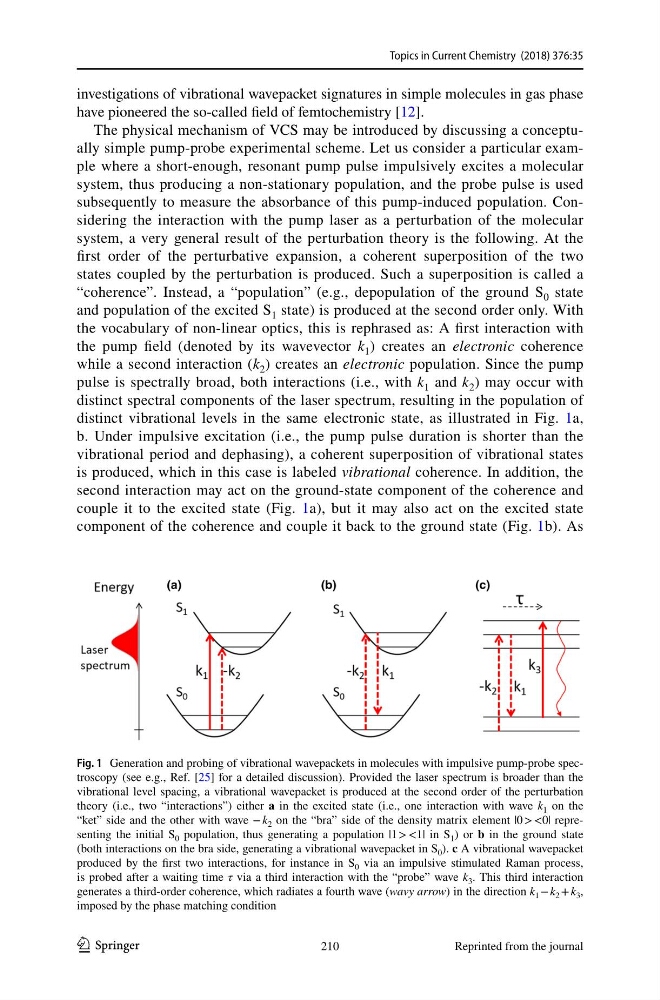
distinct vibrational levels in the same electronic state, as illustrated in Fig. 1a,
b. Under impulsive excitation (i.e., the pump pulse duration is shorter than the
vibrational period and dephasing), a coherent superposition of vibrational states
is produced, which in this case is labeled vibrational coherence. In addition, the
second interaction may act on the ground-state component of the coherence and
couple it to the excited state (Fig. 1a), but it may also act on the excited state
component of the coherence and couple it back to the ground state (Fig. 1b). As
Fig. 1 Generation and probing of vibrational wavepackets in molecules with impulsive pump-probe spectroscopy (see e.g., Ref. [25] for a detailed discussion). Provided the laser spectrum is broader than the
vibrational level spacing, a vibrational wavepacket is produced at the second order of the perturbation
theory (i.e., two “interactions”) either a in the excited state (i.e., one interaction with wave k 1 on the
“ket” side and the other with wave − k 2 on the “bra” side of the density matrix element |0 > <0| representing the initial S 0 population, thus generating a population |1 > <1| in S 1 ) or b in the ground state
(both interactions on the bra side, generating a vibrational wavepacket in S 0 ). c A vibrational wavepacket
produced by the first two interactions, for instance in S 0 via an impulsive stimulated Raman process,
is probed after a waiting time τ via a third interaction with the “probe” wave k 3 . This third interaction
generates a third-order coherence, which radiates a fourth wave (wavy arrow) in the direction k 1 − k 2 + k 3 ,
imposed by the phase matching condition
210
Reprinted from the journal
1 3
investigations of vibrational wavepacket signatures in simple molecules in gas phase
have pioneered the so-called field of femtochemistry [12].
The physical mechanism of VCS may be introduced by discussing a conceptually simple pump-probe experimental scheme. Let us consider a particular example where a short-enough, resonant pump pulse impulsively excites a molecular
system, thus producing a non-stationary population, and the probe pulse is used
subsequently to measure the absorbance of this pump-induced population. Considering the interaction with the pump laser as a perturbation of the molecular
system, a very general result of the perturbation theory is the following. At the
first order of the perturbative expansion, a coherent superposition of the two
states coupled by the perturbation is produced. Such a superposition is called a
“coherence”. Instead, a “population” (e.g., depopulation of the ground S 0 state
and population of the excited S 1 state) is produced at the second order only. With
the vocabulary of non-linear optics, this is rephrased as: A first interaction with
the pump field (denoted by its wavevector k 1 ) creates an electronic coherence
while a second interaction (k 2 ) creates an electronic population. Since the pump
pulse is spectrally broad, both interactions (i.e., with k 1 and k 2 ) may occur with
distinct spectral components of the laser spectrum, resulting in the population of
distinct vibrational levels in the same electronic state, as illustrated in Fig. 1a,
b. Under impulsive excitation (i.e., the pump pulse duration is shorter than the
vibrational period and dephasing), a coherent superposition of vibrational states
is produced, which in this case is labeled vibrational coherence. In addition, the
second interaction may act on the ground-state component of the coherence and
couple it to the excited state (Fig. 1a), but it may also act on the excited state
component of the coherence and couple it back to the ground state (Fig. 1b). As
Fig. 1 Generation and probing of vibrational wavepackets in molecules with impulsive pump-probe spectroscopy (see e.g., Ref. [25] for a detailed discussion). Provided the laser spectrum is broader than the
vibrational level spacing, a vibrational wavepacket is produced at the second order of the perturbation
theory (i.e., two “interactions”) either a in the excited state (i.e., one interaction with wave k 1 on the
“ket” side and the other with wave − k 2 on the “bra” side of the density matrix element |0 > <0| representing the initial S 0 population, thus generating a population |1 > <1| in S 1 ) or b in the ground state
(both interactions on the bra side, generating a vibrational wavepacket in S 0 ). c A vibrational wavepacket
produced by the first two interactions, for instance in S 0 via an impulsive stimulated Raman process,
is probed after a waiting time τ via a third interaction with the “probe” wave k 3 . This third interaction
generates a third-order coherence, which radiates a fourth wave (wavy arrow) in the direction k 1 − k 2 + k 3 ,
imposed by the phase matching condition
210
Reprinted from the journal