

1 3
Topics in Current Chemistry (2018) 376:28
interferogram in the time-domain. So-called under-sampling [81, 82] or sparse sampling [83] also requires a high degree of phase-stability as well as an accurate readout of the delay. However, reliable measurements of this sort are technically feasible
and nowadays routinely used in laser labs around the world [79, 84–86].
Finally, the time for measurements can be simply and drastically reduced by
increasing the repetition rate of the light source [87]. Commercially available amplified laser systems in useful frequency ranges have long been restricted to sub-10 kHz
repetition rates, i.e., delivering light bursts only about every 100 µs. Recently, technological breakthroughs in developments of new laser variants have made it possible to shorten the shot-to-shot delay down to less than 10 µs (> 100 kHz). In this
context, it is important to consider systems that work at a stability that is comparable
to the highly developed few kHz systems, but it has been shown that an increase of
repetition rate can indeed lead to a proportionally reduced measurement time [88].
Developments on other routes currently aim at increasing the repetition rate even
further (~ MHz) [89]. Given the fairly high laser pulse energies that are often used
in the experiments (several nano to micro Joules per pulse), however, these developments are all but straightforward and require a careful choice of the employed optics
to prevent effects of heat generation and sample damage as well as sufficiently rapid
replenishment of the investigated sample volume.
5 What Can a Chemist Learn from Multidimensional Time‑Resolved
Spectroscopy?
This is the question with which ultrafast spectroscopists are most often challenged
when talking to a colleague from a different chemistry discipline. To come up
with an answer to this question, it is useful to think about conceptual analogues to
the optical methods. The technique that is most straightforward to understand for
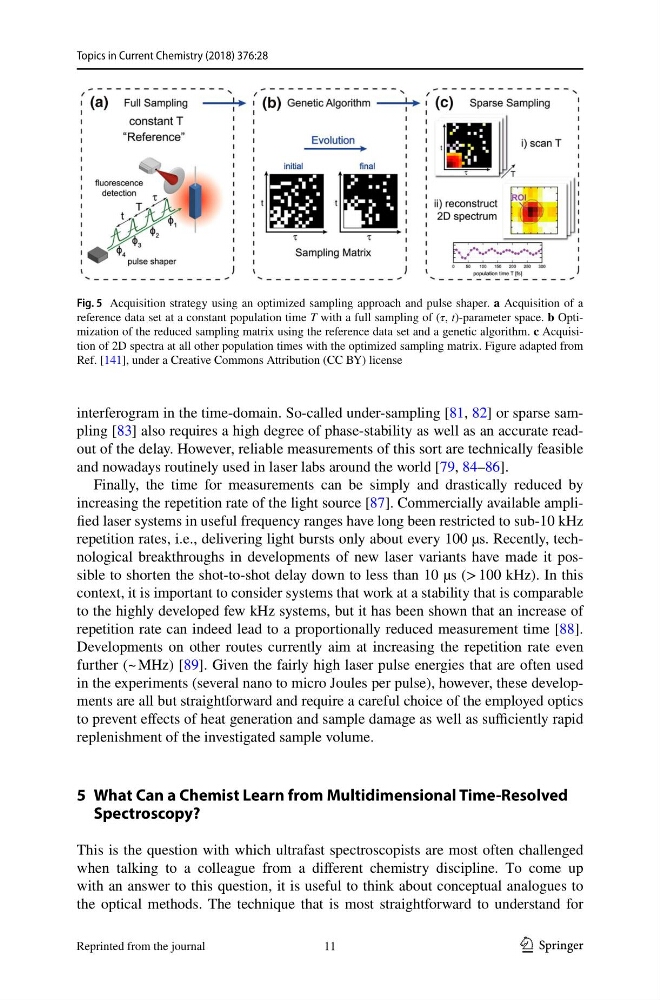
Fig. 5 Acquisition strategy using an optimized sampling approach and pulse shaper. a Acquisition of a
reference data set at a constant population time T with a full sampling of (τ, t)-parameter space. b Optimization of the reduced sampling matrix using the reference data set and a genetic algorithm. c Acquisition of 2D spectra at all other population times with the optimized sampling matrix. Figure adapted from
Ref. [141], under a Creative Commons Attribution (CC BY) license
11
Reprinted from the journal
Topics in Current Chemistry (2018) 376:28
interferogram in the time-domain. So-called under-sampling [81, 82] or sparse sampling [83] also requires a high degree of phase-stability as well as an accurate readout of the delay. However, reliable measurements of this sort are technically feasible
and nowadays routinely used in laser labs around the world [79, 84–86].
Finally, the time for measurements can be simply and drastically reduced by
increasing the repetition rate of the light source [87]. Commercially available amplified laser systems in useful frequency ranges have long been restricted to sub-10 kHz
repetition rates, i.e., delivering light bursts only about every 100 µs. Recently, technological breakthroughs in developments of new laser variants have made it possible to shorten the shot-to-shot delay down to less than 10 µs (> 100 kHz). In this
context, it is important to consider systems that work at a stability that is comparable
to the highly developed few kHz systems, but it has been shown that an increase of
repetition rate can indeed lead to a proportionally reduced measurement time [88].
Developments on other routes currently aim at increasing the repetition rate even
further (~ MHz) [89]. Given the fairly high laser pulse energies that are often used
in the experiments (several nano to micro Joules per pulse), however, these developments are all but straightforward and require a careful choice of the employed optics
to prevent effects of heat generation and sample damage as well as sufficiently rapid
replenishment of the investigated sample volume.
5 What Can a Chemist Learn from Multidimensional Time‑Resolved
Spectroscopy?
This is the question with which ultrafast spectroscopists are most often challenged
when talking to a colleague from a different chemistry discipline. To come up
with an answer to this question, it is useful to think about conceptual analogues to
the optical methods. The technique that is most straightforward to understand for
Fig. 5 Acquisition strategy using an optimized sampling approach and pulse shaper. a Acquisition of a
reference data set at a constant population time T with a full sampling of (τ, t)-parameter space. b Optimization of the reduced sampling matrix using the reference data set and a genetic algorithm. c Acquisition of 2D spectra at all other population times with the optimized sampling matrix. Figure adapted from
Ref. [141], under a Creative Commons Attribution (CC BY) license
11
Reprinted from the journal