

10,000 cm
-1 of vibrational energy were deposited in a single chemical bond. This
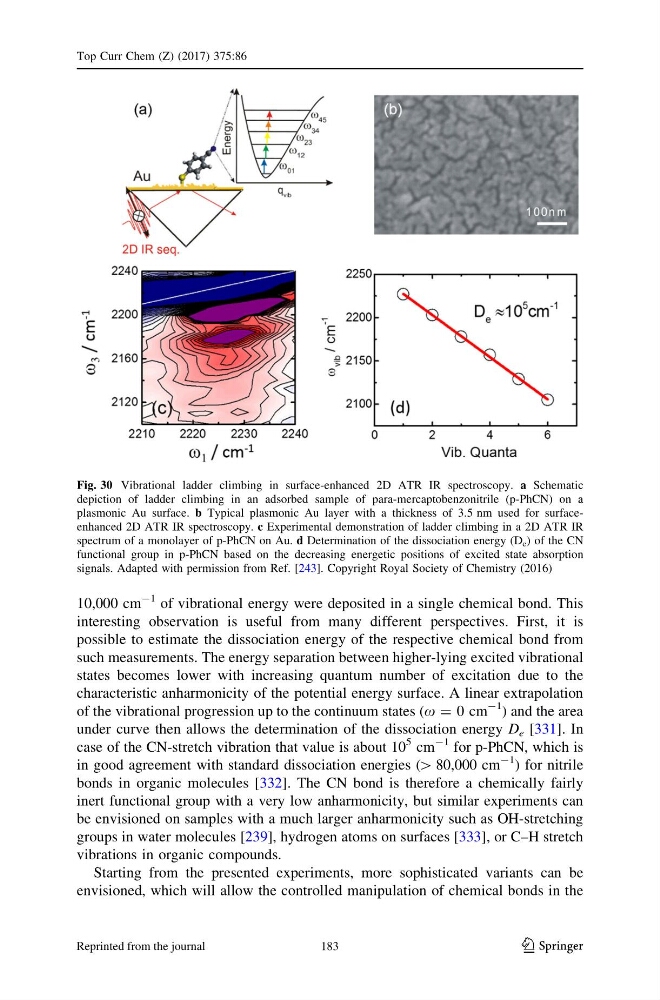
interesting observation is useful from many different perspectives. First, it is
possible to estimate the dissociation energy of the respective chemical bond from
such measurements. The energy separation between higher-lying excited vibrational
states becomes lower with increasing quantum number of excitation due to the
characteristic anharmonicity of the potential energy surface. A linear extrapolation
of the vibrational progression up to the continuum states (x = 0 cm
-1
) and the area
under curve then allows the determination of the dissociation energy D e [331]. In
case of the CN-stretch vibration that value is about 10
5 cm
-1 for p-PhCN, which is
in good agreement with standard dissociation energies ([ 80,000 cm
-1 ) for nitrile
bonds in organic molecules [332]. The CN bond is therefore a chemically fairly
inert functional group with a very low anharmonicity, but similar experiments can
be envisioned on samples with a much larger anharmonicity such as OH-stretching
groups in water molecules [239], hydrogen atoms on surfaces [333], or C–H stretch
vibrations in organic compounds.
Starting from the presented experiments, more sophisticated variants can be
envisioned, which will allow the controlled manipulation of chemical bonds in the
Fig. 30 Vibrational ladder climbing in surface-enhanced 2D ATR IR spectroscopy. a Schematic
depiction of ladder climbing in an adsorbed sample of para-mercaptobenzonitrile (p-PhCN) on a
plasmonic Au surface. b Typical plasmonic Au layer with a thickness of 3.5 nm used for surfaceenhanced 2D ATR IR spectroscopy. c Experimental demonstration of ladder climbing in a 2D ATR IR
spectrum of a monolayer of p-PhCN on Au. d Determination of the dissociation energy (D e ) of the CN
functional group in p-PhCN based on the decreasing energetic positions of excited state absorption
signals. Adapted with permission from Ref. [243]. Copyright Royal Society of Chemistry (2016)
Top Curr Chem (Z) (2017) 375:86
123
183
Reprinted from the journal
-1 of vibrational energy were deposited in a single chemical bond. This
interesting observation is useful from many different perspectives. First, it is
possible to estimate the dissociation energy of the respective chemical bond from
such measurements. The energy separation between higher-lying excited vibrational
states becomes lower with increasing quantum number of excitation due to the
characteristic anharmonicity of the potential energy surface. A linear extrapolation
of the vibrational progression up to the continuum states (x = 0 cm
-1
) and the area
under curve then allows the determination of the dissociation energy D e [331]. In
case of the CN-stretch vibration that value is about 10
5 cm
-1 for p-PhCN, which is
in good agreement with standard dissociation energies ([ 80,000 cm
-1 ) for nitrile
bonds in organic molecules [332]. The CN bond is therefore a chemically fairly
inert functional group with a very low anharmonicity, but similar experiments can
be envisioned on samples with a much larger anharmonicity such as OH-stretching
groups in water molecules [239], hydrogen atoms on surfaces [333], or C–H stretch
vibrations in organic compounds.
Starting from the presented experiments, more sophisticated variants can be
envisioned, which will allow the controlled manipulation of chemical bonds in the
Fig. 30 Vibrational ladder climbing in surface-enhanced 2D ATR IR spectroscopy. a Schematic
depiction of ladder climbing in an adsorbed sample of para-mercaptobenzonitrile (p-PhCN) on a
plasmonic Au surface. b Typical plasmonic Au layer with a thickness of 3.5 nm used for surfaceenhanced 2D ATR IR spectroscopy. c Experimental demonstration of ladder climbing in a 2D ATR IR
spectrum of a monolayer of p-PhCN on Au. d Determination of the dissociation energy (D e ) of the CN
functional group in p-PhCN based on the decreasing energetic positions of excited state absorption
signals. Adapted with permission from Ref. [243]. Copyright Royal Society of Chemistry (2016)
Top Curr Chem (Z) (2017) 375:86
123
183
Reprinted from the journal