

1 3
Topics in Current Chemistry (2018) 376:28
heterodyne detection have been thoroughly discussed in many reports. This is not
repeated here and we refer the readers to Refs. [41, 51] for more details. As a
bottom-line, however, we would like to briefly stress that the homodyne variant
is the by far experimentally easier and cheaper method, but also contains limited
obtainable information content as compared to heterodyne detection.
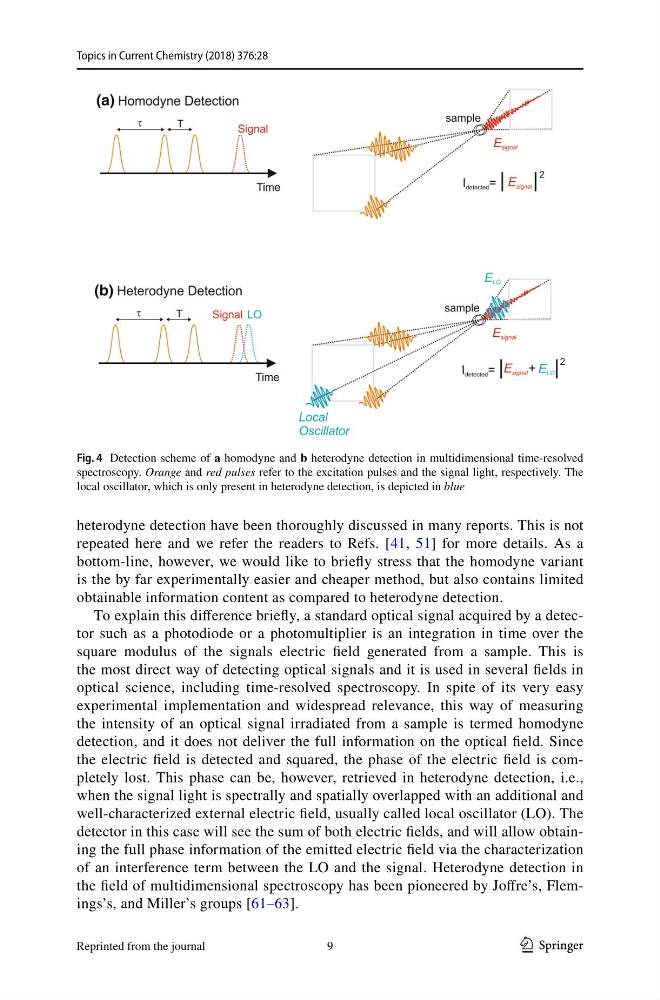
To explain this difference briefly, a standard optical signal acquired by a detector such as a photodiode or a photomultiplier is an integration in time over the
square modulus of the signals electric field generated from a sample. This is
the most direct way of detecting optical signals and it is used in several fields in
optical science, including time-resolved spectroscopy. In spite of its very easy
experimental implementation and widespread relevance, this way of measuring
the intensity of an optical signal irradiated from a sample is termed homodyne
detection, and it does not deliver the full information on the optical field. Since
the electric field is detected and squared, the phase of the electric field is completely lost. This phase can be, however, retrieved in heterodyne detection, i.e.,
when the signal light is spectrally and spatially overlapped with an additional and
well-characterized external electric field, usually called local oscillator (LO). The
detector in this case will see the sum of both electric fields, and will allow obtaining the full phase information of the emitted electric field via the characterization
of an interference term between the LO and the signal. Heterodyne detection in
the field of multidimensional spectroscopy has been pioneered by Joffre’s, Flemings’s, and Miller’s groups [61–63].
Fig. 4 Detection scheme of a homodyne and b heterodyne detection in multidimensional time-resolved
spectroscopy. Orange and red pulses refer to the excitation pulses and the signal light, respectively. The
local oscillator, which is only present in heterodyne detection, is depicted in blue
9
Reprinted from the journal
Topics in Current Chemistry (2018) 376:28
heterodyne detection have been thoroughly discussed in many reports. This is not
repeated here and we refer the readers to Refs. [41, 51] for more details. As a
bottom-line, however, we would like to briefly stress that the homodyne variant
is the by far experimentally easier and cheaper method, but also contains limited
obtainable information content as compared to heterodyne detection.
To explain this difference briefly, a standard optical signal acquired by a detector such as a photodiode or a photomultiplier is an integration in time over the
square modulus of the signals electric field generated from a sample. This is
the most direct way of detecting optical signals and it is used in several fields in
optical science, including time-resolved spectroscopy. In spite of its very easy
experimental implementation and widespread relevance, this way of measuring
the intensity of an optical signal irradiated from a sample is termed homodyne
detection, and it does not deliver the full information on the optical field. Since
the electric field is detected and squared, the phase of the electric field is completely lost. This phase can be, however, retrieved in heterodyne detection, i.e.,
when the signal light is spectrally and spatially overlapped with an additional and
well-characterized external electric field, usually called local oscillator (LO). The
detector in this case will see the sum of both electric fields, and will allow obtaining the full phase information of the emitted electric field via the characterization
of an interference term between the LO and the signal. Heterodyne detection in
the field of multidimensional spectroscopy has been pioneered by Joffre’s, Flemings’s, and Miller’s groups [61–63].
Fig. 4 Detection scheme of a homodyne and b heterodyne detection in multidimensional time-resolved
spectroscopy. Orange and red pulses refer to the excitation pulses and the signal light, respectively. The
local oscillator, which is only present in heterodyne detection, is depicted in blue
9
Reprinted from the journal