

mentioned three types of non-equilibrium states of preparation to demonstrate the
power of transient 2D IR spectroscopy.
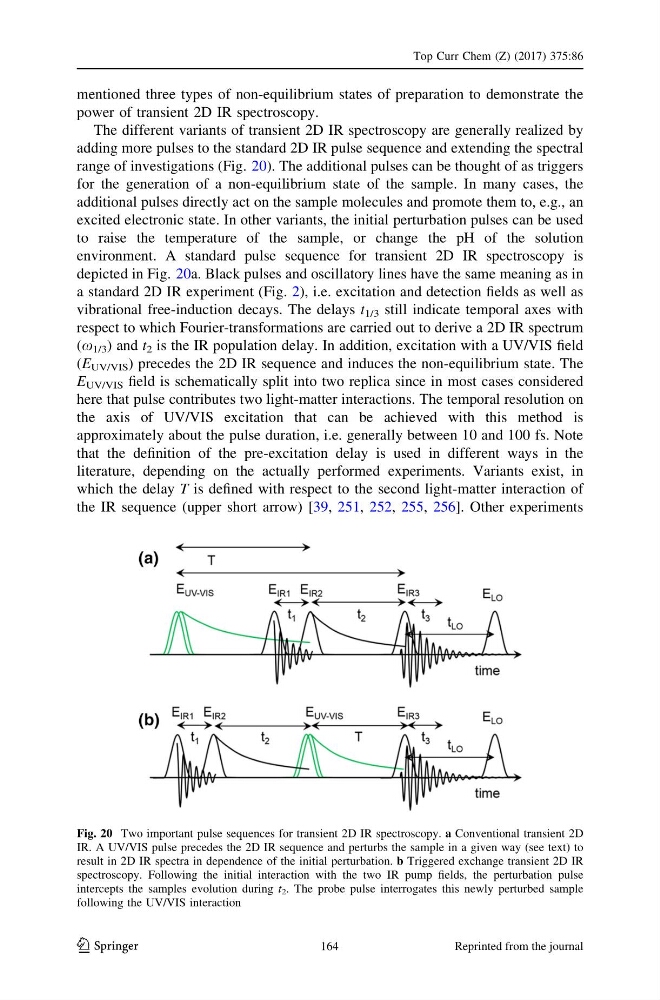
The different variants of transient 2D IR spectroscopy are generally realized by
adding more pulses to the standard 2D IR pulse sequence and extending the spectral
range of investigations (Fig. 20). The additional pulses can be thought of as triggers
for the generation of a non-equilibrium state of the sample. In many cases, the
additional pulses directly act on the sample molecules and promote them to, e.g., an
excited electronic state. In other variants, the initial perturbation pulses can be used
to raise the temperature of the sample, or change the pH of the solution
environment. A standard pulse sequence for transient 2D IR spectroscopy is
depicted in Fig. 20a. Black pulses and oscillatory lines have the same meaning as in
a standard 2D IR experiment (Fig. 2), i.e. excitation and detection fields as well as
vibrational free-induction decays. The delays t 1/3 still indicate temporal axes with
respect to which Fourier-transformations are carried out to derive a 2D IR spectrum
(x 1/3 ) and t 2 is the IR population delay. In addition, excitation with a UV/VIS field
(E UV/VIS ) precedes the 2D IR sequence and induces the non-equilibrium state. The
E UV/VIS field is schematically split into two replica since in most cases considered
here that pulse contributes two light-matter interactions. The temporal resolution on
the axis of UV/VIS excitation that can be achieved with this method is
approximately about the pulse duration, i.e. generally between 10 and 100 fs. Note
that the definition of the pre-excitation delay is used in different ways in the
literature, depending on the actually performed experiments. Variants exist, in
which the delay T is defined with respect to the second light-matter interaction of
the IR sequence (upper short arrow) [39, 251, 252, 255, 256]. Other experiments
Fig. 20 Two important pulse sequences for transient 2D IR spectroscopy. a Conventional transient 2D
IR. A UV/VIS pulse precedes the 2D IR sequence and perturbs the sample in a given way (see text) to
result in 2D IR spectra in dependence of the initial perturbation. b Triggered exchange transient 2D IR
spectroscopy. Following the initial interaction with the two IR pump fields, the perturbation pulse
intercepts the samples evolution during t 2 . The probe pulse interrogates this newly perturbed sample
following the UV/VIS interaction
Top Curr Chem (Z) (2017) 375:86
123
164
Reprinted from the journal
power of transient 2D IR spectroscopy.
The different variants of transient 2D IR spectroscopy are generally realized by
adding more pulses to the standard 2D IR pulse sequence and extending the spectral
range of investigations (Fig. 20). The additional pulses can be thought of as triggers
for the generation of a non-equilibrium state of the sample. In many cases, the
additional pulses directly act on the sample molecules and promote them to, e.g., an
excited electronic state. In other variants, the initial perturbation pulses can be used
to raise the temperature of the sample, or change the pH of the solution
environment. A standard pulse sequence for transient 2D IR spectroscopy is
depicted in Fig. 20a. Black pulses and oscillatory lines have the same meaning as in
a standard 2D IR experiment (Fig. 2), i.e. excitation and detection fields as well as
vibrational free-induction decays. The delays t 1/3 still indicate temporal axes with
respect to which Fourier-transformations are carried out to derive a 2D IR spectrum
(x 1/3 ) and t 2 is the IR population delay. In addition, excitation with a UV/VIS field
(E UV/VIS ) precedes the 2D IR sequence and induces the non-equilibrium state. The
E UV/VIS field is schematically split into two replica since in most cases considered
here that pulse contributes two light-matter interactions. The temporal resolution on
the axis of UV/VIS excitation that can be achieved with this method is
approximately about the pulse duration, i.e. generally between 10 and 100 fs. Note
that the definition of the pre-excitation delay is used in different ways in the
literature, depending on the actually performed experiments. Variants exist, in
which the delay T is defined with respect to the second light-matter interaction of
the IR sequence (upper short arrow) [39, 251, 252, 255, 256]. Other experiments
Fig. 20 Two important pulse sequences for transient 2D IR spectroscopy. a Conventional transient 2D
IR. A UV/VIS pulse precedes the 2D IR sequence and perturbs the sample in a given way (see text) to
result in 2D IR spectra in dependence of the initial perturbation. b Triggered exchange transient 2D IR
spectroscopy. Following the initial interaction with the two IR pump fields, the perturbation pulse
intercepts the samples evolution during t 2 . The probe pulse interrogates this newly perturbed sample
following the UV/VIS interaction
Top Curr Chem (Z) (2017) 375:86
123
164
Reprinted from the journal