

research directions are presented and discussed in the context of obtaining dynamic
structural information of samples that is difficult to obtain by other methods.
4.1 2D IR Electrochemistry: Vibrational Stark-Shift and Redox
Spectroscopy
Developments in the field of surface-sensitive 2D IR spectroscopy (Sect. 3.2.1)
have evoked interest recently to expand the capabilities of time-resolved
spectroscopy towards purposely charged solid-liquid interfaces. Such interfaces
play a prominent role in the fields of electro-catalysis, fuel cells, or battery
assemblies. Important questions to be addressed are re-orientational dynamics of
molecules in electric fields, dynamics of charge-transfer processes between an
electrode and a solute, or the molecular basis of vibrational Stark-shifts of
adsorbates. Additional points to be tackled are dynamics of intermediates in
electrocytalytic systems, the molecular origin of overpotentials, or transient
responses of molecules to potential-jumps at an electrode interface, only to mention
a few important aspects. 2D IR spectroscopy is again an ideal tool for these type of
investigations since it directly allows looking at the molecular vibrations.
Frequencies, bandwidths and dynamics are very sensitive reporters for interfacial
electric fields and thus allow precise measurements under working electrochemical
conditions.
An important step towards addressing and answering these questions has been
recently made by combining 2D IR spectroscopy with surface-sensitive spectroelectrochemistry by the development of 2D ATR IR electrochemistry [218]. In this
variant of 2D ATR IR, the reflecting interface of an ATR substrate is made
conductive and can thus work as an electrode at which molecules can be
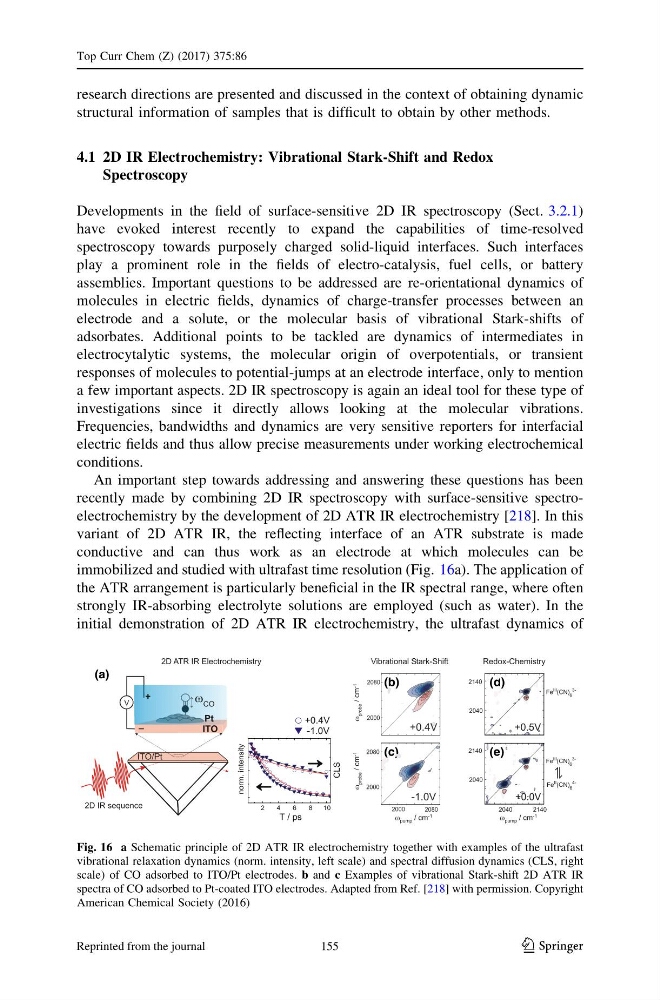
immobilized and studied with ultrafast time resolution (Fig. 16a). The application of
the ATR arrangement is particularly beneficial in the IR spectral range, where often
strongly IR-absorbing electrolyte solutions are employed (such as water). In the
initial demonstration of 2D ATR IR electrochemistry, the ultrafast dynamics of
(a)
(b)
(d)
(c)
(e)
Fig. 16 a Schematic principle of 2D ATR IR electrochemistry together with examples of the ultrafast
vibrational relaxation dynamics (norm. intensity, left scale) and spectral diffusion dynamics (CLS, right
scale) of CO adsorbed to ITO/Pt electrodes. b and c Examples of vibrational Stark-shift 2D ATR IR
spectra of CO adsorbed to Pt-coated ITO electrodes. Adapted from Ref. [218] with permission. Copyright
American Chemical Society (2016)
Top Curr Chem (Z) (2017) 375:86
123
155
Reprinted from the journal
structural information of samples that is difficult to obtain by other methods.
4.1 2D IR Electrochemistry: Vibrational Stark-Shift and Redox
Spectroscopy
Developments in the field of surface-sensitive 2D IR spectroscopy (Sect. 3.2.1)
have evoked interest recently to expand the capabilities of time-resolved
spectroscopy towards purposely charged solid-liquid interfaces. Such interfaces
play a prominent role in the fields of electro-catalysis, fuel cells, or battery
assemblies. Important questions to be addressed are re-orientational dynamics of
molecules in electric fields, dynamics of charge-transfer processes between an
electrode and a solute, or the molecular basis of vibrational Stark-shifts of
adsorbates. Additional points to be tackled are dynamics of intermediates in
electrocytalytic systems, the molecular origin of overpotentials, or transient
responses of molecules to potential-jumps at an electrode interface, only to mention
a few important aspects. 2D IR spectroscopy is again an ideal tool for these type of
investigations since it directly allows looking at the molecular vibrations.
Frequencies, bandwidths and dynamics are very sensitive reporters for interfacial
electric fields and thus allow precise measurements under working electrochemical
conditions.
An important step towards addressing and answering these questions has been
recently made by combining 2D IR spectroscopy with surface-sensitive spectroelectrochemistry by the development of 2D ATR IR electrochemistry [218]. In this
variant of 2D ATR IR, the reflecting interface of an ATR substrate is made
conductive and can thus work as an electrode at which molecules can be
immobilized and studied with ultrafast time resolution (Fig. 16a). The application of
the ATR arrangement is particularly beneficial in the IR spectral range, where often
strongly IR-absorbing electrolyte solutions are employed (such as water). In the
initial demonstration of 2D ATR IR electrochemistry, the ultrafast dynamics of
(a)
(b)
(d)
(c)
(e)
Fig. 16 a Schematic principle of 2D ATR IR electrochemistry together with examples of the ultrafast
vibrational relaxation dynamics (norm. intensity, left scale) and spectral diffusion dynamics (CLS, right
scale) of CO adsorbed to ITO/Pt electrodes. b and c Examples of vibrational Stark-shift 2D ATR IR
spectra of CO adsorbed to Pt-coated ITO electrodes. Adapted from Ref. [218] with permission. Copyright
American Chemical Society (2016)
Top Curr Chem (Z) (2017) 375:86
123
155
Reprinted from the journal