

molecules either to establish delocalized vibrational states or exchange excitation
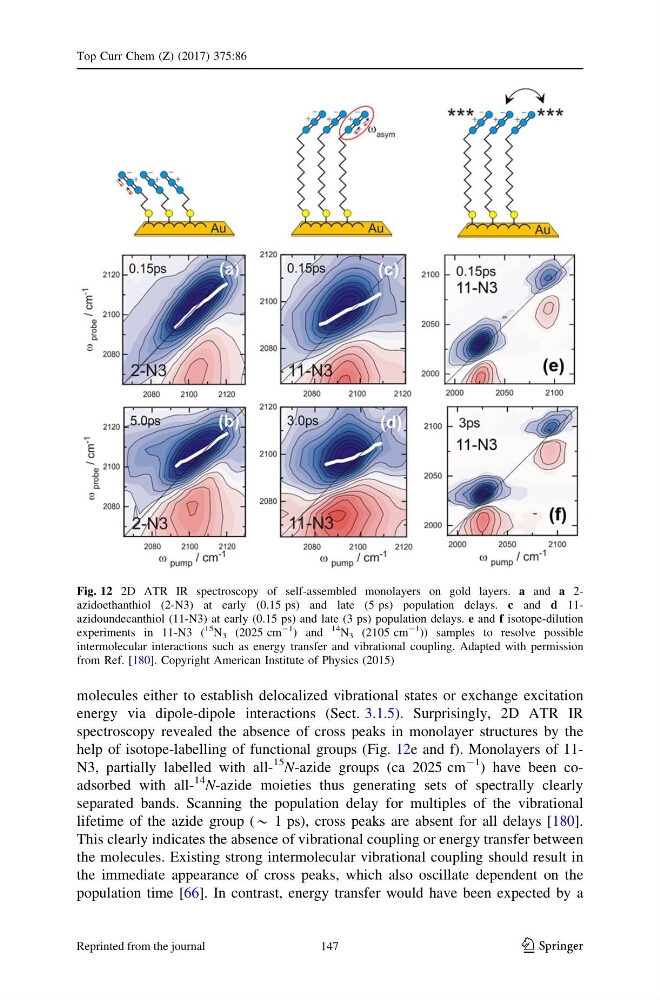
energy via dipole-dipole interactions (Sect. 3.1.5). Surprisingly, 2D ATR IR
spectroscopy revealed the absence of cross peaks in monolayer structures by the
help of isotope-labelling of functional groups (Fig. 12e and f). Monolayers of 11N3, partially labelled with all15 N-azide groups (ca 2025 cm
-1 ) have been coadsorbed with all14 N-azide moieties thus generating sets of spectrally clearly
separated bands. Scanning the population delay for multiples of the vibrational
lifetime of the azide group (* 1 ps), cross peaks are absent for all delays [180].
This clearly indicates the absence of vibrational coupling or energy transfer between
the molecules. Existing strong intermolecular vibrational coupling should result in
the immediate appearance of cross peaks, which also oscillate dependent on the
population time [66]. In contrast, energy transfer would have been expected by a
Fig. 12 2D ATR IR spectroscopy of self-assembled monolayers on gold layers. a and a 2azidoethanthiol (2-N3) at early (0.15 ps) and late (5 ps) population delays. c and d 11azidoundecanthiol (11-N3) at early (0.15 ps) and late (3 ps) population delays. e and f isotope-dilution
experiments in 11-N3 (
15 N 3 (2025 cm
-1
) and
14
N 3 (2105 cm
-1 )) samples to resolve possible
intermolecular interactions such as energy transfer and vibrational coupling. Adapted with permission
from Ref. [180]. Copyright American Institute of Physics (2015)
Top Curr Chem (Z) (2017) 375:86
123
147
Reprinted from the journal
energy via dipole-dipole interactions (Sect. 3.1.5). Surprisingly, 2D ATR IR
spectroscopy revealed the absence of cross peaks in monolayer structures by the
help of isotope-labelling of functional groups (Fig. 12e and f). Monolayers of 11N3, partially labelled with all15 N-azide groups (ca 2025 cm
-1 ) have been coadsorbed with all14 N-azide moieties thus generating sets of spectrally clearly
separated bands. Scanning the population delay for multiples of the vibrational
lifetime of the azide group (* 1 ps), cross peaks are absent for all delays [180].
This clearly indicates the absence of vibrational coupling or energy transfer between
the molecules. Existing strong intermolecular vibrational coupling should result in
the immediate appearance of cross peaks, which also oscillate dependent on the
population time [66]. In contrast, energy transfer would have been expected by a
Fig. 12 2D ATR IR spectroscopy of self-assembled monolayers on gold layers. a and a 2azidoethanthiol (2-N3) at early (0.15 ps) and late (5 ps) population delays. c and d 11azidoundecanthiol (11-N3) at early (0.15 ps) and late (3 ps) population delays. e and f isotope-dilution
experiments in 11-N3 (
15 N 3 (2025 cm
-1
) and
14
N 3 (2105 cm
-1 )) samples to resolve possible
intermolecular interactions such as energy transfer and vibrational coupling. Adapted with permission
from Ref. [180]. Copyright American Institute of Physics (2015)
Top Curr Chem (Z) (2017) 375:86
123
147
Reprinted from the journal