

3.1.4 Structural Dynamics Resolved with 2D IR Chemical Exchange Spectroscopy
The formation and breaking of chemical bonds in molecules often occurs on the
femto- to picosecond timescale. It is relatively easy to observe such a process with
conventional time-resolved pump-probe type variants of ultrafast spectroscopy
when a starting material and a photoproduct exhibit spectrally distinct features and
the starting material is in a pure form [118–128]. The situation is much less
straightforward if one considers a chemical equilibrium between such spectroscopically distinct species. In this case, a single spectral axis is not sufficient to
characterize the dynamic aspects of bond formation and breaking in chemical
equilibrium. 2D IR spectroscopy considerably helps in this respect by resolving
correlated spectral features, just as in case of 2D NMR spectroscopy, albeit with a
significantly
higher
temporal
resolution
down
to
sub-picoseconds
[10, 20, 23, 25, 129, 130].
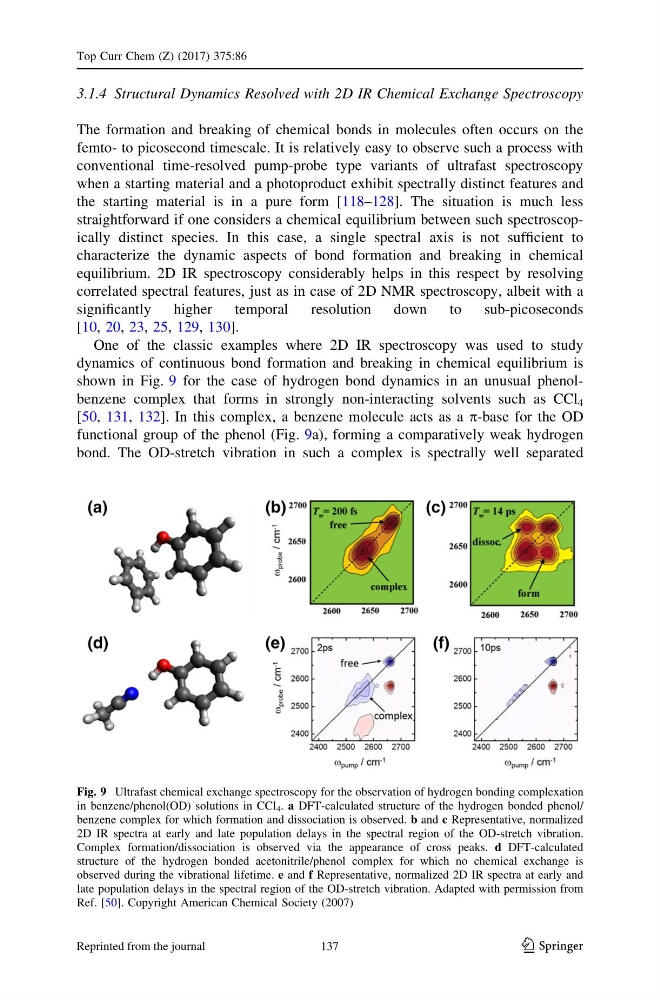
One of the classic examples where 2D IR spectroscopy was used to study
dynamics of continuous bond formation and breaking in chemical equilibrium is
shown in Fig. 9 for the case of hydrogen bond dynamics in an unusual phenolbenzene complex that forms in strongly non-interacting solvents such as CCl 4
[50, 131, 132]. In this complex, a benzene molecule acts as a p-base for the OD
functional group of the phenol (Fig. 9a), forming a comparatively weak hydrogen
bond. The OD-stretch vibration in such a complex is spectrally well separated
Fig. 9 Ultrafast chemical exchange spectroscopy for the observation of hydrogen bonding complexation
in benzene/phenol(OD) solutions in CCl 4 . a DFT-calculated structure of the hydrogen bonded phenol/
benzene complex for which formation and dissociation is observed. b and c Representative, normalized
2D IR spectra at early and late population delays in the spectral region of the OD-stretch vibration.
Complex formation/dissociation is observed via the appearance of cross peaks. d DFT-calculated
structure of the hydrogen bonded acetonitrile/phenol complex for which no chemical exchange is
observed during the vibrational lifetime. e and f Representative, normalized 2D IR spectra at early and
late population delays in the spectral region of the OD-stretch vibration. Adapted with permission from
Ref. [50]. Copyright American Chemical Society (2007)
Top Curr Chem (Z) (2017) 375:86
123
137
Reprinted from the journal
The formation and breaking of chemical bonds in molecules often occurs on the
femto- to picosecond timescale. It is relatively easy to observe such a process with
conventional time-resolved pump-probe type variants of ultrafast spectroscopy
when a starting material and a photoproduct exhibit spectrally distinct features and
the starting material is in a pure form [118–128]. The situation is much less
straightforward if one considers a chemical equilibrium between such spectroscopically distinct species. In this case, a single spectral axis is not sufficient to
characterize the dynamic aspects of bond formation and breaking in chemical
equilibrium. 2D IR spectroscopy considerably helps in this respect by resolving
correlated spectral features, just as in case of 2D NMR spectroscopy, albeit with a
significantly
higher
temporal
resolution
down
to
sub-picoseconds
[10, 20, 23, 25, 129, 130].
One of the classic examples where 2D IR spectroscopy was used to study
dynamics of continuous bond formation and breaking in chemical equilibrium is
shown in Fig. 9 for the case of hydrogen bond dynamics in an unusual phenolbenzene complex that forms in strongly non-interacting solvents such as CCl 4
[50, 131, 132]. In this complex, a benzene molecule acts as a p-base for the OD
functional group of the phenol (Fig. 9a), forming a comparatively weak hydrogen
bond. The OD-stretch vibration in such a complex is spectrally well separated
Fig. 9 Ultrafast chemical exchange spectroscopy for the observation of hydrogen bonding complexation
in benzene/phenol(OD) solutions in CCl 4 . a DFT-calculated structure of the hydrogen bonded phenol/
benzene complex for which formation and dissociation is observed. b and c Representative, normalized
2D IR spectra at early and late population delays in the spectral region of the OD-stretch vibration.
Complex formation/dissociation is observed via the appearance of cross peaks. d DFT-calculated
structure of the hydrogen bonded acetonitrile/phenol complex for which no chemical exchange is
observed during the vibrational lifetime. e and f Representative, normalized 2D IR spectra at early and
late population delays in the spectral region of the OD-stretch vibration. Adapted with permission from
Ref. [50]. Copyright American Chemical Society (2007)
Top Curr Chem (Z) (2017) 375:86
123
137
Reprinted from the journal