

A good example of the value of the informational content obtainable from
spectral diffusion has been reported by Hamm et al. for the case of the origin of
inhomogeneous broadening in peptides [102]. By comparing spectral diffusion in
N-methylacetamide (NMA) and trialanine in water, the origin of spectral
broadening of the absorption bands could be revealed. This was done by a
combined experimental and theoretical approach that led to the overall most
detailed understanding of structural dynamics in peptides at the time of the
experiments [77, 84, 102–104]. Looking at the amide-I band in the two samples, it
could be determined that the respective transition is significantly inhomogeneously
broadened in trialanine, but not in NMA. This holds despite the fact that the FTIR
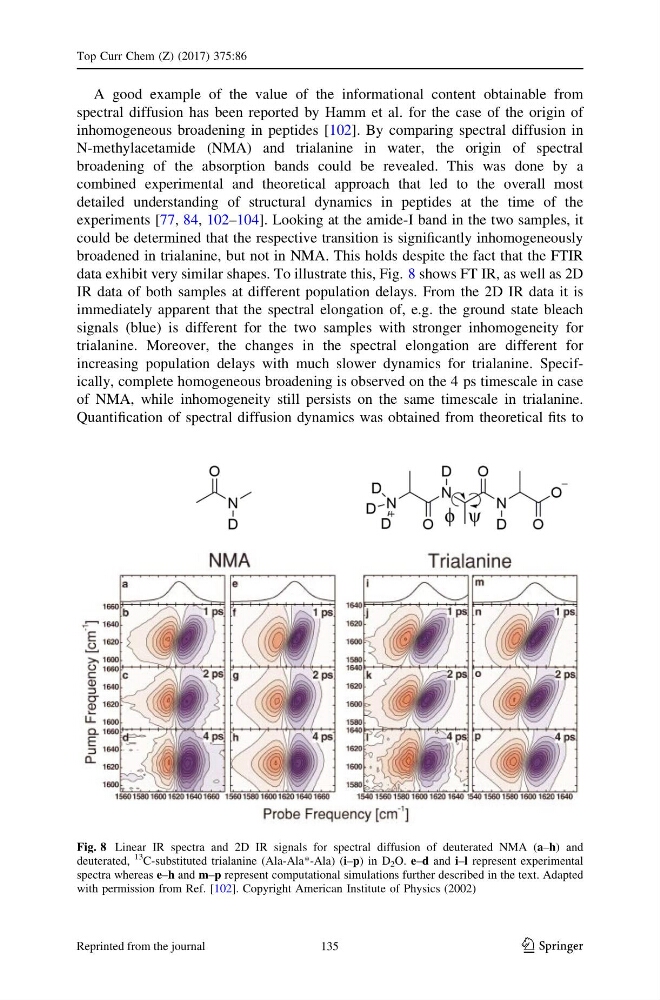
data exhibit very similar shapes. To illustrate this, Fig. 8 shows FT IR, as well as 2D
IR data of both samples at different population delays. From the 2D IR data it is
immediately apparent that the spectral elongation of, e.g. the ground state bleach
signals (blue) is different for the two samples with stronger inhomogeneity for
trialanine. Moreover, the changes in the spectral elongation are different for
increasing population delays with much slower dynamics for trialanine. Specifically, complete homogeneous broadening is observed on the 4 ps timescale in case
of NMA, while inhomogeneity still persists on the same timescale in trialanine.
Quantification of spectral diffusion dynamics was obtained from theoretical fits to
Fig. 8 Linear IR spectra and 2D IR signals for spectral diffusion of deuterated NMA (a–h) and
deuterated,
13
C-substituted trialanine (Ala-Ala*-Ala) (i–p) in D 2 O. e–d and i–l represent experimental
spectra whereas e–h and m–p represent computational simulations further described in the text. Adapted
with permission from Ref. [102]. Copyright American Institute of Physics (2002)
Top Curr Chem (Z) (2017) 375:86
123
135
Reprinted from the journal
spectral diffusion has been reported by Hamm et al. for the case of the origin of
inhomogeneous broadening in peptides [102]. By comparing spectral diffusion in
N-methylacetamide (NMA) and trialanine in water, the origin of spectral
broadening of the absorption bands could be revealed. This was done by a
combined experimental and theoretical approach that led to the overall most
detailed understanding of structural dynamics in peptides at the time of the
experiments [77, 84, 102–104]. Looking at the amide-I band in the two samples, it
could be determined that the respective transition is significantly inhomogeneously
broadened in trialanine, but not in NMA. This holds despite the fact that the FTIR
data exhibit very similar shapes. To illustrate this, Fig. 8 shows FT IR, as well as 2D
IR data of both samples at different population delays. From the 2D IR data it is
immediately apparent that the spectral elongation of, e.g. the ground state bleach
signals (blue) is different for the two samples with stronger inhomogeneity for
trialanine. Moreover, the changes in the spectral elongation are different for
increasing population delays with much slower dynamics for trialanine. Specifically, complete homogeneous broadening is observed on the 4 ps timescale in case
of NMA, while inhomogeneity still persists on the same timescale in trialanine.
Quantification of spectral diffusion dynamics was obtained from theoretical fits to
Fig. 8 Linear IR spectra and 2D IR signals for spectral diffusion of deuterated NMA (a–h) and
deuterated,
13
C-substituted trialanine (Ala-Ala*-Ala) (i–p) in D 2 O. e–d and i–l represent experimental
spectra whereas e–h and m–p represent computational simulations further described in the text. Adapted
with permission from Ref. [102]. Copyright American Institute of Physics (2002)
Top Curr Chem (Z) (2017) 375:86
123
135
Reprinted from the journal