

experimental developments have made it possible to increase signal to noise ratios
in a way that time-resolved IR spectroscopy can now even be applied to study
monolayer thin samples at two dimensional interfaces of weakly absorbing
chromophores [15]. To expand the capabilities of time-resolved IR spectroscopy,
it was suggested approximately 20 years ago to advance ultrafast vibrational
spectroscopy to a two-dimensional (2D) version [16]. This extension was designed
to reveal even correlated dynamics of functional groups.
1.2 Multi-Dimensional IR Spectroscopy
Multi-dimensional optical molecular spectroscopy is generally widely known to
exhibit the prominent benefit of resolving correlations and interactions between
different resonances [1, 10, 17, 18]. That concept has been borrowed from wellestablished nuclear magnetic resonance (NMR) spectroscopy, where spreading the
signals into two or more frequency dimensions allows the determination of coupled
spins and the deconstruction of congested spectra [19–23]. Sequences of ultrashort
laser pulses from different frequency ranges have been devised recently to allow
establishing correlations of different types of molecular resonances, including also
electronic and vibrational transitions in different types of samples. Up to now, the
development of ultrafast multi-dimensional optical spectroscopy has led to a
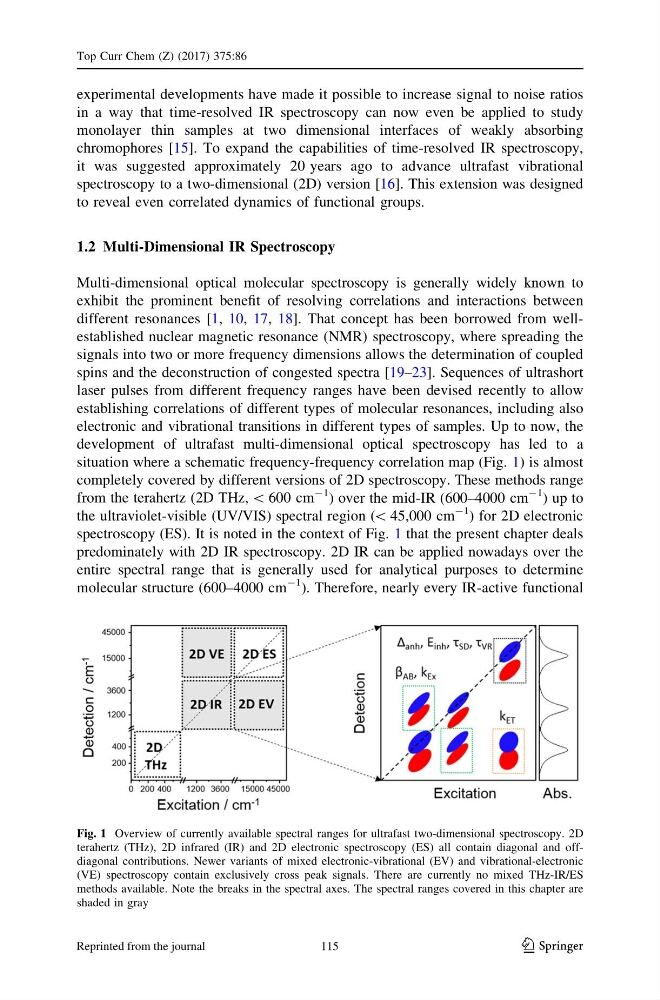
situation where a schematic frequency-frequency correlation map (Fig. 1) is almost
completely covered by different versions of 2D spectroscopy. These methods range
from the terahertz (2D THz, \ 600 cm
-1 ) over the mid-IR (600–4000 cm
-1 ) up to
the ultraviolet-visible (UV/VIS) spectral region (\ 45,000 cm
-1 ) for 2D electronic
spectroscopy (ES). It is noted in the context of Fig. 1 that the present chapter deals
predominately with 2D IR spectroscopy. 2D IR can be applied nowadays over the
entire spectral range that is generally used for analytical purposes to determine
molecular structure (600–4000 cm
-1 ). Therefore, nearly every IR-active functional
Fig. 1 Overview of currently available spectral ranges for ultrafast two-dimensional spectroscopy. 2D
terahertz (THz), 2D infrared (IR) and 2D electronic spectroscopy (ES) all contain diagonal and offdiagonal contributions. Newer variants of mixed electronic-vibrational (EV) and vibrational-electronic
(VE) spectroscopy contain exclusively cross peak signals. There are currently no mixed THz-IR/ES
methods available. Note the breaks in the spectral axes. The spectral ranges covered in this chapter are
shaded in gray
Top Curr Chem (Z) (2017) 375:86
123
115
Reprinted from the journal
in a way that time-resolved IR spectroscopy can now even be applied to study
monolayer thin samples at two dimensional interfaces of weakly absorbing
chromophores [15]. To expand the capabilities of time-resolved IR spectroscopy,
it was suggested approximately 20 years ago to advance ultrafast vibrational
spectroscopy to a two-dimensional (2D) version [16]. This extension was designed
to reveal even correlated dynamics of functional groups.
1.2 Multi-Dimensional IR Spectroscopy
Multi-dimensional optical molecular spectroscopy is generally widely known to
exhibit the prominent benefit of resolving correlations and interactions between
different resonances [1, 10, 17, 18]. That concept has been borrowed from wellestablished nuclear magnetic resonance (NMR) spectroscopy, where spreading the
signals into two or more frequency dimensions allows the determination of coupled
spins and the deconstruction of congested spectra [19–23]. Sequences of ultrashort
laser pulses from different frequency ranges have been devised recently to allow
establishing correlations of different types of molecular resonances, including also
electronic and vibrational transitions in different types of samples. Up to now, the
development of ultrafast multi-dimensional optical spectroscopy has led to a
situation where a schematic frequency-frequency correlation map (Fig. 1) is almost
completely covered by different versions of 2D spectroscopy. These methods range
from the terahertz (2D THz, \ 600 cm
-1 ) over the mid-IR (600–4000 cm
-1 ) up to
the ultraviolet-visible (UV/VIS) spectral region (\ 45,000 cm
-1 ) for 2D electronic
spectroscopy (ES). It is noted in the context of Fig. 1 that the present chapter deals
predominately with 2D IR spectroscopy. 2D IR can be applied nowadays over the
entire spectral range that is generally used for analytical purposes to determine
molecular structure (600–4000 cm
-1 ). Therefore, nearly every IR-active functional
Fig. 1 Overview of currently available spectral ranges for ultrafast two-dimensional spectroscopy. 2D
terahertz (THz), 2D infrared (IR) and 2D electronic spectroscopy (ES) all contain diagonal and offdiagonal contributions. Newer variants of mixed electronic-vibrational (EV) and vibrational-electronic
(VE) spectroscopy contain exclusively cross peak signals. There are currently no mixed THz-IR/ES
methods available. Note the breaks in the spectral axes. The spectral ranges covered in this chapter are
shaded in gray
Top Curr Chem (Z) (2017) 375:86
123
115
Reprinted from the journal