

4.2 Biomass Pretreatment
61
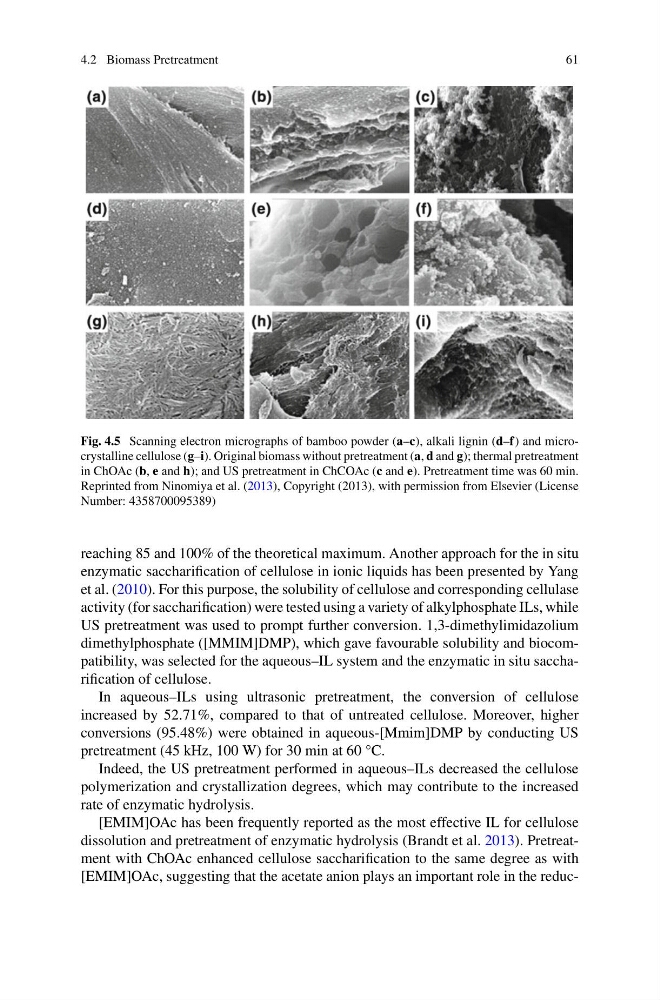
Fig. 4.5 Scanning electron micrographs of bamboo powder (a–c), alkali lignin (d–f) and microcrystalline cellulose (g–i). Original biomass without pretreatment (a, d and g); thermal pretreatment
in ChOAc (b, e and h); and US pretreatment in ChCOAc (c and e). Pretreatment time was 60 min.
Reprinted from Ninomiya et al. (2013), Copyright (2013), with permission from Elsevier (License
Number: 4358700095389)
reaching 85 and 100% of the theoretical maximum. Another approach for the in situ
enzymatic saccharification of cellulose in ionic liquids has been presented by Yang
et al. (2010). For this purpose, the solubility of cellulose and corresponding cellulase
activity (for saccharification) were tested using a variety of alkylphosphate ILs, while
US pretreatment was used to prompt further conversion. 1,3-dimethylimidazolium
dimethylphosphate ([MMIM]DMP), which gave favourable solubility and biocompatibility, was selected for the aqueous–IL system and the enzymatic in situ saccharification of cellulose.
In aqueous–ILs using ultrasonic pretreatment, the conversion of cellulose
increased by 52.71%, compared to that of untreated cellulose. Moreover, higher
conversions (95.48%) were obtained in aqueous-[Mmim]DMP by conducting US
pretreatment (45 kHz, 100 W) for 30 min at 60 °C.
Indeed, the US pretreatment performed in aqueous–ILs decreased the cellulose
polymerization and crystallization degrees, which may contribute to the increased
rate of enzymatic hydrolysis.
[EMIM]OAc has been frequently reported as the most effective IL for cellulose
dissolution and pretreatment of enzymatic hydrolysis (Brandt et al. 2013). Pretreatment with ChOAc enhanced cellulose saccharification to the same degree as with
[EMIM]OAc, suggesting that the acetate anion plays an important role in the reduc-
61
Fig. 4.5 Scanning electron micrographs of bamboo powder (a–c), alkali lignin (d–f) and microcrystalline cellulose (g–i). Original biomass without pretreatment (a, d and g); thermal pretreatment
in ChOAc (b, e and h); and US pretreatment in ChCOAc (c and e). Pretreatment time was 60 min.
Reprinted from Ninomiya et al. (2013), Copyright (2013), with permission from Elsevier (License
Number: 4358700095389)
reaching 85 and 100% of the theoretical maximum. Another approach for the in situ
enzymatic saccharification of cellulose in ionic liquids has been presented by Yang
et al. (2010). For this purpose, the solubility of cellulose and corresponding cellulase
activity (for saccharification) were tested using a variety of alkylphosphate ILs, while
US pretreatment was used to prompt further conversion. 1,3-dimethylimidazolium
dimethylphosphate ([MMIM]DMP), which gave favourable solubility and biocompatibility, was selected for the aqueous–IL system and the enzymatic in situ saccharification of cellulose.
In aqueous–ILs using ultrasonic pretreatment, the conversion of cellulose
increased by 52.71%, compared to that of untreated cellulose. Moreover, higher
conversions (95.48%) were obtained in aqueous-[Mmim]DMP by conducting US
pretreatment (45 kHz, 100 W) for 30 min at 60 °C.
Indeed, the US pretreatment performed in aqueous–ILs decreased the cellulose
polymerization and crystallization degrees, which may contribute to the increased
rate of enzymatic hydrolysis.
[EMIM]OAc has been frequently reported as the most effective IL for cellulose
dissolution and pretreatment of enzymatic hydrolysis (Brandt et al. 2013). Pretreatment with ChOAc enhanced cellulose saccharification to the same degree as with
[EMIM]OAc, suggesting that the acetate anion plays an important role in the reduc-