

2.4 Sonochemical Approaches in Organic Synthesis
35
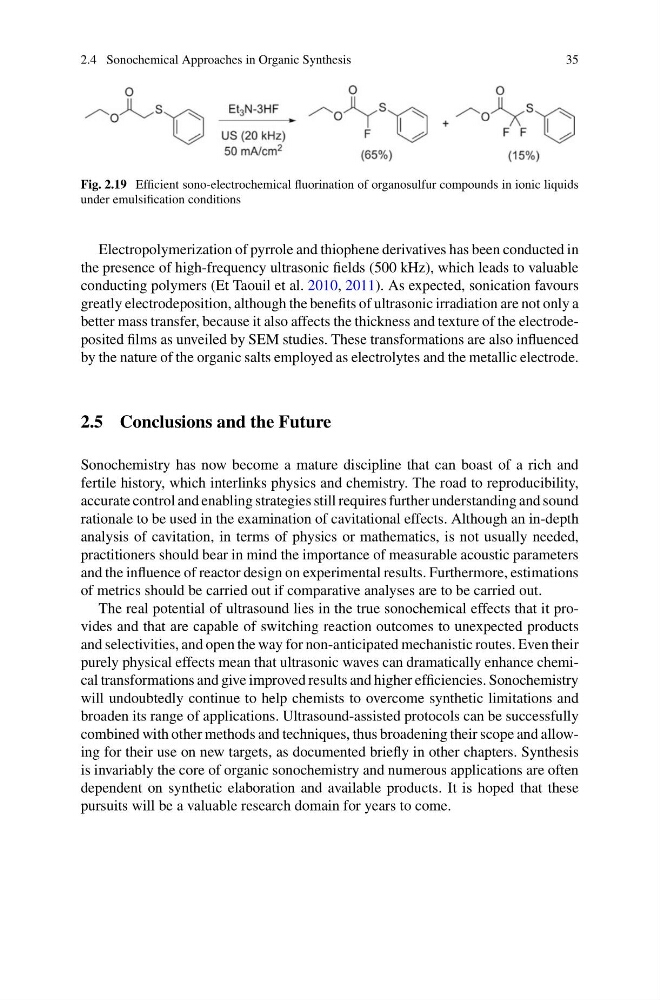
Fig. 2.19 Efficient sono-electrochemical fluorination of organosulfur compounds in ionic liquids
under emulsification conditions
Electropolymerization of pyrrole and thiophene derivatives has been conducted in
the presence of high-frequency ultrasonic fields (500 kHz), which leads to valuable
conducting polymers (Et Taouil et al. 2010, 2011). As expected, sonication favours
greatly electrodeposition, although the benefits of ultrasonic irradiation are not only a
better mass transfer, because it also affects the thickness and texture of the electrodeposited films as unveiled by SEM studies. These transformations are also influenced
by the nature of the organic salts employed as electrolytes and the metallic electrode.
2.5 Conclusions and the Future
Sonochemistry has now become a mature discipline that can boast of a rich and
fertile history, which interlinks physics and chemistry. The road to reproducibility,
accurate control and enabling strategies still requires further understanding and sound
rationale to be used in the examination of cavitational effects. Although an in-depth
analysis of cavitation, in terms of physics or mathematics, is not usually needed,
practitioners should bear in mind the importance of measurable acoustic parameters
and the influence of reactor design on experimental results. Furthermore, estimations
of metrics should be carried out if comparative analyses are to be carried out.
The real potential of ultrasound lies in the true sonochemical effects that it provides and that are capable of switching reaction outcomes to unexpected products
and selectivities, and open the way for non-anticipated mechanistic routes. Even their
purely physical effects mean that ultrasonic waves can dramatically enhance chemical transformations and give improved results and higher efficiencies. Sonochemistry
will undoubtedly continue to help chemists to overcome synthetic limitations and
broaden its range of applications. Ultrasound-assisted protocols can be successfully
combined with other methods and techniques, thus broadening their scope and allowing for their use on new targets, as documented briefly in other chapters. Synthesis
is invariably the core of organic sonochemistry and numerous applications are often
dependent on synthetic elaboration and available products. It is hoped that these
pursuits will be a valuable research domain for years to come.
35
Fig. 2.19 Efficient sono-electrochemical fluorination of organosulfur compounds in ionic liquids
under emulsification conditions
Electropolymerization of pyrrole and thiophene derivatives has been conducted in
the presence of high-frequency ultrasonic fields (500 kHz), which leads to valuable
conducting polymers (Et Taouil et al. 2010, 2011). As expected, sonication favours
greatly electrodeposition, although the benefits of ultrasonic irradiation are not only a
better mass transfer, because it also affects the thickness and texture of the electrodeposited films as unveiled by SEM studies. These transformations are also influenced
by the nature of the organic salts employed as electrolytes and the metallic electrode.
2.5 Conclusions and the Future
Sonochemistry has now become a mature discipline that can boast of a rich and
fertile history, which interlinks physics and chemistry. The road to reproducibility,
accurate control and enabling strategies still requires further understanding and sound
rationale to be used in the examination of cavitational effects. Although an in-depth
analysis of cavitation, in terms of physics or mathematics, is not usually needed,
practitioners should bear in mind the importance of measurable acoustic parameters
and the influence of reactor design on experimental results. Furthermore, estimations
of metrics should be carried out if comparative analyses are to be carried out.
The real potential of ultrasound lies in the true sonochemical effects that it provides and that are capable of switching reaction outcomes to unexpected products
and selectivities, and open the way for non-anticipated mechanistic routes. Even their
purely physical effects mean that ultrasonic waves can dramatically enhance chemical transformations and give improved results and higher efficiencies. Sonochemistry
will undoubtedly continue to help chemists to overcome synthetic limitations and
broaden its range of applications. Ultrasound-assisted protocols can be successfully
combined with other methods and techniques, thus broadening their scope and allowing for their use on new targets, as documented briefly in other chapters. Synthesis
is invariably the core of organic sonochemistry and numerous applications are often
dependent on synthetic elaboration and available products. It is hoped that these
pursuits will be a valuable research domain for years to come.