

8
1 Cavitation and Chemical Reactivity
a 1.66 Cp/Cv ratio) will be much higher than in the presence of nitrogen (with a 1.40
Cp/Cv ratio). Argon is a commonly added gas in sonochemistry’s world to maximize
cavitation powerness. Some dissolved entrain gases that present in solution such as
H 2 , O 2 or CO 2 undergo homolytic scission to afford radical species able then to
participate or to trigger a variety of reactions including redox ones. Mixtures of
some of these gases are also used to maximize specific desired effects.
1.7 Generation of Ultrasonic Waves and Subsequent
Equipment
The conversion of alternative electrical energy into a mechanical vibration can be
ensured either by magnetostriction (Briquard 1983; i.e. an induced magnetic field
able to contract metals such as zinc or iron) or by piezoelectric properties of some
inorganic materials. There is an obvious preference in the world of sonochemistry
for the latter as the former are limited in terms of emitted frequency range with
a maximum at 50 kHz. The direct piezoelectric phenomenon was discovered by
P. and J. Curie in 1880 when they subjected quartz to an electric field which then
emitted mechanical stresses. At early twentieth century, Lewis Richarson stipulated
the possibility to probe the underwater obstacles by an experiment of the ultrasonic
waves emission/recovery. Later on, Paul Langevin and Constantin Chilowski postulated that the use of high-frequency electrical oscillations may synchronously excite
all the points of a large surface, which they named ‘singing capacitor’. Thus, in
1917, they created the first transducer that was successfully put into action in the
laboratory sink, the ‘Langevin Triplet’, able to enhance oscillations for underwater
detection purpose (S.O.N.A.R). Historically, this is considered as the first technological breakthrough in ultrasonic technology. The frequency tuning of the triplet is
obtained when the power consumption is minimal with a maximum displacement of
the masses set in motion. Most common today’s materials (ceramics) are made of
barium titanate, lithium niobate or titanozirconate of lead (known as PZT), which
display good piezoelectric activity together with ease of handling and shaping. Whatever the used material, a drilled or undrilled flat surface (disc, plate, etc.) is shaped
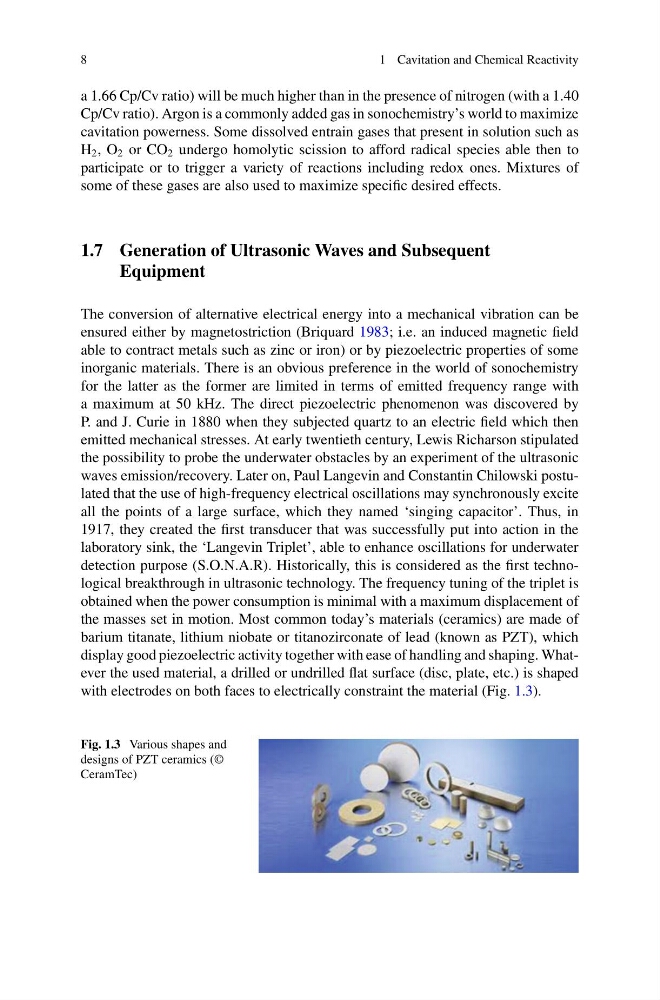
with electrodes on both faces to electrically constraint the material (Fig. 1.3).
Fig. 1.3 Various shapes and
designs of PZT ceramics (©
CeramTec)
1 Cavitation and Chemical Reactivity
a 1.66 Cp/Cv ratio) will be much higher than in the presence of nitrogen (with a 1.40
Cp/Cv ratio). Argon is a commonly added gas in sonochemistry’s world to maximize
cavitation powerness. Some dissolved entrain gases that present in solution such as
H 2 , O 2 or CO 2 undergo homolytic scission to afford radical species able then to
participate or to trigger a variety of reactions including redox ones. Mixtures of
some of these gases are also used to maximize specific desired effects.
1.7 Generation of Ultrasonic Waves and Subsequent
Equipment
The conversion of alternative electrical energy into a mechanical vibration can be
ensured either by magnetostriction (Briquard 1983; i.e. an induced magnetic field
able to contract metals such as zinc or iron) or by piezoelectric properties of some
inorganic materials. There is an obvious preference in the world of sonochemistry
for the latter as the former are limited in terms of emitted frequency range with
a maximum at 50 kHz. The direct piezoelectric phenomenon was discovered by
P. and J. Curie in 1880 when they subjected quartz to an electric field which then
emitted mechanical stresses. At early twentieth century, Lewis Richarson stipulated
the possibility to probe the underwater obstacles by an experiment of the ultrasonic
waves emission/recovery. Later on, Paul Langevin and Constantin Chilowski postulated that the use of high-frequency electrical oscillations may synchronously excite
all the points of a large surface, which they named ‘singing capacitor’. Thus, in
1917, they created the first transducer that was successfully put into action in the
laboratory sink, the ‘Langevin Triplet’, able to enhance oscillations for underwater
detection purpose (S.O.N.A.R). Historically, this is considered as the first technological breakthrough in ultrasonic technology. The frequency tuning of the triplet is
obtained when the power consumption is minimal with a maximum displacement of
the masses set in motion. Most common today’s materials (ceramics) are made of
barium titanate, lithium niobate or titanozirconate of lead (known as PZT), which
display good piezoelectric activity together with ease of handling and shaping. Whatever the used material, a drilled or undrilled flat surface (disc, plate, etc.) is shaped
with electrodes on both faces to electrically constraint the material (Fig. 1.3).
Fig. 1.3 Various shapes and
designs of PZT ceramics (©
CeramTec)