

106
7 Hybrid Technologies in Action: Sonochemistry and Beyond
7.5 Combined MW/US Transesterification Reaction
The use of combined MW/US in the process intensification of biodiesel production
leads to increased mass and heat transfer in the transesterification of vegetable oil. In
2014, Soni et al. demonstrated that cavitation efficiently sped up the transesterification of vegetable castor oil in the presence of symmetrical acidic ionic liquid as the
catalyst. Lower catalyst loading was required as the methanol was efficiently suspended in the oil and the reaction occurred at the interfacial phase (Soni et al. 2014).
Response surface methodology (RSM) has been used by Safieddin et al. to analyse
the influence of reaction conditions, including methanol/palm oil molar ratio, catalyst concentration, reaction temperature and irradiation time on biodiesel yield. RSM
analyses indicated 136 and 129 s as the optimal MW/US irradiation times, respectively. Optimized parameters for full conversion (97.53%) are as follows: 1.09%
catalyst concentration and a 7:3.1 methanol/oil molar ratio at 58.4 °C. Simultaneous
MW/US irradiation dramatically accelerates the palm oil transesterification reaction.
Pure biodiesel was obtained after only 2.2 min (Safieddin et al. 2015).
Martinez-Guerra et al. have developed an optimized protocol for the production
of biodiesel from waste vegetable oil under simultaneous MW/US irradiation. While
their first study focused on methanol, their second one investigated the effect of
simultaneous MW and US irradiation on methanol and ethanol-based transesterifications at different alcohol-to-oil ratios in the presence of varying catalyst amounts
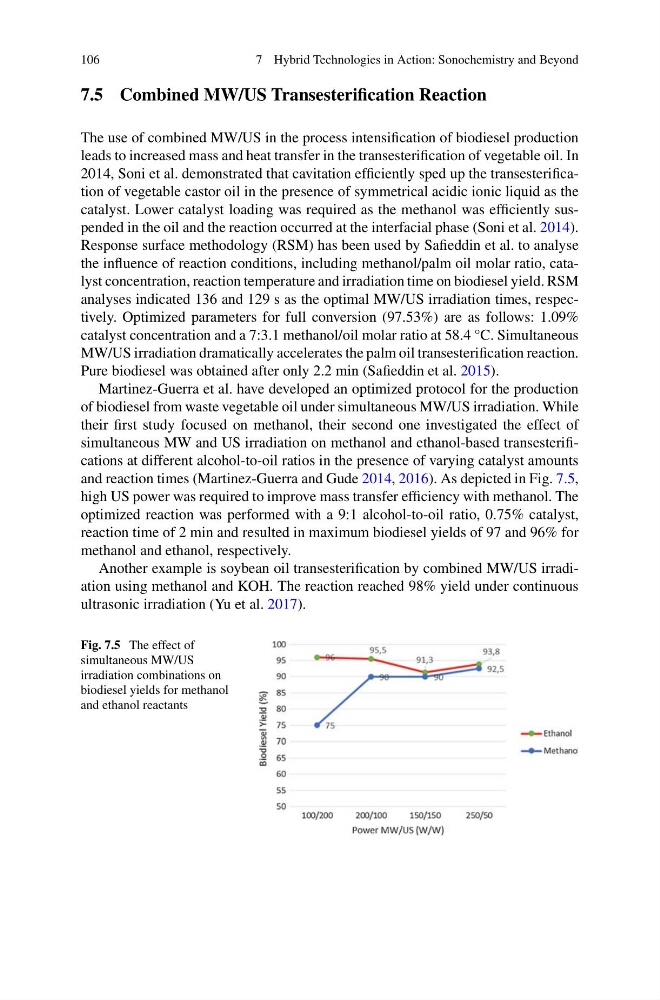
and reaction times (Martinez-Guerra and Gude 2014, 2016). As depicted in Fig. 7.5,
high US power was required to improve mass transfer efficiency with methanol. The
optimized reaction was performed with a 9:1 alcohol-to-oil ratio, 0.75% catalyst,
reaction time of 2 min and resulted in maximum biodiesel yields of 97 and 96% for
methanol and ethanol, respectively.
Another example is soybean oil transesterification by combined MW/US irradiation using methanol and KOH. The reaction reached 98% yield under continuous
ultrasonic irradiation (Yu et al. 2017).
Fig. 7.5 The effect of
simultaneous MW/US
irradiation combinations on
biodiesel yields for methanol
and ethanol reactants
7 Hybrid Technologies in Action: Sonochemistry and Beyond
7.5 Combined MW/US Transesterification Reaction
The use of combined MW/US in the process intensification of biodiesel production
leads to increased mass and heat transfer in the transesterification of vegetable oil. In
2014, Soni et al. demonstrated that cavitation efficiently sped up the transesterification of vegetable castor oil in the presence of symmetrical acidic ionic liquid as the
catalyst. Lower catalyst loading was required as the methanol was efficiently suspended in the oil and the reaction occurred at the interfacial phase (Soni et al. 2014).
Response surface methodology (RSM) has been used by Safieddin et al. to analyse
the influence of reaction conditions, including methanol/palm oil molar ratio, catalyst concentration, reaction temperature and irradiation time on biodiesel yield. RSM
analyses indicated 136 and 129 s as the optimal MW/US irradiation times, respectively. Optimized parameters for full conversion (97.53%) are as follows: 1.09%
catalyst concentration and a 7:3.1 methanol/oil molar ratio at 58.4 °C. Simultaneous
MW/US irradiation dramatically accelerates the palm oil transesterification reaction.
Pure biodiesel was obtained after only 2.2 min (Safieddin et al. 2015).
Martinez-Guerra et al. have developed an optimized protocol for the production
of biodiesel from waste vegetable oil under simultaneous MW/US irradiation. While
their first study focused on methanol, their second one investigated the effect of
simultaneous MW and US irradiation on methanol and ethanol-based transesterifications at different alcohol-to-oil ratios in the presence of varying catalyst amounts
and reaction times (Martinez-Guerra and Gude 2014, 2016). As depicted in Fig. 7.5,
high US power was required to improve mass transfer efficiency with methanol. The
optimized reaction was performed with a 9:1 alcohol-to-oil ratio, 0.75% catalyst,
reaction time of 2 min and resulted in maximum biodiesel yields of 97 and 96% for
methanol and ethanol, respectively.
Another example is soybean oil transesterification by combined MW/US irradiation using methanol and KOH. The reaction reached 98% yield under continuous
ultrasonic irradiation (Yu et al. 2017).
Fig. 7.5 The effect of
simultaneous MW/US
irradiation combinations on
biodiesel yields for methanol
and ethanol reactants