

104
7 Hybrid Technologies in Action: Sonochemistry and Beyond
7.4 Simultaneous US/MW-Promoted Organic Syntheses
The MW and US irradiation combination has been investigated as a means of providing a reliable and cost-effective strategy for an increasing number of synthetic
transformations (Cravotto and Cintas 2007).
The benign effects that simultaneous MW and US irradiation (SMUI) can provide
have been proven in catalyst activations and heterogeneous catalysis as well as in a
number of chemical reactions, where they have provided improved results (Carmona
et al. 2015, Chowdhury and Abd Hamid 2016; Cintas et al. 2007, Cravotto et al. 2011).
They have also granted further benefits to C–C coupling, Pd-catalysed reactions and
in a number of other organometallic protocols.
Pd-catalysed C–C couplings have been efficiently performed under SMUI conditions. Examples of ligand-free Heck reactions have been performed using Pd(OAc) 2
(0.01–0.1 mol%) and Pd/C (1.0–2.0 mol% range) to give stilbene derivatives in high
yields at 120 °C in 30 min (Palmisano et al. 2007). A Pyrex
® horn (20.3 kHz, 35 W)
together with 50 W of MW power was used during the reaction with a short initiating
200 W MW irradiation time to reach 120 °C.
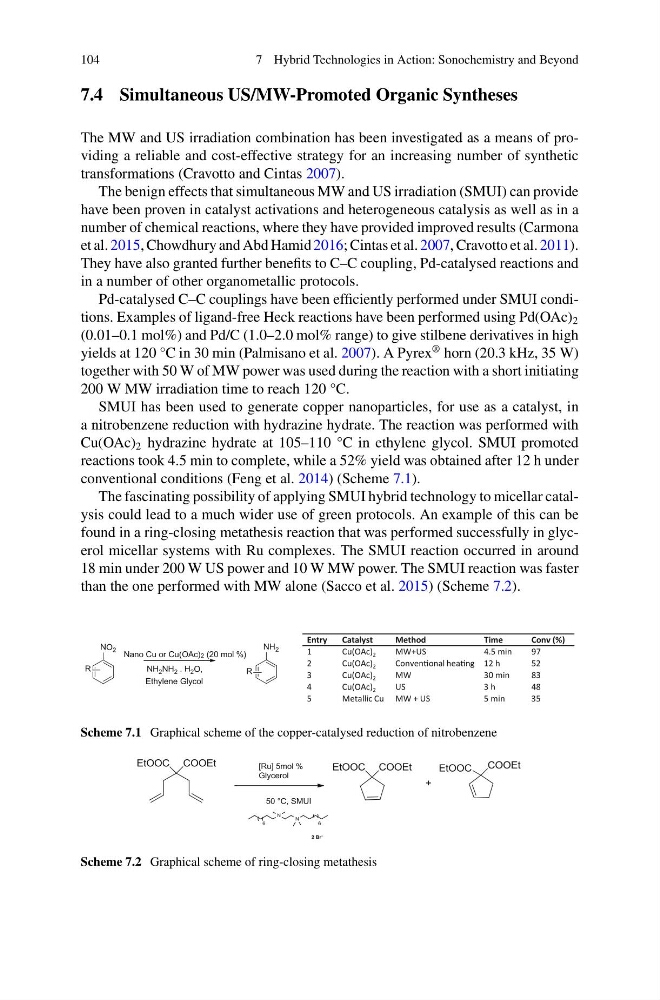
SMUI has been used to generate copper nanoparticles, for use as a catalyst, in
a nitrobenzene reduction with hydrazine hydrate. The reaction was performed with
Cu(OAc) 2 hydrazine hydrate at 105–110 °C in ethylene glycol. SMUI promoted
reactions took 4.5 min to complete, while a 52% yield was obtained after 12 h under
conventional conditions (Feng et al. 2014) (Scheme 7.1).
The fascinating possibility of applying SMUI hybrid technology to micellar catalysis could lead to a much wider use of green protocols. An example of this can be
found in a ring-closing metathesis reaction that was performed successfully in glycerol micellar systems with Ru complexes. The SMUI reaction occurred in around
18 min under 200 W US power and 10 W MW power. The SMUI reaction was faster
than the one performed with MW alone (Sacco et al. 2015) (Scheme 7.2).
NO 2
NH 2
Nano Cu or Cu(OAc)2 (20 mol %)
NH 2 NH 2 . H 2 O,
Ethylene Glycol
R
R
Entry
Catalyst
Method
Time
Conv (%)
1
C u ( O A c ) 2
MW+US
4.5 min
97
2
C u ( O A c ) 2
ConvenƟonal heaƟng 12 h
52
3
C u ( O A c ) 2
MW
30 min
83
4
C u ( O A c ) 2
US
3 h
48
5
Metallic Cu MW + US
5 min
35
Scheme 7.1 Graphical scheme of the copper-catalysed reduction of nitrobenzene
Scheme 7.2 Graphical scheme of ring-closing metathesis
7 Hybrid Technologies in Action: Sonochemistry and Beyond
7.4 Simultaneous US/MW-Promoted Organic Syntheses
The MW and US irradiation combination has been investigated as a means of providing a reliable and cost-effective strategy for an increasing number of synthetic
transformations (Cravotto and Cintas 2007).
The benign effects that simultaneous MW and US irradiation (SMUI) can provide
have been proven in catalyst activations and heterogeneous catalysis as well as in a
number of chemical reactions, where they have provided improved results (Carmona
et al. 2015, Chowdhury and Abd Hamid 2016; Cintas et al. 2007, Cravotto et al. 2011).
They have also granted further benefits to C–C coupling, Pd-catalysed reactions and
in a number of other organometallic protocols.
Pd-catalysed C–C couplings have been efficiently performed under SMUI conditions. Examples of ligand-free Heck reactions have been performed using Pd(OAc) 2
(0.01–0.1 mol%) and Pd/C (1.0–2.0 mol% range) to give stilbene derivatives in high
yields at 120 °C in 30 min (Palmisano et al. 2007). A Pyrex
® horn (20.3 kHz, 35 W)
together with 50 W of MW power was used during the reaction with a short initiating
200 W MW irradiation time to reach 120 °C.
SMUI has been used to generate copper nanoparticles, for use as a catalyst, in
a nitrobenzene reduction with hydrazine hydrate. The reaction was performed with
Cu(OAc) 2 hydrazine hydrate at 105–110 °C in ethylene glycol. SMUI promoted
reactions took 4.5 min to complete, while a 52% yield was obtained after 12 h under
conventional conditions (Feng et al. 2014) (Scheme 7.1).
The fascinating possibility of applying SMUI hybrid technology to micellar catalysis could lead to a much wider use of green protocols. An example of this can be
found in a ring-closing metathesis reaction that was performed successfully in glycerol micellar systems with Ru complexes. The SMUI reaction occurred in around
18 min under 200 W US power and 10 W MW power. The SMUI reaction was faster
than the one performed with MW alone (Sacco et al. 2015) (Scheme 7.2).
NO 2
NH 2
Nano Cu or Cu(OAc)2 (20 mol %)
NH 2 NH 2 . H 2 O,
Ethylene Glycol
R
R
Entry
Catalyst
Method
Time
Conv (%)
1
C u ( O A c ) 2
MW+US
4.5 min
97
2
C u ( O A c ) 2
ConvenƟonal heaƟng 12 h
52
3
C u ( O A c ) 2
MW
30 min
83
4
C u ( O A c ) 2
US
3 h
48
5
Metallic Cu MW + US
5 min
35
Scheme 7.1 Graphical scheme of the copper-catalysed reduction of nitrobenzene
Scheme 7.2 Graphical scheme of ring-closing metathesis