

1.3 Cavitation and Origin of Ultrasonic Effects
3
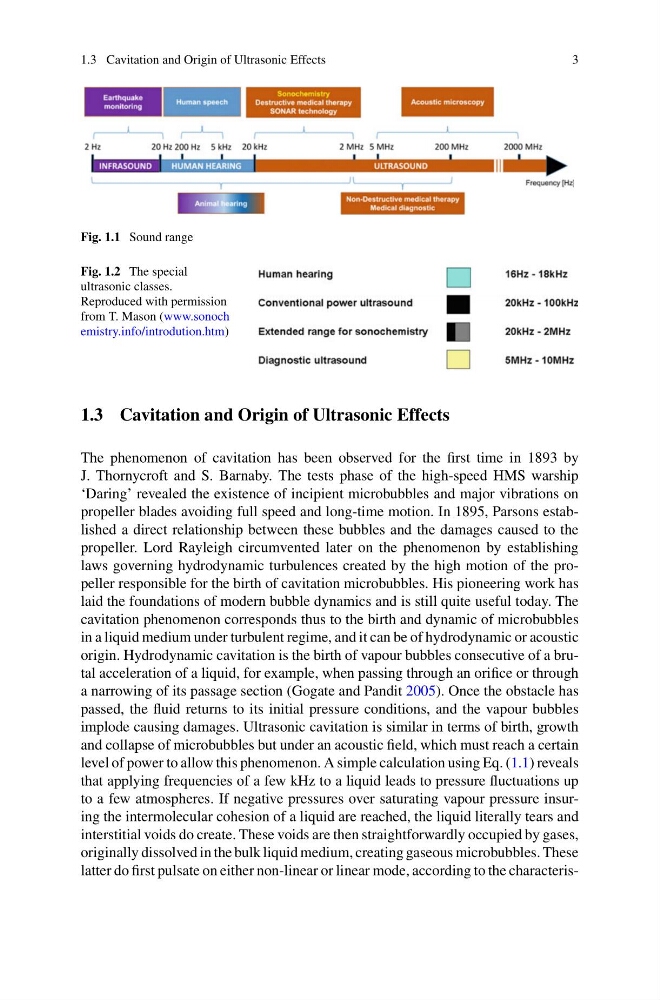
Fig. 1.1 Sound range
Fig. 1.2 The special
ultrasonic classes.
Reproduced with permission
from T. Mason (www.sonoch
emistry.info/introdution.htm)
1.3 Cavitation and Origin of Ultrasonic Effects
The phenomenon of cavitation has been observed for the first time in 1893 by
J. Thornycroft and S. Barnaby. The tests phase of the high-speed HMS warship
‘Daring’ revealed the existence of incipient microbubbles and major vibrations on
propeller blades avoiding full speed and long-time motion. In 1895, Parsons established a direct relationship between these bubbles and the damages caused to the
propeller. Lord Rayleigh circumvented later on the phenomenon by establishing
laws governing hydrodynamic turbulences created by the high motion of the propeller responsible for the birth of cavitation microbubbles. His pioneering work has
laid the foundations of modern bubble dynamics and is still quite useful today. The
cavitation phenomenon corresponds thus to the birth and dynamic of microbubbles
in a liquid medium under turbulent regime, and it can be of hydrodynamic or acoustic
origin. Hydrodynamic cavitation is the birth of vapour bubbles consecutive of a brutal acceleration of a liquid, for example, when passing through an orifice or through
a narrowing of its passage section (Gogate and Pandit 2005). Once the obstacle has
passed, the fluid returns to its initial pressure conditions, and the vapour bubbles
implode causing damages. Ultrasonic cavitation is similar in terms of birth, growth
and collapse of microbubbles but under an acoustic field, which must reach a certain
level of power to allow this phenomenon. A simple calculation using Eq. (1.1) reveals
that applying frequencies of a few kHz to a liquid leads to pressure fluctuations up
to a few atmospheres. If negative pressures over saturating vapour pressure insuring the intermolecular cohesion of a liquid are reached, the liquid literally tears and
interstitial voids do create. These voids are then straightforwardly occupied by gases,
originally dissolved in the bulk liquid medium, creating gaseous microbubbles. These
latter do first pulsate on either non-linear or linear mode, according to the characteris-
3
Fig. 1.1 Sound range
Fig. 1.2 The special
ultrasonic classes.
Reproduced with permission
from T. Mason (www.sonoch
emistry.info/introdution.htm)
1.3 Cavitation and Origin of Ultrasonic Effects
The phenomenon of cavitation has been observed for the first time in 1893 by
J. Thornycroft and S. Barnaby. The tests phase of the high-speed HMS warship
‘Daring’ revealed the existence of incipient microbubbles and major vibrations on
propeller blades avoiding full speed and long-time motion. In 1895, Parsons established a direct relationship between these bubbles and the damages caused to the
propeller. Lord Rayleigh circumvented later on the phenomenon by establishing
laws governing hydrodynamic turbulences created by the high motion of the propeller responsible for the birth of cavitation microbubbles. His pioneering work has
laid the foundations of modern bubble dynamics and is still quite useful today. The
cavitation phenomenon corresponds thus to the birth and dynamic of microbubbles
in a liquid medium under turbulent regime, and it can be of hydrodynamic or acoustic
origin. Hydrodynamic cavitation is the birth of vapour bubbles consecutive of a brutal acceleration of a liquid, for example, when passing through an orifice or through
a narrowing of its passage section (Gogate and Pandit 2005). Once the obstacle has
passed, the fluid returns to its initial pressure conditions, and the vapour bubbles
implode causing damages. Ultrasonic cavitation is similar in terms of birth, growth
and collapse of microbubbles but under an acoustic field, which must reach a certain
level of power to allow this phenomenon. A simple calculation using Eq. (1.1) reveals
that applying frequencies of a few kHz to a liquid leads to pressure fluctuations up
to a few atmospheres. If negative pressures over saturating vapour pressure insuring the intermolecular cohesion of a liquid are reached, the liquid literally tears and
interstitial voids do create. These voids are then straightforwardly occupied by gases,
originally dissolved in the bulk liquid medium, creating gaseous microbubbles. These
latter do first pulsate on either non-linear or linear mode, according to the characteris-