

102
7 Hybrid Technologies in Action: Sonochemistry and Beyond
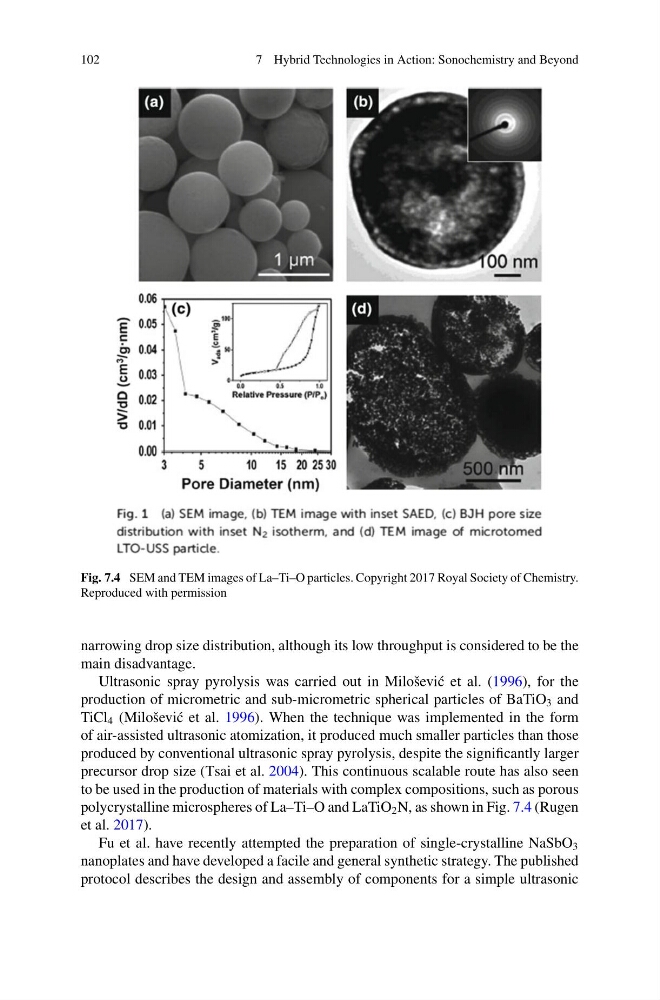
Fig. 7.4 SEM and TEM images of La–Ti–O particles. Copyright 2017 Royal Society of Chemistry.
Reproduced with permission
narrowing drop size distribution, although its low throughput is considered to be the
main disadvantage.
Ultrasonic spray pyrolysis was carried out in Miloševi´ c et al. (1996), for the
production of micrometric and sub-micrometric spherical particles of BaTiO 3 and
TiCl 4 (Miloševi´ c et al. 1996). When the technique was implemented in the form
of air-assisted ultrasonic atomization, it produced much smaller particles than those
produced by conventional ultrasonic spray pyrolysis, despite the significantly larger
precursor drop size (Tsai et al. 2004). This continuous scalable route has also seen
to be used in the production of materials with complex compositions, such as porous
polycrystalline microspheres of La–Ti–O and LaTiO 2 N, as shown in Fig. 7.4 (Rugen
et al. 2017).
Fu et al. have recently attempted the preparation of single-crystalline NaSbO 3
nanoplates and have developed a facile and general synthetic strategy. The published
protocol describes the design and assembly of components for a simple ultrasonic
7 Hybrid Technologies in Action: Sonochemistry and Beyond
Fig. 7.4 SEM and TEM images of La–Ti–O particles. Copyright 2017 Royal Society of Chemistry.
Reproduced with permission
narrowing drop size distribution, although its low throughput is considered to be the
main disadvantage.
Ultrasonic spray pyrolysis was carried out in Miloševi´ c et al. (1996), for the
production of micrometric and sub-micrometric spherical particles of BaTiO 3 and
TiCl 4 (Miloševi´ c et al. 1996). When the technique was implemented in the form
of air-assisted ultrasonic atomization, it produced much smaller particles than those
produced by conventional ultrasonic spray pyrolysis, despite the significantly larger
precursor drop size (Tsai et al. 2004). This continuous scalable route has also seen
to be used in the production of materials with complex compositions, such as porous
polycrystalline microspheres of La–Ti–O and LaTiO 2 N, as shown in Fig. 7.4 (Rugen
et al. 2017).
Fu et al. have recently attempted the preparation of single-crystalline NaSbO 3
nanoplates and have developed a facile and general synthetic strategy. The published
protocol describes the design and assembly of components for a simple ultrasonic