

687
Europe. Tests of key sectors for the German and European economy have shown (Berger
2015) that a progress is possible due to a digital transformation, having the following basic
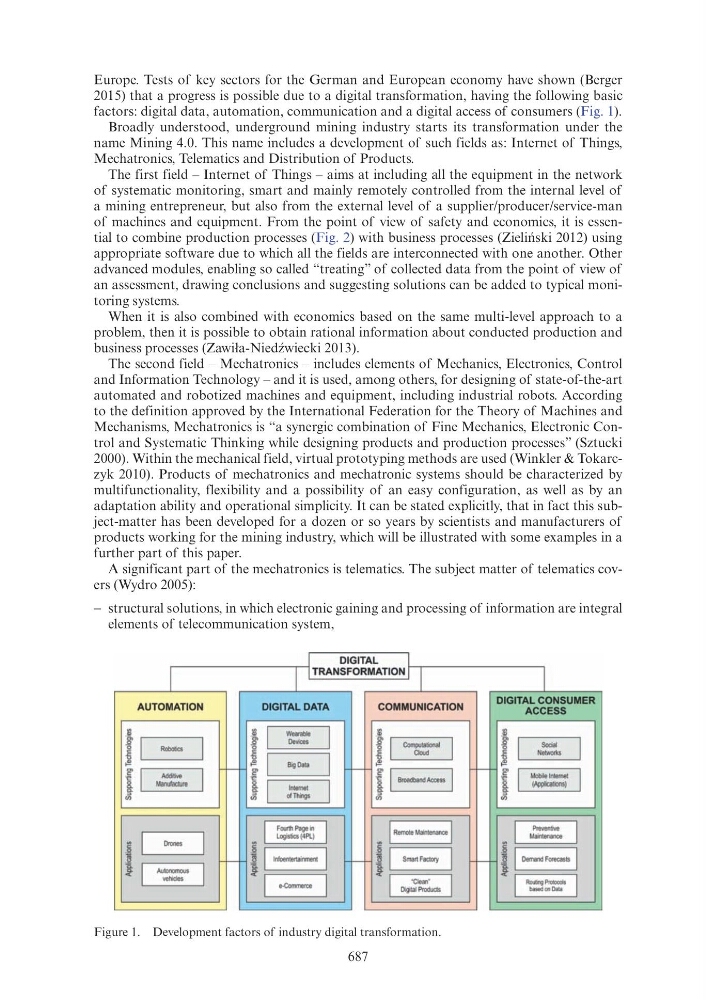
factors: digital data, automation, communication and a digital access of consumers (Fig. 1).
Broadly understood, underground mining industry starts its transformation under the
name Mining 4.0. This name includes a development of such fields as: Internet of Things,
Mechatronics, Telematics and Distribution of Products.
The first field – Internet of Things – aims at including all the equipment in the network
of systematic monitoring, smart and mainly remotely controlled from the internal level of
a mining entrepreneur, but also from the external level of a supplier/producer/service-man
of machines and equipment. From the point of view of safety and economics, it is essential to combine production processes (Fig. 2) with business processes (Zieliński 2012) using
appropriate software due to which all the fields are interconnected with one another. Other
advanced modules, enabling so called “treating” of collected data from the point of view of
an assessment, drawing conclusions and suggesting solutions can be added to typical monitoring systems.
When it is also combined with economics based on the same multi-level approach to a
problem, then it is possible to obtain rational information about conducted production and
business processes (Zawiła-Niedźwiecki 2013).
The second field – Mechatronics – includes elements of Mechanics, Electronics, Control
and Information Technology – and it is used, among others, for designing of state-of-the-art
automated and robotized machines and equipment, including industrial robots. According
to the definition approved by the International Federation for the Theory of Machines and
Mechanisms, Mechatronics is “a synergic combination of Fine Mechanics, Electronic Control and Systematic Thinking while designing products and production processes” (Sztucki
2000). Within the mechanical field, virtual prototyping methods are used (Winkler & Tokarczyk 2010). Products of mechatronics and mechatronic systems should be characterized by
multifunctionality, flexibility and a possibility of an easy configuration, as well as by an
adaptation ability and operational simplicity. It can be stated explicitly, that in fact this subject-matter has been developed for a dozen or so years by scientists and manufacturers of
products working for the mining industry, which will be illustrated with some examples in a
further part of this paper.
A significant part of the mechatronics is telematics. The subject matter of telematics covers (Wydro 2005):
− structural solutions, in which electronic gaining and processing of information are integral
elements of telecommunication system,
Figure 1. Development factors of industry digital transformation.
I
DIGITAL
I
~.-----------. ~ ---11 TRANSFORMATION 11----.~------------,~
, - - - - . l - - - - ,
AUTOMATION
~
~ I Ro~ I
~ '---- - - --'
! l __ ·_dd_ij_·_· _j
~ _
Manufacture
-
"'
~ I Drones I
i L - - - - - - ' ·
§: I Autonomous I
vehides
L _ _ _ _ _ j
-
DIGITAL DATA
·-~~- I Wearable I
Devices
~ ~ ~ ==s=ig=o . ="=~~
"'
-~ I Internet I
, 0
ofThings
~
I
Fourth Page in
I
Logislics(4Pll
~ I tnfoentertainment I
~ I ~c~merce I
COMMUNICATION
-
~ I B~dband A=ss I
"'
I Remote Maintenance I
~~ SmartFact~ I
~I "Clean" I
Digital Products
-
-
-
DIGITAL CONSUMER
ACCESS
~
{ I N::~. I
~
'---- - - --'
~ I Mobilelntemet I
~ '----(Ap_pl_ica_tio_"'_i---'
"'
I
Preventive
I
Maintenance
~
~ I Demand Forncas~ I
~I Rooting Protocot. I
based on Data