

684
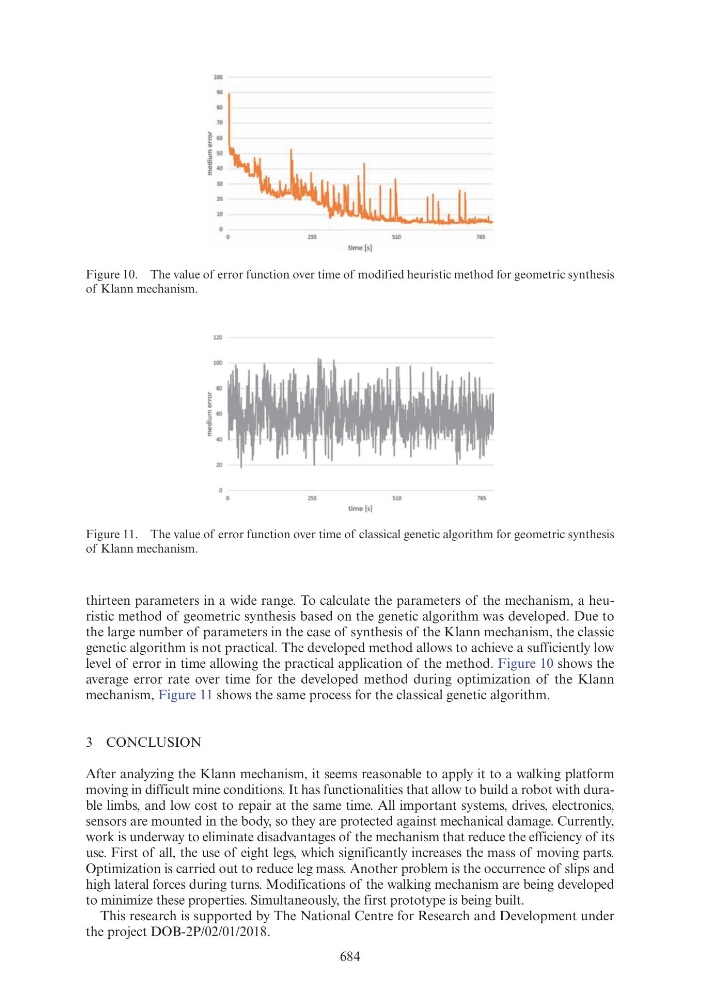
thirteen parameters in a wide range. To calculate the parameters of the mechanism, a heuristic method of geometric synthesis based on the genetic algorithm was developed. Due to
the large number of parameters in the case of synthesis of the Klann mechanism, the classic
genetic algorithm is not practical. The developed method allows to achieve a sufficiently low
level of error in time allowing the practical application of the method. Figure 10 shows the
average error rate over time for the developed method during optimization of the Klann
mechanism, Figure 11 shows the same process for the classical genetic algorithm.
3 CONCLUSION
After analyzing the Klann mechanism, it seems reasonable to apply it to a walking platform
moving in difficult mine conditions. It has functionalities that allow to build a robot with durable limbs, and low cost to repair at the same time. All important systems, drives, electronics,
sensors are mounted in the body, so they are protected against mechanical damage. Currently,
work is underway to eliminate disadvantages of the mechanism that reduce the efficiency of its
use. First of all, the use of eight legs, which significantly increases the mass of moving parts.
Optimization is carried out to reduce leg mass. Another problem is the occurrence of slips and
high lateral forces during turns. Modifications of the walking mechanism are being developed
to minimize these properties. Simultaneously, the first prototype is being built.
This research is supported by The National Centre for Research and Development under
the project DOB-2P/02/01/2018.
Figure 10. The value of error function over time of modified heuristic method for geometric synthesis
of Klann mechanism.
Figure 11. The value of error function over time of classical genetic algorithm for geometric synthesis
of Klann mechanism.