

605
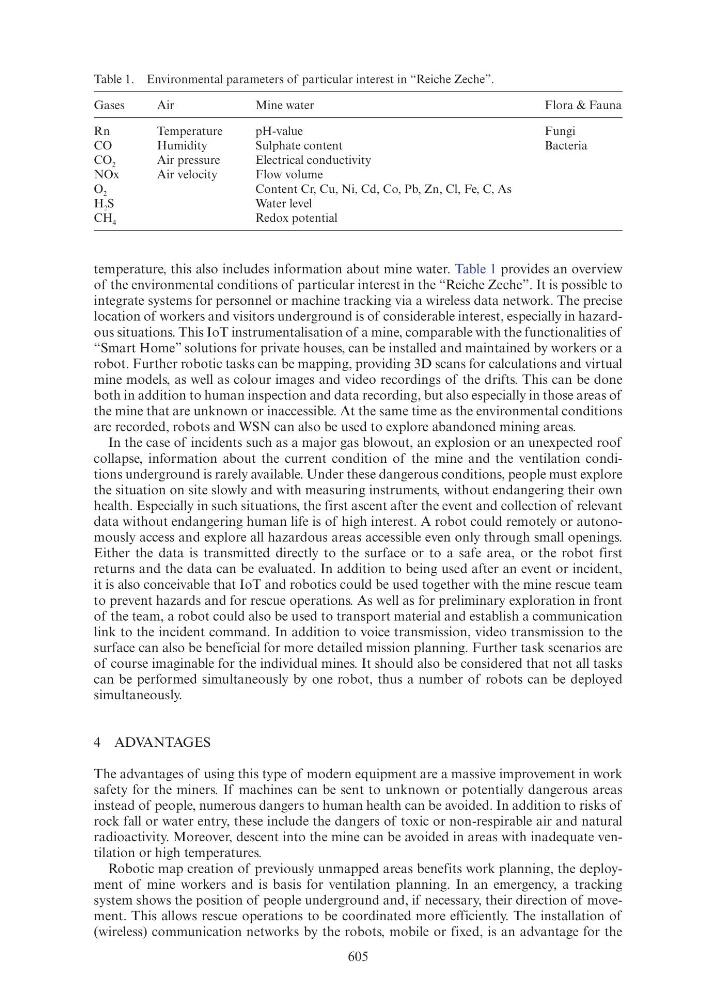
temperature, this also includes information about mine water. Table 1 provides an overview
of the environmental conditions of particular interest in the “Reiche Zeche”. It is possible to
integrate systems for personnel or machine tracking via a wireless data network. The precise
location of workers and visitors underground is of considerable interest, especially in hazardous situations. This IoT instrumentalisation of a mine, comparable with the functionalities of
“Smart Home” solutions for private houses, can be installed and maintained by workers or a
robot. Further robotic tasks can be mapping, providing 3D scans for calculations and virtual
mine models, as well as colour images and video recordings of the drifts. This can be done
both in addition to human inspection and data recording, but also especially in those areas of
the mine that are unknown or inaccessible. At the same time as the environmental conditions
are recorded, robots and WSN can also be used to explore abandoned mining areas.
In the case of incidents such as a major gas blowout, an explosion or an unexpected roof
collapse, information about the current condition of the mine and the ventilation conditions underground is rarely available. Under these dangerous conditions, people must explore
the situation on site slowly and with measuring instruments, without endangering their own
health. Especially in such situations, the first ascent after the event and collection of relevant
data without endangering human life is of high interest. A robot could remotely or autonomously access and explore all hazardous areas accessible even only through small openings.
Either the data is transmitted directly to the surface or to a safe area, or the robot first
returns and the data can be evaluated. In addition to being used after an event or incident,
it is also conceivable that IoT and robotics could be used together with the mine rescue team
to prevent hazards and for rescue operations. As well as for preliminary exploration in front
of the team, a robot could also be used to transport material and establish a communication
link to the incident command. In addition to voice transmission, video transmission to the
surface can also be beneficial for more detailed mission planning. Further task scenarios are
of course imaginable for the individual mines. It should also be considered that not all tasks
can be performed simultaneously by one robot, thus a number of robots can be deployed
simultaneously.
4 ADVANTAGES
The advantages of using this type of modern equipment are a massive improvement in work
safety for the miners. If machines can be sent to unknown or potentially dangerous areas
instead of people, numerous dangers to human health can be avoided. In addition to risks of
rock fall or water entry, these include the dangers of toxic or non-respirable air and natural
radioactivity. Moreover, descent into the mine can be avoided in areas with inadequate ventilation or high temperatures.
Robotic map creation of previously unmapped areas benefits work planning, the deployment of mine workers and is basis for ventilation planning. In an emergency, a tracking
system shows the position of people underground and, if necessary, their direction of movement. This allows rescue operations to be coordinated more efficiently. The installation of
(wireless) communication networks by the robots, mobile or fixed, is an advantage for the
Table 1. Environmental parameters of particular interest in “Reiche Zeche”.
Gases
Air
Mine water
Flora & Fauna
Rn
Temperature
pH-value
Fungi
CO
Humidity
Sulphate content
Bacteria
CO 2
Air pressure
Electrical conductivity
NOx
Air velocity
Flow volume
O 2
Content Cr, Cu, Ni, Cd, Co, Pb, Zn, Cl, Fe, C, As
H 2 S
Water level
CH 4
Redox potential