

571
2.2 DAMA-DMBOK2 as an example of an architectural framework
The guide DAMA International contains a set of processes in specific thematic areas (specialisations) related to data management provided in the form of good practices. The concept
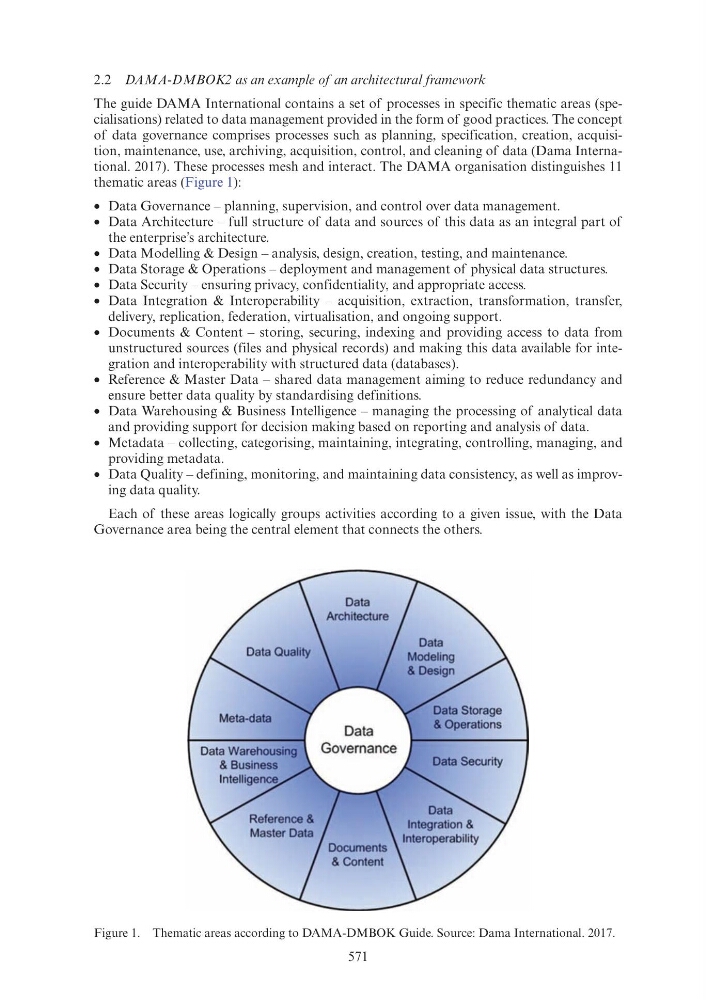
of data governance comprises processes such as planning, specification, creation, acquisition, maintenance, use, archiving, acquisition, control, and cleaning of data (Dama International. 2017). These processes mesh and interact. The DAMA organisation distinguishes 11
thematic areas (Figure 1):
• Data Governance – planning, supervision, and control over data management.
• Data Architecture – full structure of data and sources of this data as an integral part of
the enterprise’s architecture.
• Data Modelling & Design – analysis, design, creation, testing, and maintenance.
• Data Storage & Operations – deployment and management of physical data structures.
• Data Security – ensuring privacy, confidentiality, and appropriate access.
• Data Integration & Interoperability – acquisition, extraction, transformation, transfer,
delivery, replication, federation, virtualisation, and ongoing support.
• Documents & Content – storing, securing, indexing and providing access to data from
unstructured sources (files and physical records) and making this data available for integration and interoperability with structured data (databases).
• Reference & Master Data – shared data management aiming to reduce redundancy and
ensure better data quality by standardising definitions.
• Data Warehousing & Business Intelligence – managing the processing of analytical data
and providing support for decision making based on reporting and analysis of data.
• Metadata – collecting, categorising, maintaining, integrating, controlling, managing, and
providing metadata.
• Data Quality – defining, monitoring, and maintaining data consistency, as well as improving data quality.
Each of these areas logically groups activities according to a given issue, with the Data
Governance area being the central element that connects the others.
Figure 1. Thematic areas according to DAMA-DMBOK Guide. Source: Dama International. 2017.