

530
of the algorithm. We believe that it requires more tests on the large data set and the final
decision should be made on effectiveness analysis.
4 RESULTS
In this section results of the proposed procedure will be presented and discussed step by step.
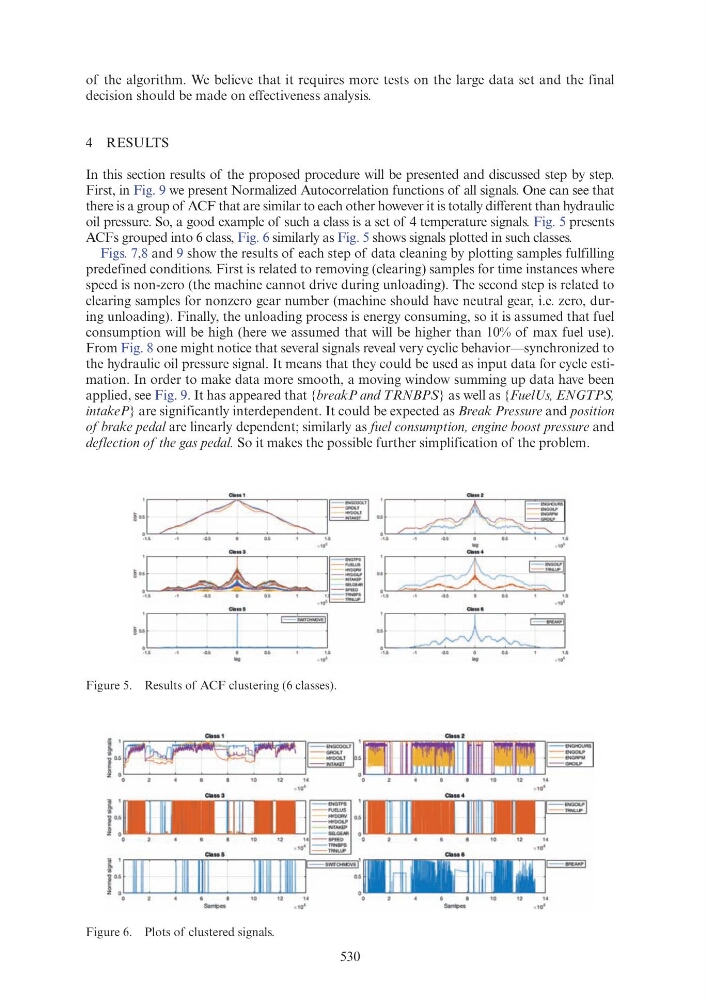
First, in Fig. 9 we present Normalized Autocorrelation functions of all signals. One can see that
there is a group of ACF that are similar to each other however it is totally different than hydraulic
oil pressure. So, a good example of such a class is a set of 4 temperature signals. Fig. 5 presents
ACFs grouped into 6 class, Fig. 6 similarly as Fig. 5 shows signals plotted in such classes.
Figs. 7,8 and 9 show the results of each step of data cleaning by plotting samples fulfilling
predefined conditions. First is related to removing (clearing) samples for time instances where
speed is non-zero (the machine cannot drive during unloading). The second step is related to
clearing samples for nonzero gear number (machine should have neutral gear, i.e. zero, during unloading). Finally, the unloading process is energy consuming, so it is assumed that fuel
consumption will be high (here we assumed that will be higher than 10% of max fuel use).
From Fig. 8 one might notice that several signals reveal very cyclic behavior—synchronized to
the hydraulic oil pressure signal. It means that they could be used as input data for cycle estimation. In order to make data more smooth, a moving window summing up data have been
applied, see Fig. 9. It has appeared that {breakP and TRNBPS} as well as {FuelUs, ENGTPS,
intakeP} are significantly interdependent. It could be expected as Break Pressure and position
of brake pedal are linearly dependent; similarly as fuel consumption, engine boost pressure and
deflection of the gas pedal. So it makes the possible further simplification of the problem.
Figure 5. Results of ACF clustering (6 classes).
Figure 6. Plots of clustered signals.
i'
105
z 0
0
·~1 .2$ 1 . ~·J~.
• 10&
lag
x \0&
§o:,,--------,[ ~ ;;: -------=r , ~ : . . : : _ _ _ _ _ _ _ _ _ _
; ~-------,=== •J ~1 .
.,c'
·~I . _ T . . ·:1. =;&;::= ~1 .
lag
x \0&
lag
x 101
I o: f I I II I . 1111 11r ·. 111 1 1 11 1 1 1 1 11'
0
2
4
6
8
10
12
14
~es
xto'
14
xto'