

507
for saving brakes—typical for heavy tipper trucks, mine vehicles etc. [10–19]. Unfortunately,
in mining conditions, many innovative solutions commonly used in other industries do not
meet or do not fully meet demands. It can also be said that in many cases determining the
cost-effectiveness of implementation of a given innovation is difficult which also does not
favor the introduction of new solutions.
In this paper, we present results of a simple test done in the underground mine, as well as
the methodology that allows to evaluate the impact of the lockup system on efficiency of
machines noticed from several perspectives. The procedure is based on analysis of data from
on-board monitoring system that has been successfully implemented and now there are more
than 120 machines covered by efficiency monitoring program in considered underground
mines [4–9]. The paper is organized as follows: first we present a machine selected for the
experimental work, then basic features of on-board monitoring system will be introduced,
next we will briefly recall the idea of lock up system used in this machine and finally the
results of the experiment will be presented and be discussed.
2 ON-BOARD MONITORING SYSTEM DESCRIPTION
2.1 Machine description
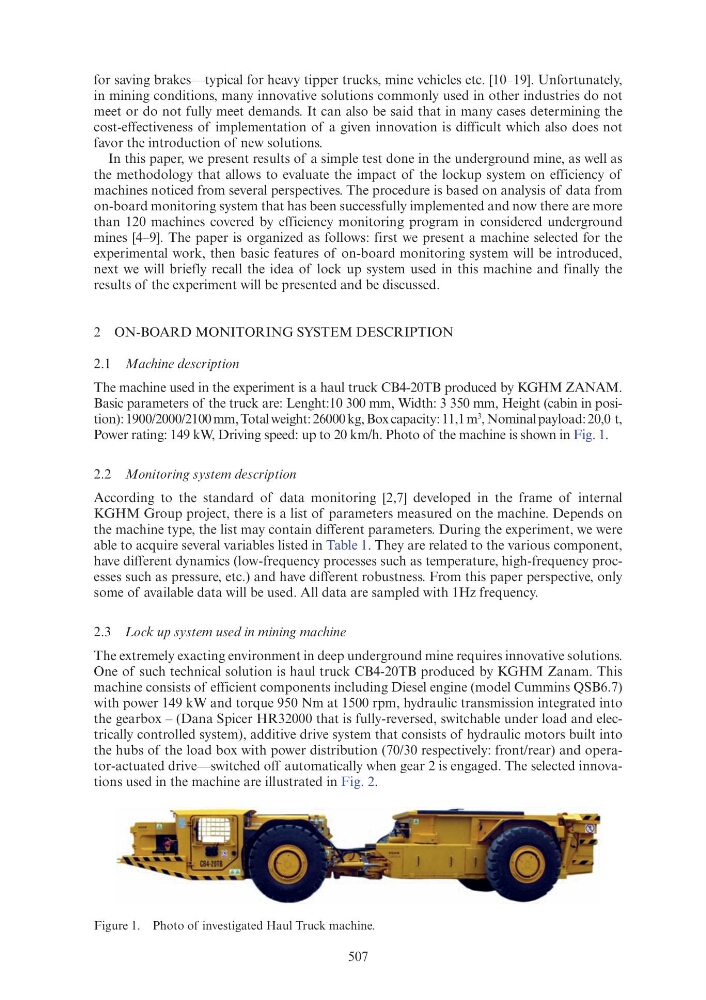
The machine used in the experiment is a haul truck CB4-20TB produced by KGHM ZANAM.
Basic parameters of the truck are: Lenght:10 300 mm, Width: 3 350 mm, Height (cabin in position): 1900/2000/2100 mm, Total weight: 26000 kg, Box capacity: 11,1 m
3
, Nominal payload: 20,0 t,
Power rating: 149 kW, Driving speed: up to 20 km/h. Photo of the machine is shown in Fig. 1.
2.2 Monitoring system description
According to the standard of data monitoring [2,7] developed in the frame of internal
KGHM Group project, there is a list of parameters measured on the machine. Depends on
the machine type, the list may contain different parameters. During the experiment, we were
able to acquire several variables listed in Table 1. They are related to the various component,
have different dynamics (low-frequency processes such as temperature, high-frequency processes such as pressure, etc.) and have different robustness. From this paper perspective, only
some of available data will be used. All data are sampled with 1Hz frequency.
2.3 Lock up system used in mining machine
The extremely exacting environment in deep underground mine requires innovative solutions.
One of such technical solution is haul truck CB4-20TB produced by KGHM Zanam. This
machine consists of efficient components including Diesel engine (model Cummins QSB6.7)
with power 149 kW and torque 950 Nm at 1500 rpm, hydraulic transmission integrated into
the gearbox – (Dana Spicer HR32000 that is fully-reversed, switchable under load and electrically controlled system), additive drive system that consists of hydraulic motors built into
the hubs of the load box with power distribution (70/30 respectively: front/rear) and operator-actuated drive—switched off automatically when gear 2 is engaged. The selected innovations used in the machine are illustrated in Fig. 2.
Figure 1. Photo of investigated Haul Truck machine.