

502
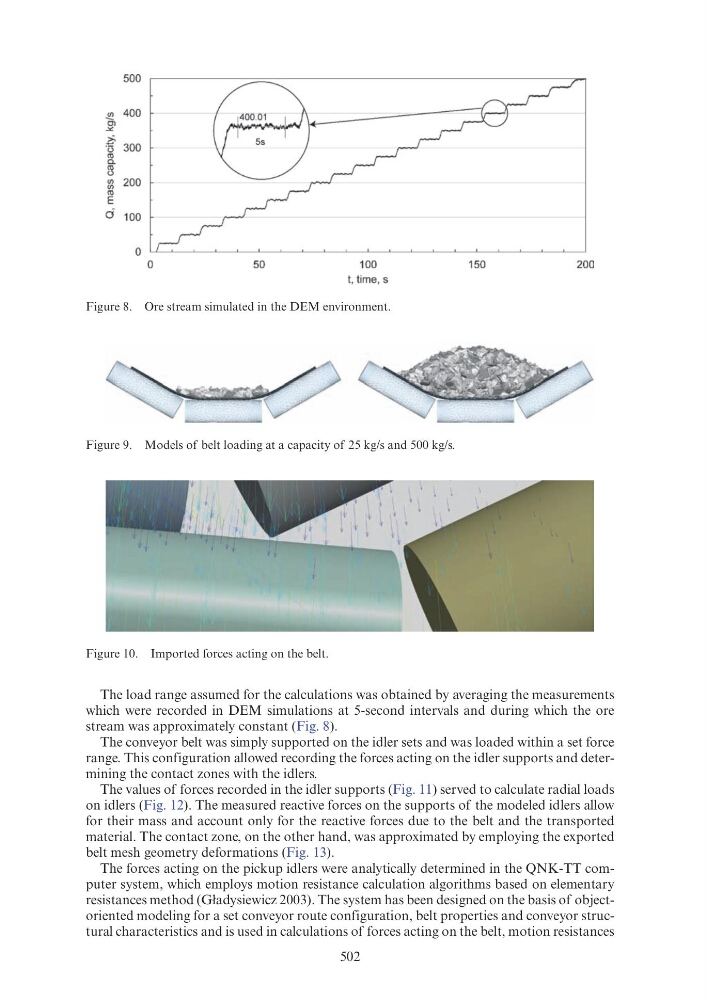
The load range assumed for the calculations was obtained by averaging the measurements
which were recorded in DEM simulations at 5-second intervals and during which the ore
stream was approximately constant (Fig. 8).
The conveyor belt was simply supported on the idler sets and was loaded within a set force
range. This configuration allowed recording the forces acting on the idler supports and determining the contact zones with the idlers.
The values of forces recorded in the idler supports (Fig. 11) served to calculate radial loads
on idlers (Fig. 12). The measured reactive forces on the supports of the modeled idlers allow
for their mass and account only for the reactive forces due to the belt and the transported
material. The contact zone, on the other hand, was approximated by employing the exported
belt mesh geometry deformations (Fig. 13).
The forces acting on the pickup idlers were analytically determined in the QNK-TT computer system, which employs motion resistance calculation algorithms based on elementary
resistances method (Gładysiewicz 2003). The system has been designed on the basis of objectoriented modeling for a set conveyor route configuration, belt properties and conveyor structural characteristics and is used in calculations of forces acting on the belt, motion resistances
Figure 8. Ore stream simulated in the DEM environment.
Figure 9. Models of belt loading at a capacity of 25 kg/s and 500 kg/s.
Figure 10. Imported forces acting on the belt.
500
en 400
0,
-"'
~ 300
·o
"' c.
~
en 200
en
"'
E
d 100
0
0
50
100
150
200
t, time, s
The load range assumed for the calculations was obtained by averaging the measurements
which were recorded in DEM simulations at 5-second intervals and during which the ore
stream was approximately constant (Fig. 8).
The conveyor belt was simply supported on the idler sets and was loaded within a set force
range. This configuration allowed recording the forces acting on the idler supports and determining the contact zones with the idlers.
The values of forces recorded in the idler supports (Fig. 11) served to calculate radial loads
on idlers (Fig. 12). The measured reactive forces on the supports of the modeled idlers allow
for their mass and account only for the reactive forces due to the belt and the transported
material. The contact zone, on the other hand, was approximated by employing the exported
belt mesh geometry deformations (Fig. 13).
The forces acting on the pickup idlers were analytically determined in the QNK-TT computer system, which employs motion resistance calculation algorithms based on elementary
resistances method (Gładysiewicz 2003). The system has been designed on the basis of objectoriented modeling for a set conveyor route configuration, belt properties and conveyor structural characteristics and is used in calculations of forces acting on the belt, motion resistances
Figure 8. Ore stream simulated in the DEM environment.
Figure 9. Models of belt loading at a capacity of 25 kg/s and 500 kg/s.
Figure 10. Imported forces acting on the belt.
500
en 400
0,
-"'
~ 300
·o
"' c.
~
en 200
en
"'
E
d 100
0
0
50
100
150
200
t, time, s