

28
9. Realigning mining boards: To transition to “the mine of the future”, mining companies
need to ensure that their boards embrace the full power of digitisation and innovation to
help drive the technological changes the industry requires.
10. Commodities of the future: To assess which commodities to invest in, and which to
divest, miners need to track fluctuating consumer demands, global demographic and
economic shifts, the effects of environmental change, and the emergence and adoption
of new technologies. An example being the demand for lithium, graphite, and cobalt,
resulting from the growth of electric vehicles.”
Future engineers will be required to be highly trained and digitally conversant professionals, and although beliefs in many industries are that fewer people will be required to achieve
more, the mining industry will most likely require more relevant expertise and experience,
rather than fewer if it is to thrive moving forward.
4 THE ROLE OF THE MINING ENGINEER
The role of the extractive engineering profession has evolved in line with how the world itself
has advanced, during especially the last half century. The education required 50 years ago,
although in many aspects still relevant today, has progressed exponentially, with technology and computer expertise amongst the few of many extra skills the modern engineer is
required to master. In line with how the world has developed, so have also the opportunities
for the most gifted learners, making attraction and retention into the industry a particularly
challenging issue. This requires a new mindset and approach to how we address the education, skills and mining expertise professionals will need to succeed in the 21st century and
beyond.
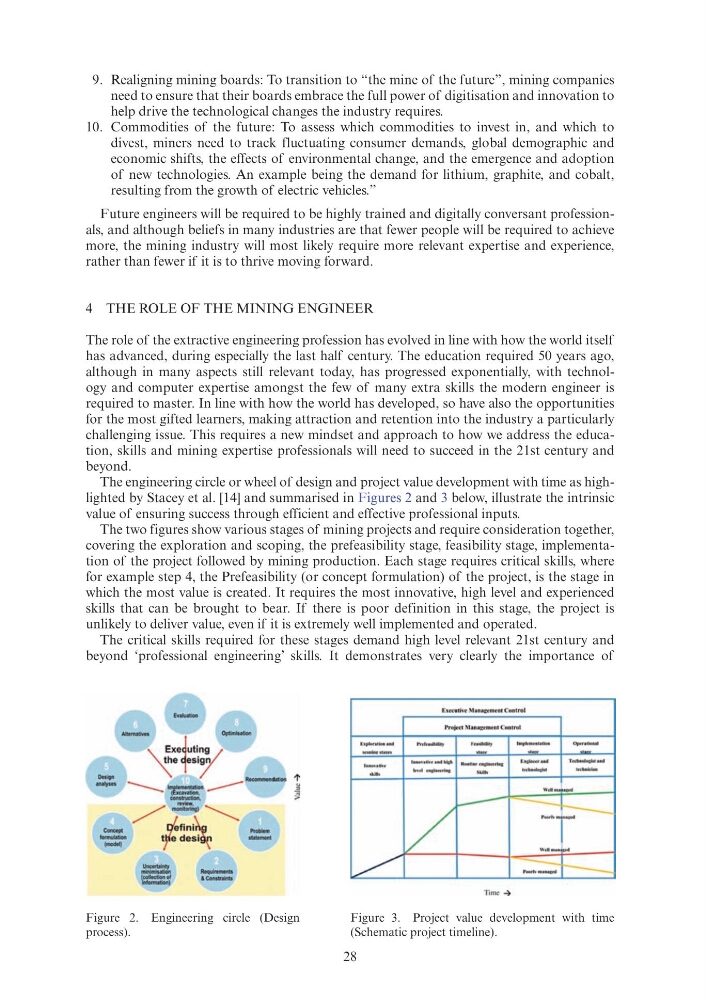
The engineering circle or wheel of design and project value development with time as highlighted by Stacey et al. [14] and summarised in Figures 2 and 3 below, illustrate the intrinsic
value of ensuring success through efficient and effective professional inputs.
The two figures show various stages of mining projects and require consideration together,
covering the exploration and scoping, the prefeasibility stage, feasibility stage, implementation of the project followed by mining production. Each stage requires critical skills, where
for example step 4, the Prefeasibility (or concept formulation) of the project, is the stage in
which the most value is created. It requires the most innovative, high level and experienced
skills that can be brought to bear. If there is poor definition in this stage, the project is
unlikely to deliver value, even if it is extremely well implemented and operated.
The critical skills required for these stages demand high level relevant 21st century and
beyond ‘professional engineering’ skills. It demonstrates very clearly the importance of
Figure 2. Engineering circle (Design
process).
Figure 3. Project value development with time
(Schematic project timeline).
- ·~
El t-nth·t Man12tmtnt ConlrOI
Proj«l Mana~:tmtnl Control
·-··lfoo·~ •-c! llll&llo
IW.IIM"'CM«rJ.t.
ln·tl .............
I /~
Time 4
Eedwrr•MI
-.,..... .....
~..:--1
9. Realigning mining boards: To transition to “the mine of the future”, mining companies
need to ensure that their boards embrace the full power of digitisation and innovation to
help drive the technological changes the industry requires.
10. Commodities of the future: To assess which commodities to invest in, and which to
divest, miners need to track fluctuating consumer demands, global demographic and
economic shifts, the effects of environmental change, and the emergence and adoption
of new technologies. An example being the demand for lithium, graphite, and cobalt,
resulting from the growth of electric vehicles.”
Future engineers will be required to be highly trained and digitally conversant professionals, and although beliefs in many industries are that fewer people will be required to achieve
more, the mining industry will most likely require more relevant expertise and experience,
rather than fewer if it is to thrive moving forward.
4 THE ROLE OF THE MINING ENGINEER
The role of the extractive engineering profession has evolved in line with how the world itself
has advanced, during especially the last half century. The education required 50 years ago,
although in many aspects still relevant today, has progressed exponentially, with technology and computer expertise amongst the few of many extra skills the modern engineer is
required to master. In line with how the world has developed, so have also the opportunities
for the most gifted learners, making attraction and retention into the industry a particularly
challenging issue. This requires a new mindset and approach to how we address the education, skills and mining expertise professionals will need to succeed in the 21st century and
beyond.
The engineering circle or wheel of design and project value development with time as highlighted by Stacey et al. [14] and summarised in Figures 2 and 3 below, illustrate the intrinsic
value of ensuring success through efficient and effective professional inputs.
The two figures show various stages of mining projects and require consideration together,
covering the exploration and scoping, the prefeasibility stage, feasibility stage, implementation of the project followed by mining production. Each stage requires critical skills, where
for example step 4, the Prefeasibility (or concept formulation) of the project, is the stage in
which the most value is created. It requires the most innovative, high level and experienced
skills that can be brought to bear. If there is poor definition in this stage, the project is
unlikely to deliver value, even if it is extremely well implemented and operated.
The critical skills required for these stages demand high level relevant 21st century and
beyond ‘professional engineering’ skills. It demonstrates very clearly the importance of
Figure 2. Engineering circle (Design
process).
Figure 3. Project value development with time
(Schematic project timeline).
- ·~
El t-nth·t Man12tmtnt ConlrOI
Proj«l Mana~:tmtnl Control
·-··lfoo·~ •-c! llll&llo
IW.IIM"'CM«rJ.t.
ln·tl .............
I /~
Time 4
Eedwrr•MI
-.,..... .....
~..:--1