

456
Deng (2011) reviewed deep learning and its applications in signal and information processing.
Huang et al. (2014) developed a deep learning model for speech separation. This study
explored the use of deep neural networks (DNN) and a recurrent neural network (RNN) for
monaural speech separation in a supervised setting. Huval et al. (2015) proposed an empirical evaluation of deep learning on highway driving. In this study, a large data set of highway
data was collected and apply deep learning and computer vision algorithms to problems
such as car and lane detection. Aliper et al. (2016) demonstrated how deep neural networks
trained on large transcriptional response data sets could classify various drugs to therapeutic
categories solely based on their transcriptional profiles. Shen et al. (2017) reviewed the recent
advances of deep learning to identify, classify, and quantify patterns in medical images.
Levine et al. (2018) described a deep learning-based approach to hand-eye coordination for
robotic grasping from monocular images. In this study, a large convolutional neural network
was trained to learn hand-eye coordination for grasping.
Many researchers used traditional artificial intelligence approaches like artificial neural
networks (ANN), support vector machines (SVM), genetic algorithms (GA) for classification ores in the mineral industry. Till date, deep learning neural networks are not used in ore
classification in the mineral industry. The present study developed feed forward deep learning
neural network model for classifications of Iron ore samples.
2 MATERIALS AND METHODOLOGY
The proposed deep learning algorithm for a machine vision system was developed in three
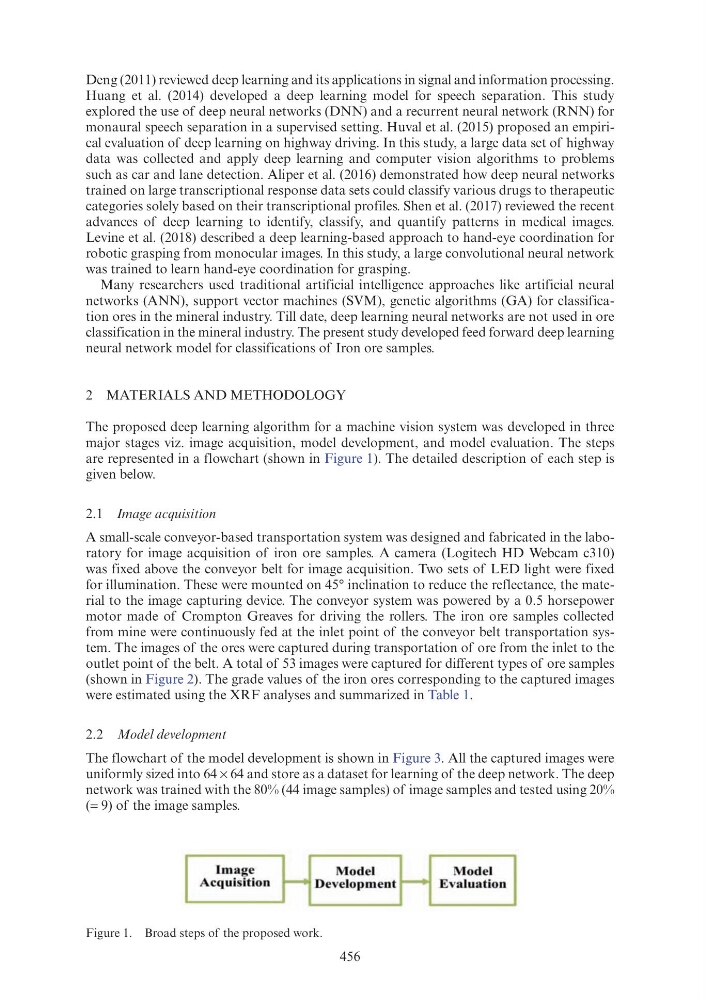
major stages viz. image acquisition, model development, and model evaluation. The steps
are represented in a flowchart (shown in Figure 1). The detailed description of each step is
given below.
2.1 Image acquisition
A small-scale conveyor-based transportation system was designed and fabricated in the laboratory for image acquisition of iron ore samples. A camera (Logitech HD Webcam c310)
was fixed above the conveyor belt for image acquisition. Two sets of LED light were fixed
for illumination. These were mounted on 45° inclination to reduce the reflectance, the material to the image capturing device. The conveyor system was powered by a 0.5 horsepower
motor made of Crompton Greaves for driving the rollers. The iron ore samples collected
from mine were continuously fed at the inlet point of the conveyor belt transportation system. The images of the ores were captured during transportation of ore from the inlet to the
outlet point of the belt. A total of 53 images were captured for different types of ore samples
(shown in Figure 2). The grade values of the iron ores corresponding to the captured images
were estimated using the XRF analyses and summarized in Table 1.
2.2 Model development
The flowchart of the model development is shown in Figure 3. All the captured images were
uniformly sized into 64 × 64 and store as a dataset for learning of the deep network. The deep
network was trained with the 80% (44 image samples) of image samples and tested using 20%
(= 9) of the image samples.
Figure 1. Broad steps of the proposed work.
Image
Model
Model
Acquisition r- Development r-- Evaluation
Deng (2011) reviewed deep learning and its applications in signal and information processing.
Huang et al. (2014) developed a deep learning model for speech separation. This study
explored the use of deep neural networks (DNN) and a recurrent neural network (RNN) for
monaural speech separation in a supervised setting. Huval et al. (2015) proposed an empirical evaluation of deep learning on highway driving. In this study, a large data set of highway
data was collected and apply deep learning and computer vision algorithms to problems
such as car and lane detection. Aliper et al. (2016) demonstrated how deep neural networks
trained on large transcriptional response data sets could classify various drugs to therapeutic
categories solely based on their transcriptional profiles. Shen et al. (2017) reviewed the recent
advances of deep learning to identify, classify, and quantify patterns in medical images.
Levine et al. (2018) described a deep learning-based approach to hand-eye coordination for
robotic grasping from monocular images. In this study, a large convolutional neural network
was trained to learn hand-eye coordination for grasping.
Many researchers used traditional artificial intelligence approaches like artificial neural
networks (ANN), support vector machines (SVM), genetic algorithms (GA) for classification ores in the mineral industry. Till date, deep learning neural networks are not used in ore
classification in the mineral industry. The present study developed feed forward deep learning
neural network model for classifications of Iron ore samples.
2 MATERIALS AND METHODOLOGY
The proposed deep learning algorithm for a machine vision system was developed in three
major stages viz. image acquisition, model development, and model evaluation. The steps
are represented in a flowchart (shown in Figure 1). The detailed description of each step is
given below.
2.1 Image acquisition
A small-scale conveyor-based transportation system was designed and fabricated in the laboratory for image acquisition of iron ore samples. A camera (Logitech HD Webcam c310)
was fixed above the conveyor belt for image acquisition. Two sets of LED light were fixed
for illumination. These were mounted on 45° inclination to reduce the reflectance, the material to the image capturing device. The conveyor system was powered by a 0.5 horsepower
motor made of Crompton Greaves for driving the rollers. The iron ore samples collected
from mine were continuously fed at the inlet point of the conveyor belt transportation system. The images of the ores were captured during transportation of ore from the inlet to the
outlet point of the belt. A total of 53 images were captured for different types of ore samples
(shown in Figure 2). The grade values of the iron ores corresponding to the captured images
were estimated using the XRF analyses and summarized in Table 1.
2.2 Model development
The flowchart of the model development is shown in Figure 3. All the captured images were
uniformly sized into 64 × 64 and store as a dataset for learning of the deep network. The deep
network was trained with the 80% (44 image samples) of image samples and tested using 20%
(= 9) of the image samples.
Figure 1. Broad steps of the proposed work.
Image
Model
Model
Acquisition r- Development r-- Evaluation