

20
• To what extent can reality be replaced by VR?
• Can the VR world generate a feeling for real processes?
• To what extent can internships in mining be replaced for a basic process understanding?
• Can VR be used to trigger affective learning through emotions?
• Can the VR world create uncertainty amongst students?
2.4 Implementation of scenarios
A test run of the concept is to be carried out first in the summer semester 2019 and then
in regular teaching from the winter semester 2019/2020: first, the concept will be tested in
the European Mining Course (EMC). The EMC is an international graduate programme
in which a group of approx. 20 (inter-)national students spend their 2nd semester at RWTH
Aachen University together with mining engineering students. Second, the lessons learned
from the test phase are to be used to adapt the learning concept. Subsequently, the concept will be integrated into the mining engineering courses of RWTH Aachen University
and TalTech University. The courses will then be evaluated in order to further elaborate the
concept.
2.5 Evaluation
The test lectures will be evaluated to run through two cycles of concept adaptation and continuous quality assurance. For this purpose, an evaluation tool has been developed to support
regular adjustments and uncover weaknesses and possibilities for improvement of the overall
concept.
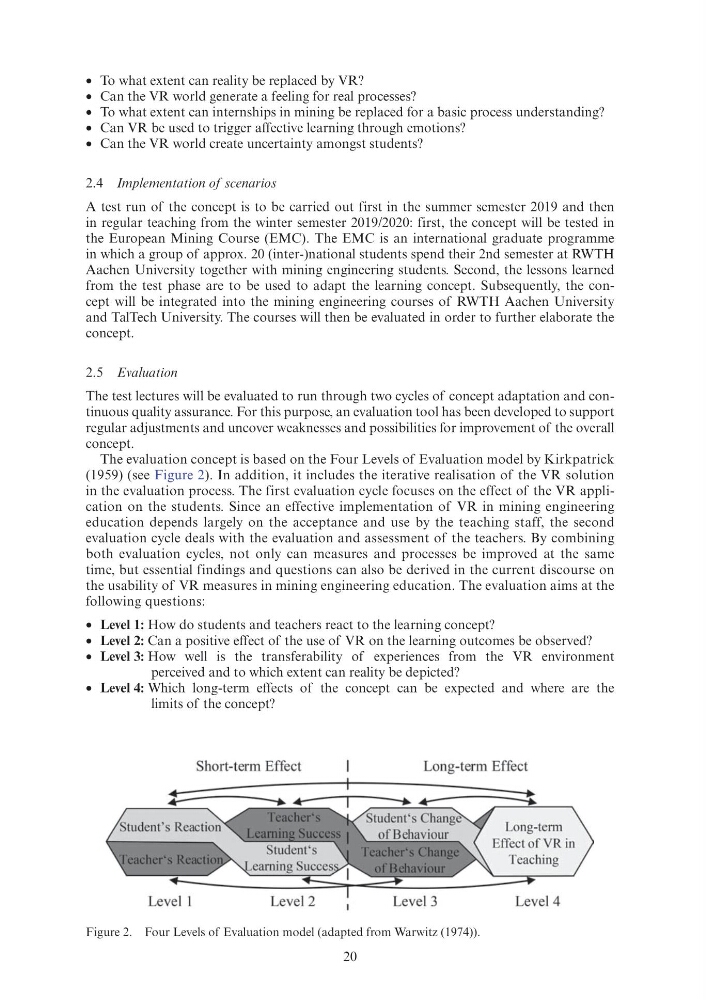
The evaluation concept is based on the Four Levels of Evaluation model by Kirkpatrick
(1959) (see Figure 2). In addition, it includes the iterative realisation of the VR solution
in the evaluation process. The first evaluation cycle focuses on the effect of the VR application on the students. Since an effective implementation of VR in mining engineering
education depends largely on the acceptance and use by the teaching staff, the second
evaluation cycle deals with the evaluation and assessment of the teachers. By combining
both evaluation cycles, not only can measures and processes be improved at the same
time, but essential findings and questions can also be derived in the current discourse on
the usability of VR measures in mining engineering education. The evaluation aims at the
following questions:
• Level 1: How do students and teachers react to the learning concept?
• Level 2: Can a positive effect of the use of VR on the learning outcomes be observed?
• Level 3: How well is the transferability of experiences from the VR environment
perceived and to which extent can reality be depicted?
• Level 4: Which long-term effects of the concept can be expected and where are the
limits of the concept?
Figure 2. Four Levels of Evaluation model (adapted from Warwitz (1974)).
Short-term Effect
Long-term Effect
• To what extent can reality be replaced by VR?
• Can the VR world generate a feeling for real processes?
• To what extent can internships in mining be replaced for a basic process understanding?
• Can VR be used to trigger affective learning through emotions?
• Can the VR world create uncertainty amongst students?
2.4 Implementation of scenarios
A test run of the concept is to be carried out first in the summer semester 2019 and then
in regular teaching from the winter semester 2019/2020: first, the concept will be tested in
the European Mining Course (EMC). The EMC is an international graduate programme
in which a group of approx. 20 (inter-)national students spend their 2nd semester at RWTH
Aachen University together with mining engineering students. Second, the lessons learned
from the test phase are to be used to adapt the learning concept. Subsequently, the concept will be integrated into the mining engineering courses of RWTH Aachen University
and TalTech University. The courses will then be evaluated in order to further elaborate the
concept.
2.5 Evaluation
The test lectures will be evaluated to run through two cycles of concept adaptation and continuous quality assurance. For this purpose, an evaluation tool has been developed to support
regular adjustments and uncover weaknesses and possibilities for improvement of the overall
concept.
The evaluation concept is based on the Four Levels of Evaluation model by Kirkpatrick
(1959) (see Figure 2). In addition, it includes the iterative realisation of the VR solution
in the evaluation process. The first evaluation cycle focuses on the effect of the VR application on the students. Since an effective implementation of VR in mining engineering
education depends largely on the acceptance and use by the teaching staff, the second
evaluation cycle deals with the evaluation and assessment of the teachers. By combining
both evaluation cycles, not only can measures and processes be improved at the same
time, but essential findings and questions can also be derived in the current discourse on
the usability of VR measures in mining engineering education. The evaluation aims at the
following questions:
• Level 1: How do students and teachers react to the learning concept?
• Level 2: Can a positive effect of the use of VR on the learning outcomes be observed?
• Level 3: How well is the transferability of experiences from the VR environment
perceived and to which extent can reality be depicted?
• Level 4: Which long-term effects of the concept can be expected and where are the
limits of the concept?
Figure 2. Four Levels of Evaluation model (adapted from Warwitz (1974)).
Short-term Effect
Long-term Effect