

387
Also, manual schedule is a time-consuming job and limit the possibility of creating scenarios, increasing the risk of having a suboptimal results.
Furthermore, given the dynamicity of an underground mine, short-term plans have to be
updated frequently. To guarantee optimal results, these updates should be done for the whole
plan, which is rarely achieved, usually being done for smaller periods (e.g. cascading month
plans in week, day and shift plans).
Operational Research is a methodology that makes use of mathematical, statistical and
algorithmic models for analysis and decision making (Winston, 2004; Taha, 2017). Transportation, communications, energy, mining, petroleum, and manufacturing are some of the
areas which problems can be represented by optimization models.
The objective is always to find the optimum (or close enough) choice within a set of possibilities regarding constraints of the problem. Poor decision making and suboptimal resource
allocation lead to losses of money and time.
This article proposes an Operational Research algorithm to optimize short-term plans.
2 METHODOLOGY
In an Operational Research study, the main goal is to translate the optimization objective and
problem constraints to algebraic equations and thus, build a mathematical model that can be
solved by software (a solver).
This process begins by the analysis of characteristics of the problem and the tools available
so that the use of a specific tool can be justified (Taha, 2017).
The short-term scheduling problem in underground mines can be considered a subset of
the flow shop scheduling problem.
A flow shop scheduling problem is defined (Pinedo, 2016) by the scheduling of n tasks in
m machines given that each task has to undergo each machine in the same order, i.e., all tasks
has to follow the same process route. The following figure gives an example of a flow shop
problem. Here, each task has to be processed by each machine in the same order (green
blue pink yellow red). Each machine can process only one task at time.
The underground mine short-term scheduling problem requires some modifications to the
generic flow shop problem. In mines, we have multiple machines doing same activity of a
cycle. Thus, the concept of activity and machine has to be split. The cycle will be formed by
activities executed by one or more parallel machines.
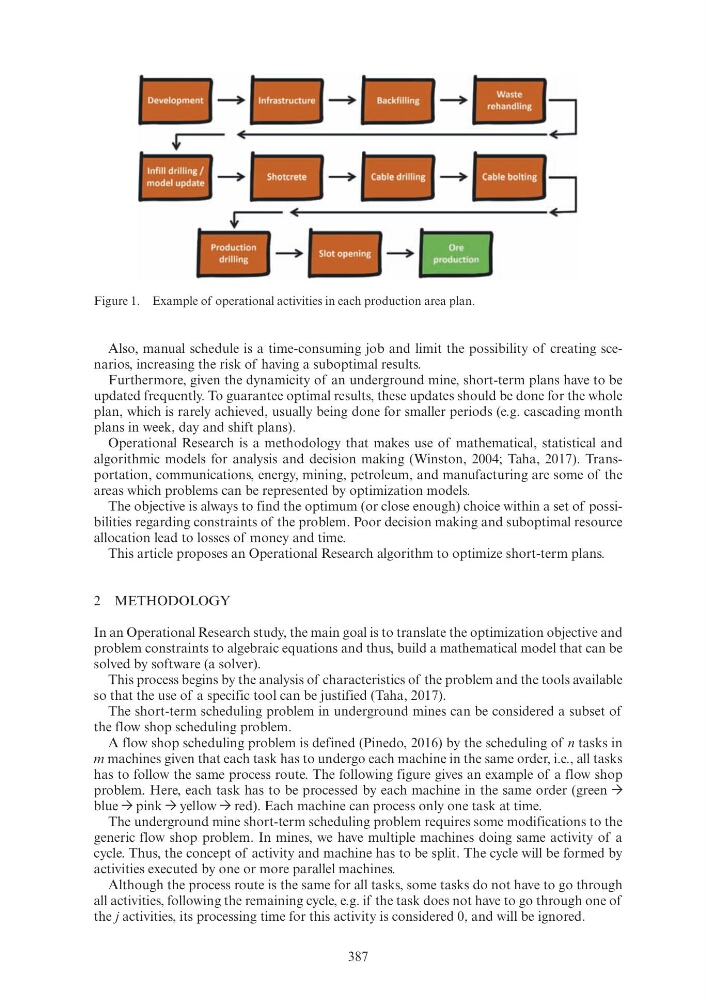
Although the process route is the same for all tasks, some tasks do not have to go through
all activities, following the remaining cycle, e.g. if the task does not have to go through one of
the j activities, its processing time for this activity is considered 0, and will be ignored.
Figure 1. Example of operational activities in each production area plan.
Also, manual schedule is a time-consuming job and limit the possibility of creating scenarios, increasing the risk of having a suboptimal results.
Furthermore, given the dynamicity of an underground mine, short-term plans have to be
updated frequently. To guarantee optimal results, these updates should be done for the whole
plan, which is rarely achieved, usually being done for smaller periods (e.g. cascading month
plans in week, day and shift plans).
Operational Research is a methodology that makes use of mathematical, statistical and
algorithmic models for analysis and decision making (Winston, 2004; Taha, 2017). Transportation, communications, energy, mining, petroleum, and manufacturing are some of the
areas which problems can be represented by optimization models.
The objective is always to find the optimum (or close enough) choice within a set of possibilities regarding constraints of the problem. Poor decision making and suboptimal resource
allocation lead to losses of money and time.
This article proposes an Operational Research algorithm to optimize short-term plans.
2 METHODOLOGY
In an Operational Research study, the main goal is to translate the optimization objective and
problem constraints to algebraic equations and thus, build a mathematical model that can be
solved by software (a solver).
This process begins by the analysis of characteristics of the problem and the tools available
so that the use of a specific tool can be justified (Taha, 2017).
The short-term scheduling problem in underground mines can be considered a subset of
the flow shop scheduling problem.
A flow shop scheduling problem is defined (Pinedo, 2016) by the scheduling of n tasks in
m machines given that each task has to undergo each machine in the same order, i.e., all tasks
has to follow the same process route. The following figure gives an example of a flow shop
problem. Here, each task has to be processed by each machine in the same order (green
blue pink yellow red). Each machine can process only one task at time.
The underground mine short-term scheduling problem requires some modifications to the
generic flow shop problem. In mines, we have multiple machines doing same activity of a
cycle. Thus, the concept of activity and machine has to be split. The cycle will be formed by
activities executed by one or more parallel machines.
Although the process route is the same for all tasks, some tasks do not have to go through
all activities, following the remaining cycle, e.g. if the task does not have to go through one of
the j activities, its processing time for this activity is considered 0, and will be ignored.
Figure 1. Example of operational activities in each production area plan.