

383
3 COMPUTATIONAL STUDY
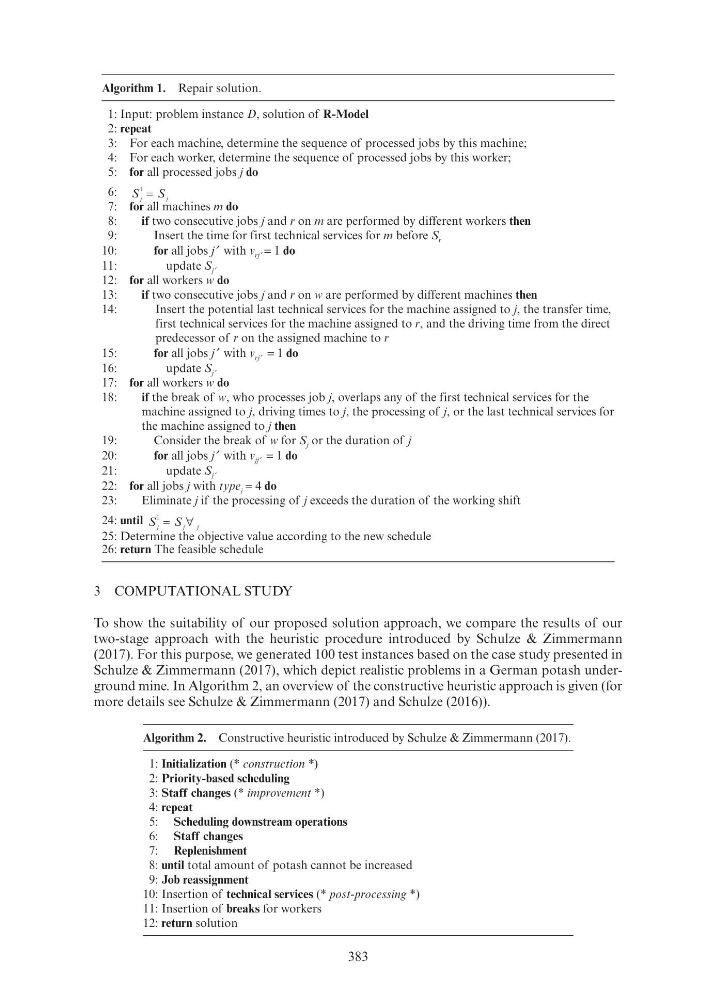
To show the suitability of our proposed solution approach, we compare the results of our
two-stage approach with the heuristic procedure introduced by Schulze & Zimmermann
(2017). For this purpose, we generated 100 test instances based on the case study presented in
Schulze & Zimmermann (2017), which depict realistic problems in a German potash underground mine. In Algorithm 2, an overview of the constructive heuristic approach is given (for
more details see Schulze & Zimmermann (2017) and Schulze (2016)).
Algorithm 1. Repair solution.
1: Input: problem instance D, solution of R-Model
2: repeat
3: For each machine, determine the sequence of processed jobs by this machine;
4: For each worker, determine the sequence of processed jobs by this worker;
5: for all processed jobs j do
6: S
S
j
j
S
S
1
7: for all machines m do
8:
if two consecutive jobs j and r on m are performed by different workers then
9:
Insert the time for first technical services for m before S r
10:
for all jobs j′ with v rj′ = 1 do
11:
update S j′
12: for all workers w do
13:
if two consecutive jobs j and r on w are performed by different machines then
14:
Insert the potential last technical services for the machine assigned to j, the transfer time,
first technical services for the machine assigned to r, and the driving time from the direct
predecessor of r on the assigned machine to r
15:
for all jobs j′ with v rj′ = 1 do
16:
update S j′
17: for all workers w do
18:
if the break of w, who processes job j, overlaps any of the first technical services for the
machine assigned to j, driving times to j, the processing of j, or the last technical services for
the machine assigned to j then
19:
Consider the break of w for S j or the duration of j
20:
for all jobs j′ with v jj′ = 1 do
21:
update S j′
22: for all jobs j with type j = 4 do
23:
Eliminate j if the processing of j exceeds the duration of the working shift
24: until S j
j
S
S j
1 = ∀
S j
S
25: Determine the objective value according to the new schedule
26: return The feasible schedule
Algorithm 2. Constructive heuristic introduced by Schulze & Zimmermann (2017).
1: Initialization (* construction *)
2: Priority-based scheduling
3: Staff changes (* improvement *)
4: repeat
5: Scheduling downstream operations
6: Staff changes
7: Replenishment
8: until total amount of potash cannot be increased
9: Job reassignment
10: Insertion of technical services (* post-processing *)
11: Insertion of breaks for workers
12: return solution
3 COMPUTATIONAL STUDY
To show the suitability of our proposed solution approach, we compare the results of our
two-stage approach with the heuristic procedure introduced by Schulze & Zimmermann
(2017). For this purpose, we generated 100 test instances based on the case study presented in
Schulze & Zimmermann (2017), which depict realistic problems in a German potash underground mine. In Algorithm 2, an overview of the constructive heuristic approach is given (for
more details see Schulze & Zimmermann (2017) and Schulze (2016)).
Algorithm 1. Repair solution.
1: Input: problem instance D, solution of R-Model
2: repeat
3: For each machine, determine the sequence of processed jobs by this machine;
4: For each worker, determine the sequence of processed jobs by this worker;
5: for all processed jobs j do
6: S
S
j
j
S
S
1
7: for all machines m do
8:
if two consecutive jobs j and r on m are performed by different workers then
9:
Insert the time for first technical services for m before S r
10:
for all jobs j′ with v rj′ = 1 do
11:
update S j′
12: for all workers w do
13:
if two consecutive jobs j and r on w are performed by different machines then
14:
Insert the potential last technical services for the machine assigned to j, the transfer time,
first technical services for the machine assigned to r, and the driving time from the direct
predecessor of r on the assigned machine to r
15:
for all jobs j′ with v rj′ = 1 do
16:
update S j′
17: for all workers w do
18:
if the break of w, who processes job j, overlaps any of the first technical services for the
machine assigned to j, driving times to j, the processing of j, or the last technical services for
the machine assigned to j then
19:
Consider the break of w for S j or the duration of j
20:
for all jobs j′ with v jj′ = 1 do
21:
update S j′
22: for all jobs j with type j = 4 do
23:
Eliminate j if the processing of j exceeds the duration of the working shift
24: until S j
j
S
S j
1 = ∀
S j
S
25: Determine the objective value according to the new schedule
26: return The feasible schedule
Algorithm 2. Constructive heuristic introduced by Schulze & Zimmermann (2017).
1: Initialization (* construction *)
2: Priority-based scheduling
3: Staff changes (* improvement *)
4: repeat
5: Scheduling downstream operations
6: Staff changes
7: Replenishment
8: until total amount of potash cannot be increased
9: Job reassignment
10: Insertion of technical services (* post-processing *)
11: Insertion of breaks for workers
12: return solution