

372
The number of chromosomes in the initial population is taken as an input. The aforementioned process is then repeated to generate the inputted number of sequences for all the
mines. The sequences, one from each of the mine, are then grouped to form chromosomes
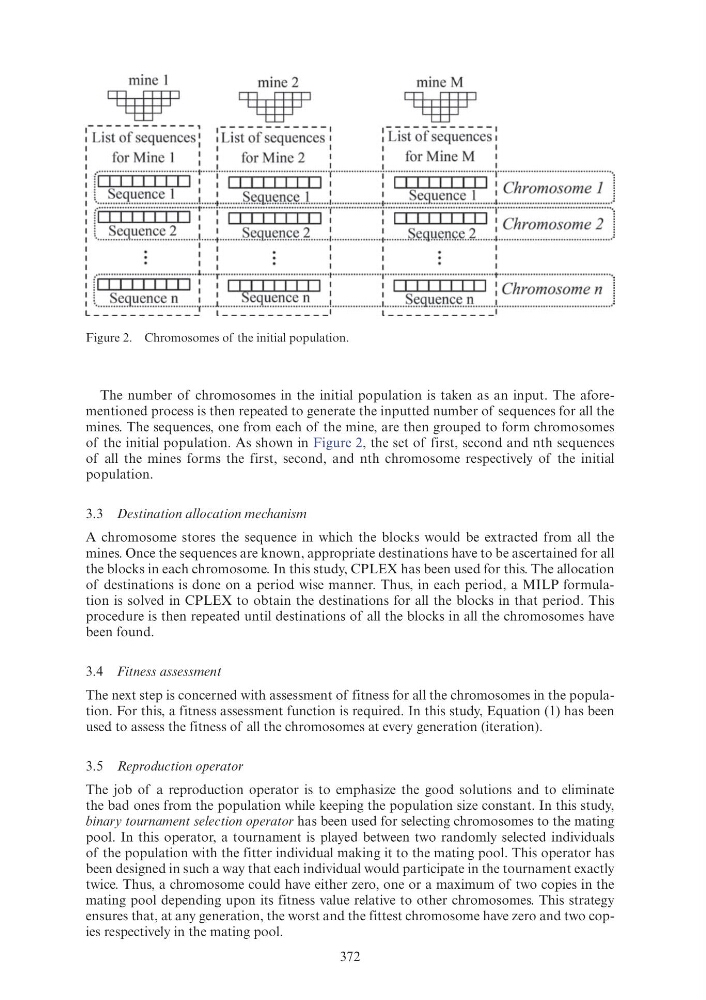
of the initial population. As shown in Figure 2, the set of first, second and nth sequences
of all the mines forms the first, second, and nth chromosome respectively of the initial
population.
3.3 Destination allocation mechanism
A chromosome stores the sequence in which the blocks would be extracted from all the
mines. Once the sequences are known, appropriate destinations have to be ascertained for all
the blocks in each chromosome. In this study, CPLEX has been used for this. The allocation
of destinations is done on a period wise manner. Thus, in each period, a MILP formulation is solved in CPLEX to obtain the destinations for all the blocks in that period. This
procedure is then repeated until destinations of all the blocks in all the chromosomes have
been found.
3.4 Fitness assessment
The next step is concerned with assessment of fitness for all the chromosomes in the population. For this, a fitness assessment function is required. In this study, Equation (1) has been
used to assess the fitness of all the chromosomes at every generation (iteration).
3.5 Reproduction operator
The job of a reproduction operator is to emphasize the good solutions and to eliminate
the bad ones from the population while keeping the population size constant. In this study,
binary tournament selection operator has been used for selecting chromosomes to the mating
pool. In this operator, a tournament is played between two randomly selected individuals
of the population with the fitter individual making it to the mating pool. This operator has
been designed in such a way that each individual would participate in the tournament exactly
twice. Thus, a chromosome could have either zero, one or a maximum of two copies in the
mating pool depending upon its fitness value relative to other chromosomes. This strategy
ensures that, at any generation, the worst and the fittest chromosome have zero and two copies respectively in the mating pool.
Figure 2. Chromosomes of the initial population.
mine 1
mine 2
mineM
w
w
w
1
-Li;t -of ~~qu~~Ze~: : iist ~f ;eq~;;c~;:
: iist ~f ~e-q~~~c~~:
I
I
1
I
for Mine 1 : 1 for Mine 2
1
1
for Mine M 1
I
I
1
I
:······································t·····"j'········································T ··················;·········································T ········· .. ································.
!I I I I I I I I I: 1 I I I I I I I I It
1 I I I I I I I I ItCh
1 !
; Sequence 1 t t
Sequence 1 t
t
Seguence 1 t
romosome ~
·:::::::::::::::::::::::::::::::::::::::;::::::t:::::::::::::::: .. ::::::::::::::::::::::::.l:::::::::::::::::::.t:::::::::::::::::.:::::::::::::::::::::::::!:::::::::::::::::::::::::::::::::::::::::::··
[I I I I I I I I It :I I I I I I I I I:
:I I I I I I I I I: Ch
2 .. !
[ _ Sequence 2 t t Se uence 2 t
t
Se uence 2 t
romosome !
...................................... .l.. ....•............... 9! ........................ t···················t··············.!l.. ....................... t .•....•....•.•.......•..........•....•....•• •
I
I
I
I
I
I
•
I
I
•
I
I
•
I
.······································· 1 ·····r··········································t···················t··········································t·············································
!I I I I I I I I I : : I I I I I I I I I :
t I I I I I I I I I :Chromosome n l
~·::·~:~~-~~::~:::l!::··~·J ..... ~.::·:::·~-~~~~:~~-~·::·:::~ ................... [ .. ~·::·~-~~y~~~~~~ .. ~-j-· ......................................... )
The number of chromosomes in the initial population is taken as an input. The aforementioned process is then repeated to generate the inputted number of sequences for all the
mines. The sequences, one from each of the mine, are then grouped to form chromosomes
of the initial population. As shown in Figure 2, the set of first, second and nth sequences
of all the mines forms the first, second, and nth chromosome respectively of the initial
population.
3.3 Destination allocation mechanism
A chromosome stores the sequence in which the blocks would be extracted from all the
mines. Once the sequences are known, appropriate destinations have to be ascertained for all
the blocks in each chromosome. In this study, CPLEX has been used for this. The allocation
of destinations is done on a period wise manner. Thus, in each period, a MILP formulation is solved in CPLEX to obtain the destinations for all the blocks in that period. This
procedure is then repeated until destinations of all the blocks in all the chromosomes have
been found.
3.4 Fitness assessment
The next step is concerned with assessment of fitness for all the chromosomes in the population. For this, a fitness assessment function is required. In this study, Equation (1) has been
used to assess the fitness of all the chromosomes at every generation (iteration).
3.5 Reproduction operator
The job of a reproduction operator is to emphasize the good solutions and to eliminate
the bad ones from the population while keeping the population size constant. In this study,
binary tournament selection operator has been used for selecting chromosomes to the mating
pool. In this operator, a tournament is played between two randomly selected individuals
of the population with the fitter individual making it to the mating pool. This operator has
been designed in such a way that each individual would participate in the tournament exactly
twice. Thus, a chromosome could have either zero, one or a maximum of two copies in the
mating pool depending upon its fitness value relative to other chromosomes. This strategy
ensures that, at any generation, the worst and the fittest chromosome have zero and two copies respectively in the mating pool.
Figure 2. Chromosomes of the initial population.
mine 1
mine 2
mineM
w
w
w
1
-Li;t -of ~~qu~~Ze~: : iist ~f ;eq~;;c~;:
: iist ~f ~e-q~~~c~~:
I
I
1
I
for Mine 1 : 1 for Mine 2
1
1
for Mine M 1
I
I
1
I
:······································t·····"j'········································T ··················;·········································T ········· .. ································.
!I I I I I I I I I: 1 I I I I I I I I It
1 I I I I I I I I ItCh
1 !
; Sequence 1 t t
Sequence 1 t
t
Seguence 1 t
romosome ~
·:::::::::::::::::::::::::::::::::::::::;::::::t:::::::::::::::: .. ::::::::::::::::::::::::.l:::::::::::::::::::.t:::::::::::::::::.:::::::::::::::::::::::::!:::::::::::::::::::::::::::::::::::::::::::··
[I I I I I I I I It :I I I I I I I I I:
:I I I I I I I I I: Ch
2 .. !
[ _ Sequence 2 t t Se uence 2 t
t
Se uence 2 t
romosome !
...................................... .l.. ....•............... 9! ........................ t···················t··············.!l.. ....................... t .•....•....•.•.......•..........•....•....•• •
I
I
I
I
I
I
•
I
I
•
I
I
•
I
.······································· 1 ·····r··········································t···················t··········································t·············································
!I I I I I I I I I : : I I I I I I I I I :
t I I I I I I I I I :Chromosome n l
~·::·~:~~-~~::~:::l!::··~·J ..... ~.::·:::·~-~~~~:~~-~·::·:::~ ................... [ .. ~·::·~-~~y~~~~~~ .. ~-j-· ......................................... )