

18
the scheelite mine in Mittersill (Austria). The project’s research consortium consists of the
Institute of Mineral Resources Engineering (MRE) and the Chair of Information Management in Mechanical Engineering (IMA) of the RWTH Aachen University (RWTH, Germany), the TalTech University (Estonia) and the mining company WOLFRAM Bergbau und
Hütten AG (Austria). For prospective mining engineers, a comprehensive understanding of
complex 3D processes as well as technical-human-environmental interdependencies are a crucial skillset. Furthermore, geological conditions in 3D deposits, the planning of mine workings
based on these conditions and specific process steps such as rock blasting or the disposition
of machines in artificially ventilated rooms have to be imagined. In general, there is limited
access to active mines because of the oftentimes remote locations and the high safety requirements, resulting from the specific hazards associated with mining. The aforementioned basic
literature is rarely updated, usually deals with the same topics for decades and is limited to
a static representation. In mining engineering, taught aspects are oftentimes site-dependent
and vary greatly, therefore requiring an individual adaptation of the visual materials. Here,
VR can contribute to answering questions using concrete examples and to creating a holistic
process understanding. In this context, the benefits of VR are the possible direct 3D immersion into locations that are remote, too costly to visit and/or unsafe. Chou (1998) notes that
the success of simulations lies primarily in the promotion of the learner’s self-determination,
unique learning experiences, support for new teaching approaches, and the development of
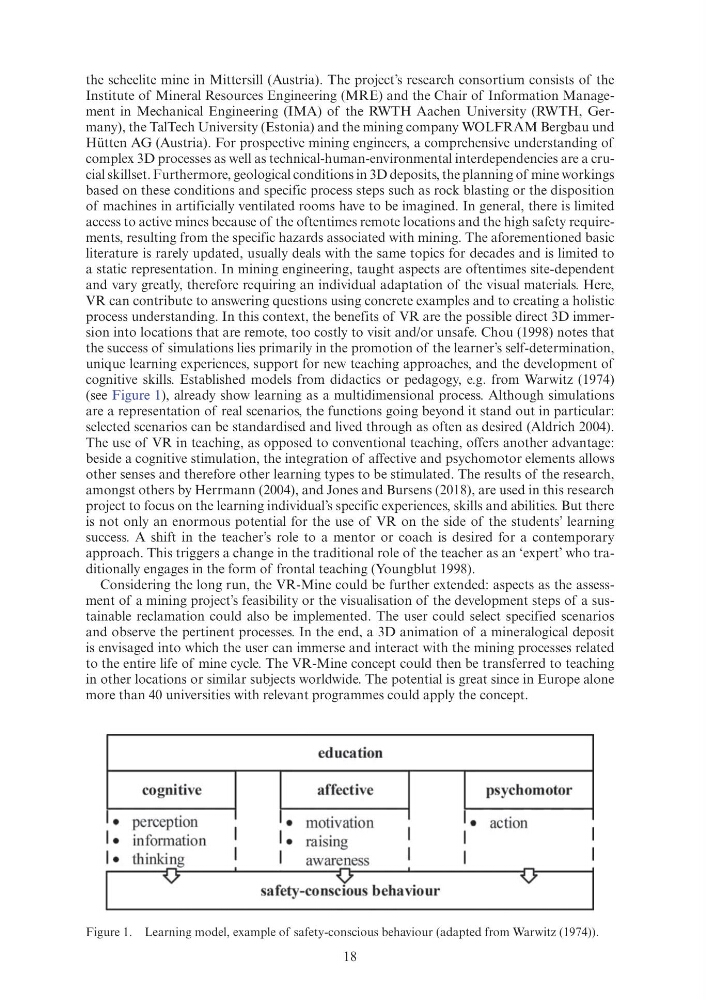
cognitive skills. Established models from didactics or pedagogy, e.g. from Warwitz (1974)
(see Figure 1), already show learning as a multidimensional process. Although simulations
are a representation of real scenarios, the functions going beyond it stand out in particular:
selected scenarios can be standardised and lived through as often as desired (Aldrich 2004).
The use of VR in teaching, as opposed to conventional teaching, offers another advantage:
beside a cognitive stimulation, the integration of affective and psychomotor elements allows
other senses and therefore other learning types to be stimulated. The results of the research,
amongst others by Herrmann (2004), and Jones and Bursens (2018), are used in this research
project to focus on the learning individual’s specific experiences, skills and abilities. But there
is not only an enormous potential for the use of VR on the side of the students’ learning
success. A shift in the teacher’s role to a mentor or coach is desired for a contemporary
approach. This triggers a change in the traditional role of the teacher as an ‘expert’ who traditionally engages in the form of frontal teaching (Youngblut 1998).
Considering the long run, the VR-Mine could be further extended: aspects as the assessment of a mining project’s feasibility or the visualisation of the development steps of a sustainable reclamation could also be implemented. The user could select specified scenarios
and observe the pertinent processes. In the end, a 3D animation of a mineralogical deposit
is envisaged into which the user can immerse and interact with the mining processes related
to the entire life of mine cycle. The VR-Mine concept could then be transferred to teaching
in other locations or similar subjects worldwide. The potential is great since in Europe alone
more than 40 universities with relevant programmes could apply the concept.
Figure 1. Learning model, example of safety-conscious behaviour (adapted from Warwitz (1974)).
education
cognitive
affective
I
psychomotor
•
•
I.
perceptwn
motivation
I. information
I. raising
action
I• thinking
I awareness
o~--~------~o~--~------~o~--~
safety-conscious behaviour
the scheelite mine in Mittersill (Austria). The project’s research consortium consists of the
Institute of Mineral Resources Engineering (MRE) and the Chair of Information Management in Mechanical Engineering (IMA) of the RWTH Aachen University (RWTH, Germany), the TalTech University (Estonia) and the mining company WOLFRAM Bergbau und
Hütten AG (Austria). For prospective mining engineers, a comprehensive understanding of
complex 3D processes as well as technical-human-environmental interdependencies are a crucial skillset. Furthermore, geological conditions in 3D deposits, the planning of mine workings
based on these conditions and specific process steps such as rock blasting or the disposition
of machines in artificially ventilated rooms have to be imagined. In general, there is limited
access to active mines because of the oftentimes remote locations and the high safety requirements, resulting from the specific hazards associated with mining. The aforementioned basic
literature is rarely updated, usually deals with the same topics for decades and is limited to
a static representation. In mining engineering, taught aspects are oftentimes site-dependent
and vary greatly, therefore requiring an individual adaptation of the visual materials. Here,
VR can contribute to answering questions using concrete examples and to creating a holistic
process understanding. In this context, the benefits of VR are the possible direct 3D immersion into locations that are remote, too costly to visit and/or unsafe. Chou (1998) notes that
the success of simulations lies primarily in the promotion of the learner’s self-determination,
unique learning experiences, support for new teaching approaches, and the development of
cognitive skills. Established models from didactics or pedagogy, e.g. from Warwitz (1974)
(see Figure 1), already show learning as a multidimensional process. Although simulations
are a representation of real scenarios, the functions going beyond it stand out in particular:
selected scenarios can be standardised and lived through as often as desired (Aldrich 2004).
The use of VR in teaching, as opposed to conventional teaching, offers another advantage:
beside a cognitive stimulation, the integration of affective and psychomotor elements allows
other senses and therefore other learning types to be stimulated. The results of the research,
amongst others by Herrmann (2004), and Jones and Bursens (2018), are used in this research
project to focus on the learning individual’s specific experiences, skills and abilities. But there
is not only an enormous potential for the use of VR on the side of the students’ learning
success. A shift in the teacher’s role to a mentor or coach is desired for a contemporary
approach. This triggers a change in the traditional role of the teacher as an ‘expert’ who traditionally engages in the form of frontal teaching (Youngblut 1998).
Considering the long run, the VR-Mine could be further extended: aspects as the assessment of a mining project’s feasibility or the visualisation of the development steps of a sustainable reclamation could also be implemented. The user could select specified scenarios
and observe the pertinent processes. In the end, a 3D animation of a mineralogical deposit
is envisaged into which the user can immerse and interact with the mining processes related
to the entire life of mine cycle. The VR-Mine concept could then be transferred to teaching
in other locations or similar subjects worldwide. The potential is great since in Europe alone
more than 40 universities with relevant programmes could apply the concept.
Figure 1. Learning model, example of safety-conscious behaviour (adapted from Warwitz (1974)).
education
cognitive
affective
I
psychomotor
•
•
I.
perceptwn
motivation
I. information
I. raising
action
I• thinking
I awareness
o~--~------~o~--~------~o~--~
safety-conscious behaviour