

10
reproducibility of the analysis at any time, a general systematics for the determination will be
developed in the following.
In order to assess the significance of individual trends for the mining industry, it is important to have an overview of the use of technology in active mining operations. A research
using conventional search engines is difficult due to the lack of search approaches (such as
the name of the mines). This leads to the second research question of this work: How can the
degree of implementation of digital trends be determined from reliable sources?
The developed method will allow stakeholders of the mining industry to evaluate the landscape of digital trends for the mining industry at any time and use this as a general orientation for future developments on the sector. The analysis regarding the implementation level
of individual technologies will make the progress visible in the industry and will allow the
classification of individual mining operations on a larger scale.
2 METHOD
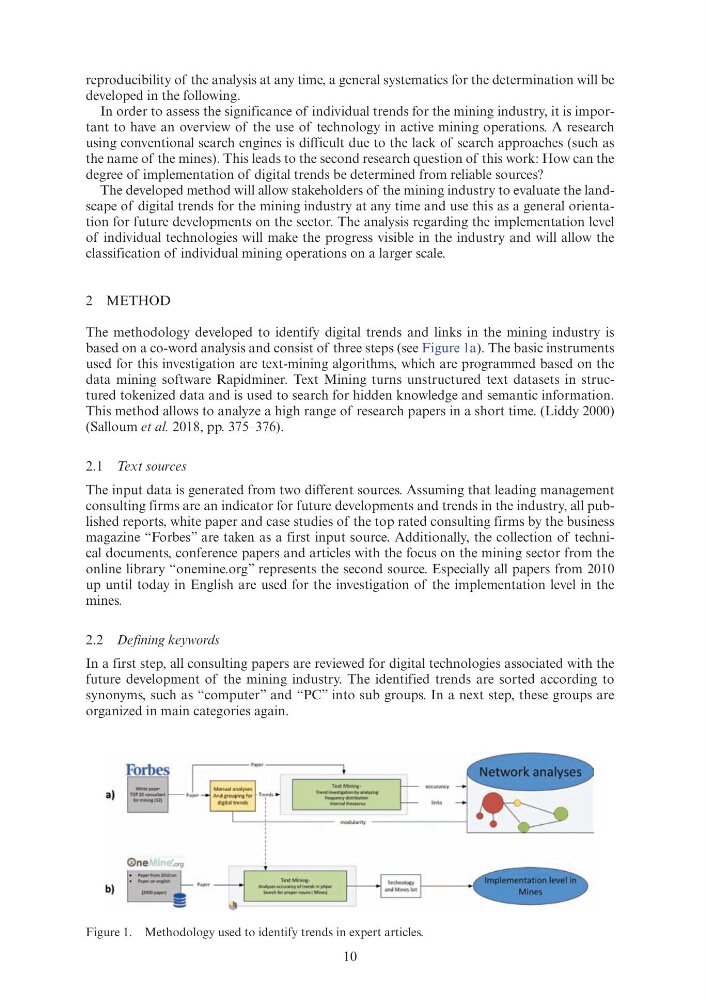
The methodology developed to identify digital trends and links in the mining industry is
based on a co-word analysis and consist of three steps (see Figure 1a). The basic instruments
used for this investigation are text-mining algorithms, which are programmed based on the
data mining software Rapidminer. Text Mining turns unstructured text datasets in structured tokenized data and is used to search for hidden knowledge and semantic information.
This method allows to analyze a high range of research papers in a short time. (Liddy 2000)
(Salloum et al. 2018, pp. 375–376).
2.1 Text sources
The input data is generated from two different sources. Assuming that leading management
consulting firms are an indicator for future developments and trends in the industry, all published reports, white paper and case studies of the top rated consulting firms by the business
magazine “Forbes” are taken as a first input source. Additionally, the collection of technical documents, conference papers and articles with the focus on the mining sector from the
online library “onemine.org” represents the second source. Especially all papers from 2010
up until today in English are used for the investigation of the implementation level in the
mines.
2.2 Defining keywords
In a first step, all consulting papers are reviewed for digital technologies associated with the
future development of the mining industry. The identified trends are sorted according to
synonyms, such as “computer” and “PC” into sub groups. In a next step, these groups are
organized in main categories again.
Figure 1. Methodology used to identify trends in expert articles.
Forbes
I
Paper
occurancy
a)
P3pe r
Tre 1 nds •
links
modlllarity
0neMine~cr9
Paper
TextM1nlngb)
An~tvses O«uramyofuends ln pAper
~•n:hforpro- nouns(Mines)
reproducibility of the analysis at any time, a general systematics for the determination will be
developed in the following.
In order to assess the significance of individual trends for the mining industry, it is important to have an overview of the use of technology in active mining operations. A research
using conventional search engines is difficult due to the lack of search approaches (such as
the name of the mines). This leads to the second research question of this work: How can the
degree of implementation of digital trends be determined from reliable sources?
The developed method will allow stakeholders of the mining industry to evaluate the landscape of digital trends for the mining industry at any time and use this as a general orientation for future developments on the sector. The analysis regarding the implementation level
of individual technologies will make the progress visible in the industry and will allow the
classification of individual mining operations on a larger scale.
2 METHOD
The methodology developed to identify digital trends and links in the mining industry is
based on a co-word analysis and consist of three steps (see Figure 1a). The basic instruments
used for this investigation are text-mining algorithms, which are programmed based on the
data mining software Rapidminer. Text Mining turns unstructured text datasets in structured tokenized data and is used to search for hidden knowledge and semantic information.
This method allows to analyze a high range of research papers in a short time. (Liddy 2000)
(Salloum et al. 2018, pp. 375–376).
2.1 Text sources
The input data is generated from two different sources. Assuming that leading management
consulting firms are an indicator for future developments and trends in the industry, all published reports, white paper and case studies of the top rated consulting firms by the business
magazine “Forbes” are taken as a first input source. Additionally, the collection of technical documents, conference papers and articles with the focus on the mining sector from the
online library “onemine.org” represents the second source. Especially all papers from 2010
up until today in English are used for the investigation of the implementation level in the
mines.
2.2 Defining keywords
In a first step, all consulting papers are reviewed for digital technologies associated with the
future development of the mining industry. The identified trends are sorted according to
synonyms, such as “computer” and “PC” into sub groups. In a next step, these groups are
organized in main categories again.
Figure 1. Methodology used to identify trends in expert articles.
Forbes
I
Paper
occurancy
a)
P3pe r
Tre 1 nds •
links
modlllarity
0neMine~cr9
Paper
TextM1nlngb)
An~tvses O«uramyofuends ln pAper
~•n:hforpro- nouns(Mines)