

283
to be trapped in the explosion funnel. The stress vector specifies the direction of dispersion of a group of these blocks; the initial velocity is calculated taking into account the
share of kinetic energy transferred from the energy of the charge explosion to the rock
mass.
3. After the formation of a new block boundary of the break line surface, its wireframe model is created (Figure 3), used in the algorithm for modelling the rock mass
shotpile.
5 SIMULATION OF THE ROCK MASS SHOTPILE AS A RESULT OF THE BLAST
The shotpile is simulated by modelling the movement of rock fragments separated from the
rock mass. At that, a minimum unit of the rock mass volume, for which the displacement
and interaction are calculated, is an elementary block. The location of elementary blocks
detached from rock mass is calculated at each time point, using the ballistics equations. In a
short-delay blast, the trajectories of individual elementary blocks can intersect, and if this
happens, the velocity vectors are corrected taking into account the partially inelastic collision
mechanism.
When falling onto the surface, the movement of rock fragments is decelerated due to the
friction, and the displacement velocity vector is corrected taking into account direction of
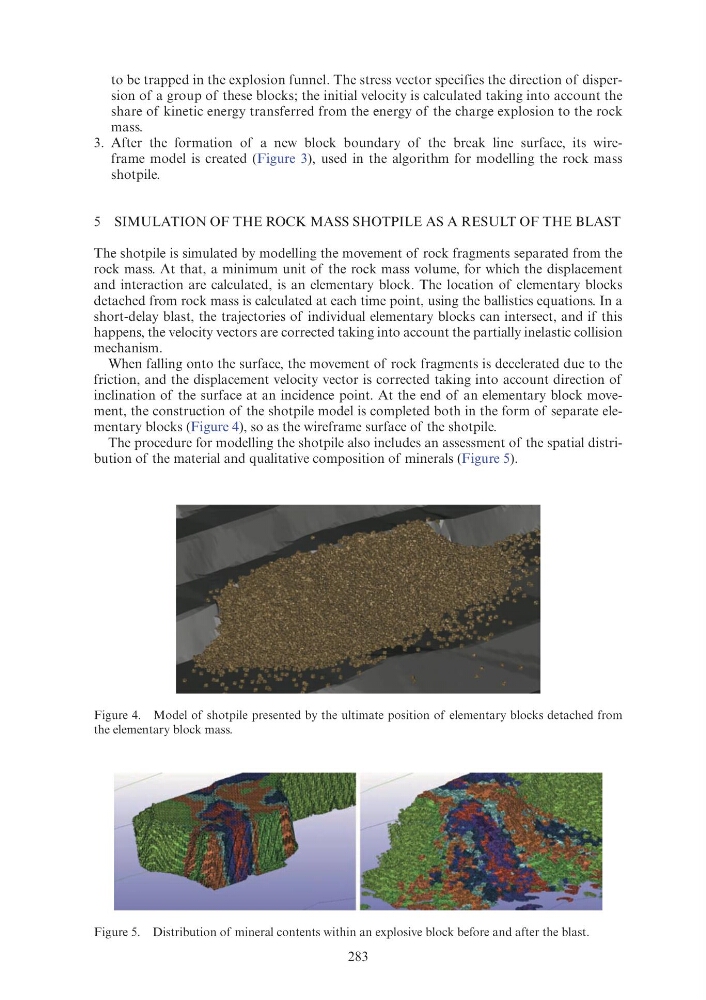
inclination of the surface at an incidence point. At the end of an elementary block movement, the construction of the shotpile model is completed both in the form of separate elementary blocks (Figure 4), so as the wireframe surface of the shotpile.
The procedure for modelling the shotpile also includes an assessment of the spatial distribution of the material and qualitative composition of minerals (Figure 5).
Figure 4. Model of shotpile presented by the ultimate position of elementary blocks detached from
the elementary block mass.
Figure 5. Distribution of mineral contents within an explosive block before and after the blast.
to be trapped in the explosion funnel. The stress vector specifies the direction of dispersion of a group of these blocks; the initial velocity is calculated taking into account the
share of kinetic energy transferred from the energy of the charge explosion to the rock
mass.
3. After the formation of a new block boundary of the break line surface, its wireframe model is created (Figure 3), used in the algorithm for modelling the rock mass
shotpile.
5 SIMULATION OF THE ROCK MASS SHOTPILE AS A RESULT OF THE BLAST
The shotpile is simulated by modelling the movement of rock fragments separated from the
rock mass. At that, a minimum unit of the rock mass volume, for which the displacement
and interaction are calculated, is an elementary block. The location of elementary blocks
detached from rock mass is calculated at each time point, using the ballistics equations. In a
short-delay blast, the trajectories of individual elementary blocks can intersect, and if this
happens, the velocity vectors are corrected taking into account the partially inelastic collision
mechanism.
When falling onto the surface, the movement of rock fragments is decelerated due to the
friction, and the displacement velocity vector is corrected taking into account direction of
inclination of the surface at an incidence point. At the end of an elementary block movement, the construction of the shotpile model is completed both in the form of separate elementary blocks (Figure 4), so as the wireframe surface of the shotpile.
The procedure for modelling the shotpile also includes an assessment of the spatial distribution of the material and qualitative composition of minerals (Figure 5).
Figure 4. Model of shotpile presented by the ultimate position of elementary blocks detached from
the elementary block mass.
Figure 5. Distribution of mineral contents within an explosive block before and after the blast.