

7
8 BEHAVIOR OF SUPPLIERS
In order to examine whether the various suppliers behave in accordance with the Hotelling
rule, it is appropriate to consider the elasticity of supply. The price elasticity of the offer indicates the percentage by which the quantity offered changes if the oil price changes by 1%. If it
is negative, the supply goes down if the oil price rises. This would correspond to the behavior
assumed by the Hotelling rule.
Table 1 shows the results of (Schlothmann, 2016), which summarizes recent studies on
the price elasticity of oil supply in the short and long term. A study recently prepared by
Golombek 2018 was added.
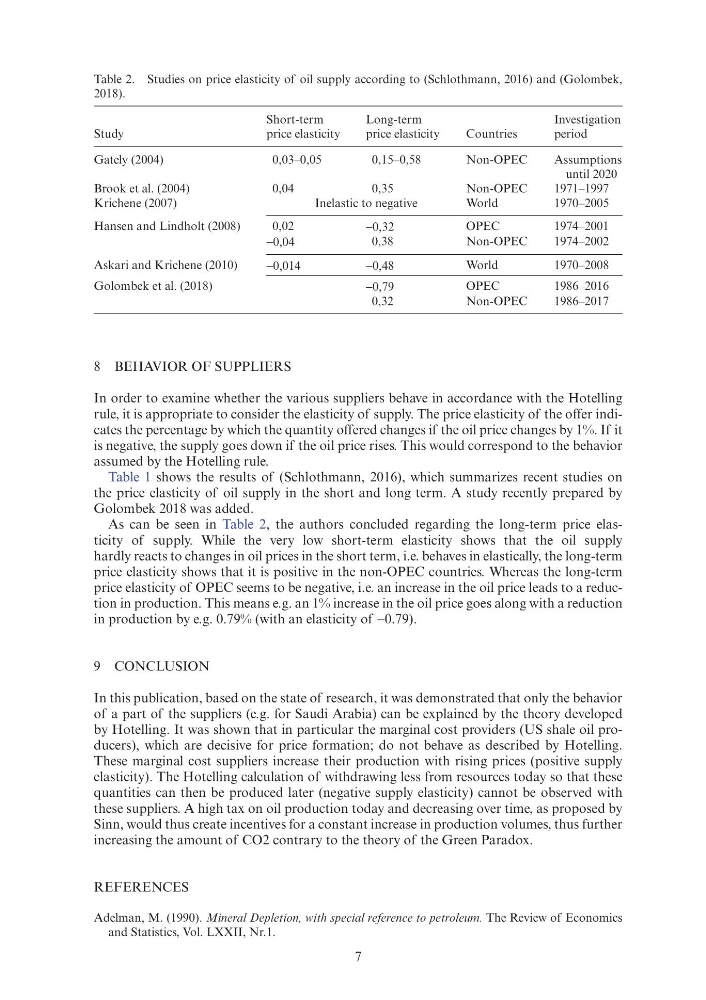
As can be seen in Table 2, the authors concluded regarding the long-term price elasticity of supply. While the very low short-term elasticity shows that the oil supply
hardly reacts to changes in oil prices in the short term, i.e. behaves in elastically, the long-term
price elasticity shows that it is positive in the non-OPEC countries. Whereas the long-term
price elasticity of OPEC seems to be negative, i.e. an increase in the oil price leads to a reduction in production. This means e.g. an 1% increase in the oil price goes along with a reduction
in production by e.g. 0.79% (with an elasticity of −0.79).
9 CONCLUSION
In this publication, based on the state of research, it was demonstrated that only the behavior
of a part of the suppliers (e.g. for Saudi Arabia) can be explained by the theory developed
by Hotelling. It was shown that in particular the marginal cost providers (US shale oil producers), which are decisive for price formation; do not behave as described by Hotelling.
These marginal cost suppliers increase their production with rising prices (positive supply
elasticity). The Hotelling calculation of withdrawing less from resources today so that these
quantities can then be produced later (negative supply elasticity) cannot be observed with
these suppliers. A high tax on oil production today and decreasing over time, as proposed by
Sinn, would thus create incentives for a constant increase in production volumes, thus further
increasing the amount of CO2 contrary to the theory of the Green Paradox.
REFERENCES
Adelman, M. (1990). Mineral Depletion, with special reference to petroleum. The Review of Economics
and Statistics, Vol. LXXII, Nr.1.
Table 2. Studies on price elasticity of oil supply according to (Schlothmann, 2016) and (Golombek,
2018).
Study
Short-term
price elasticity
Long-term
price elasticity
Countries
Investigation
period
Gately (2004)
0,03–0,05
0,15–0,58
Non-OPEC
Assumptions
until 2020
Brook et al. (2004)
0,04
0,35
Non-OPEC
1971–1997
Krichene (2007)
Inelastic to negative
World
1970–2005
Hansen and Lindholt (2008)
0,02
−0,32
OPEC
1974–2001
−0,04
0,38
Non-OPEC
1974–2002
Askari and Krichene (2010)
−0,014
−0,48
World
1970–2008
Golombek et al. (2018)
−0,79
OPEC
1986–2016
0,32
Non-OPEC
1986–2017
8 BEHAVIOR OF SUPPLIERS
In order to examine whether the various suppliers behave in accordance with the Hotelling
rule, it is appropriate to consider the elasticity of supply. The price elasticity of the offer indicates the percentage by which the quantity offered changes if the oil price changes by 1%. If it
is negative, the supply goes down if the oil price rises. This would correspond to the behavior
assumed by the Hotelling rule.
Table 1 shows the results of (Schlothmann, 2016), which summarizes recent studies on
the price elasticity of oil supply in the short and long term. A study recently prepared by
Golombek 2018 was added.
As can be seen in Table 2, the authors concluded regarding the long-term price elasticity of supply. While the very low short-term elasticity shows that the oil supply
hardly reacts to changes in oil prices in the short term, i.e. behaves in elastically, the long-term
price elasticity shows that it is positive in the non-OPEC countries. Whereas the long-term
price elasticity of OPEC seems to be negative, i.e. an increase in the oil price leads to a reduction in production. This means e.g. an 1% increase in the oil price goes along with a reduction
in production by e.g. 0.79% (with an elasticity of −0.79).
9 CONCLUSION
In this publication, based on the state of research, it was demonstrated that only the behavior
of a part of the suppliers (e.g. for Saudi Arabia) can be explained by the theory developed
by Hotelling. It was shown that in particular the marginal cost providers (US shale oil producers), which are decisive for price formation; do not behave as described by Hotelling.
These marginal cost suppliers increase their production with rising prices (positive supply
elasticity). The Hotelling calculation of withdrawing less from resources today so that these
quantities can then be produced later (negative supply elasticity) cannot be observed with
these suppliers. A high tax on oil production today and decreasing over time, as proposed by
Sinn, would thus create incentives for a constant increase in production volumes, thus further
increasing the amount of CO2 contrary to the theory of the Green Paradox.
REFERENCES
Adelman, M. (1990). Mineral Depletion, with special reference to petroleum. The Review of Economics
and Statistics, Vol. LXXII, Nr.1.
Table 2. Studies on price elasticity of oil supply according to (Schlothmann, 2016) and (Golombek,
2018).
Study
Short-term
price elasticity
Long-term
price elasticity
Countries
Investigation
period
Gately (2004)
0,03–0,05
0,15–0,58
Non-OPEC
Assumptions
until 2020
Brook et al. (2004)
0,04
0,35
Non-OPEC
1971–1997
Krichene (2007)
Inelastic to negative
World
1970–2005
Hansen and Lindholt (2008)
0,02
−0,32
OPEC
1974–2001
−0,04
0,38
Non-OPEC
1974–2002
Askari and Krichene (2010)
−0,014
−0,48
World
1970–2008
Golombek et al. (2018)
−0,79
OPEC
1986–2016
0,32
Non-OPEC
1986–2017