

5
4 THE SO-CALLED “GREEN PARADOX”
(Stern, 2006) has argued that policymakers should try to slow climate change on the demand
side through a carbon tax, i.e. a tax on carbon input and output.
However, this assumption is according to (Sinn H.-W., 2008) far away from reality. How
supply really reacts to demand reductions depends on the intertemporal decision calculation
of resource owners, and this has little to do with the static supply reactions found in reproducible goods.
If the extraction costs are negligible, so that the Hotelling rule applies (rate of price
increase = interest), the absolute price wedge rises accordingly at a rate equal to the interest
rate, which implies its constancy in present values. Consequently, there is no variation in the
extraction path (Sinn H.-W., 2008). Therefore, with negligible extraction costs, a constant
value tax will have no effect on fossil fuel consumption.
But it is unlikely that governments will agree to levy a value tax at a constant rate. What if
resource owners expect the tax rate to rise over time due to increasing temperatures and public awareness of CO 2 emissions? As it was shown in (Sinn H.-W., 1982), in this case they will
increase their sales in the present to escape the future tax burden. Climate change will therefore accelerate, a phenomenon that could be described as a “green paradox” (Sinn H.-W.,
2008).
1
In sum, Sinn comes to the conclusion that since demand policy is ineffective in its current
form because it makes completely unrealistic assumptions about supply, the question arises
as to what effective policy measures look like. Such policy measures must be derived with
explicit consideration of the temporal dimension of supply decisions.
5 STRUCTURE OF THE WORLD OIL MARKET
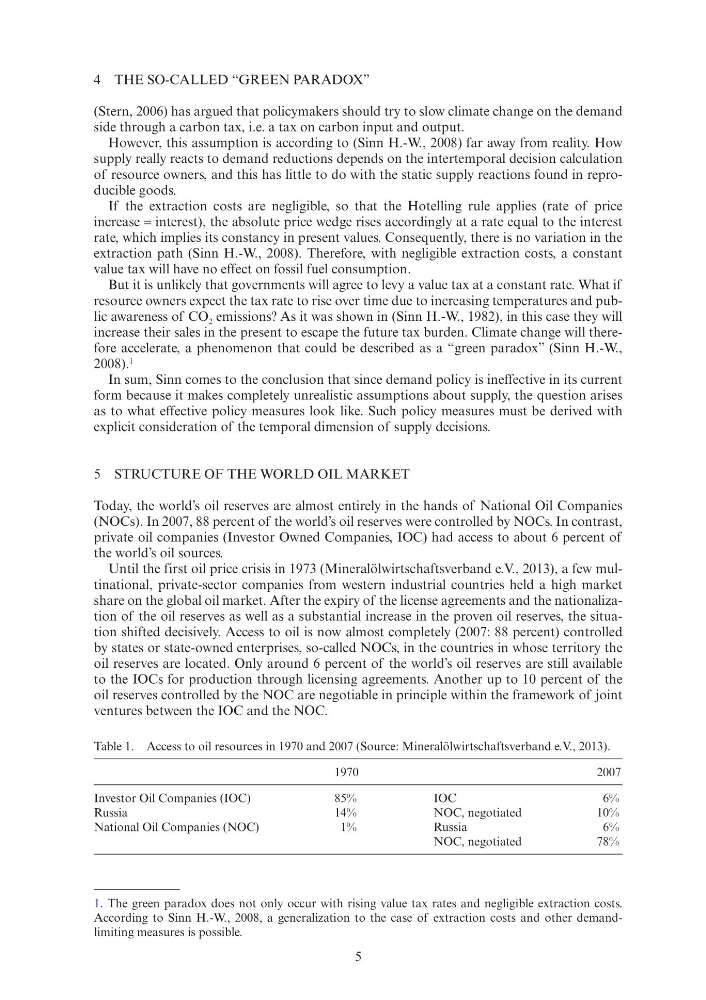
Today, the world’s oil reserves are almost entirely in the hands of National Oil Companies
(NOCs). In 2007, 88 percent of the world’s oil reserves were controlled by NOCs. In contrast,
private oil companies (Investor Owned Companies, IOC) had access to about 6 percent of
the world’s oil sources.
Until the first oil price crisis in 1973 (Mineralölwirtschaftsverband e.V., 2013), a few multinational, private-sector companies from western industrial countries held a high market
share on the global oil market. After the expiry of the license agreements and the nationalization of the oil reserves as well as a substantial increase in the proven oil reserves, the situation shifted decisively. Access to oil is now almost completely (2007: 88 percent) controlled
by states or state-owned enterprises, so-called NOCs, in the countries in whose territory the
oil reserves are located. Only around 6 percent of the world’s oil reserves are still available
to the IOCs for production through licensing agreements. Another up to 10 percent of the
oil reserves controlled by the NOC are negotiable in principle within the framework of joint
ventures between the IOC and the NOC.
Table 1. Access to oil resources in 1970 and 2007 (Source: Mineralölwirtschaftsverband e.V., 2013).
1970
2007
Investor Oil Companies (IOC)
85%
IOC
6%
Russia
14%
NOC, negotiated
10%
National Oil Companies (NOC)
1%
Russia
6%
NOC, negotiated
78%
1. The green paradox does not only occur with rising value tax rates and negligible extraction costs.
According to Sinn H.-W., 2008, a generalization to the case of extraction costs and other demandlimiting measures is possible.
4 THE SO-CALLED “GREEN PARADOX”
(Stern, 2006) has argued that policymakers should try to slow climate change on the demand
side through a carbon tax, i.e. a tax on carbon input and output.
However, this assumption is according to (Sinn H.-W., 2008) far away from reality. How
supply really reacts to demand reductions depends on the intertemporal decision calculation
of resource owners, and this has little to do with the static supply reactions found in reproducible goods.
If the extraction costs are negligible, so that the Hotelling rule applies (rate of price
increase = interest), the absolute price wedge rises accordingly at a rate equal to the interest
rate, which implies its constancy in present values. Consequently, there is no variation in the
extraction path (Sinn H.-W., 2008). Therefore, with negligible extraction costs, a constant
value tax will have no effect on fossil fuel consumption.
But it is unlikely that governments will agree to levy a value tax at a constant rate. What if
resource owners expect the tax rate to rise over time due to increasing temperatures and public awareness of CO 2 emissions? As it was shown in (Sinn H.-W., 1982), in this case they will
increase their sales in the present to escape the future tax burden. Climate change will therefore accelerate, a phenomenon that could be described as a “green paradox” (Sinn H.-W.,
2008).
1
In sum, Sinn comes to the conclusion that since demand policy is ineffective in its current
form because it makes completely unrealistic assumptions about supply, the question arises
as to what effective policy measures look like. Such policy measures must be derived with
explicit consideration of the temporal dimension of supply decisions.
5 STRUCTURE OF THE WORLD OIL MARKET
Today, the world’s oil reserves are almost entirely in the hands of National Oil Companies
(NOCs). In 2007, 88 percent of the world’s oil reserves were controlled by NOCs. In contrast,
private oil companies (Investor Owned Companies, IOC) had access to about 6 percent of
the world’s oil sources.
Until the first oil price crisis in 1973 (Mineralölwirtschaftsverband e.V., 2013), a few multinational, private-sector companies from western industrial countries held a high market
share on the global oil market. After the expiry of the license agreements and the nationalization of the oil reserves as well as a substantial increase in the proven oil reserves, the situation shifted decisively. Access to oil is now almost completely (2007: 88 percent) controlled
by states or state-owned enterprises, so-called NOCs, in the countries in whose territory the
oil reserves are located. Only around 6 percent of the world’s oil reserves are still available
to the IOCs for production through licensing agreements. Another up to 10 percent of the
oil reserves controlled by the NOC are negotiable in principle within the framework of joint
ventures between the IOC and the NOC.
Table 1. Access to oil resources in 1970 and 2007 (Source: Mineralölwirtschaftsverband e.V., 2013).
1970
2007
Investor Oil Companies (IOC)
85%
IOC
6%
Russia
14%
NOC, negotiated
10%
National Oil Companies (NOC)
1%
Russia
6%
NOC, negotiated
78%
1. The green paradox does not only occur with rising value tax rates and negligible extraction costs.
According to Sinn H.-W., 2008, a generalization to the case of extraction costs and other demandlimiting measures is possible.