

215
variety of materials, the images are highly variable in terms of resolution, aspect ratio, quality
and the relative position of the tray within the image is inconsistent.
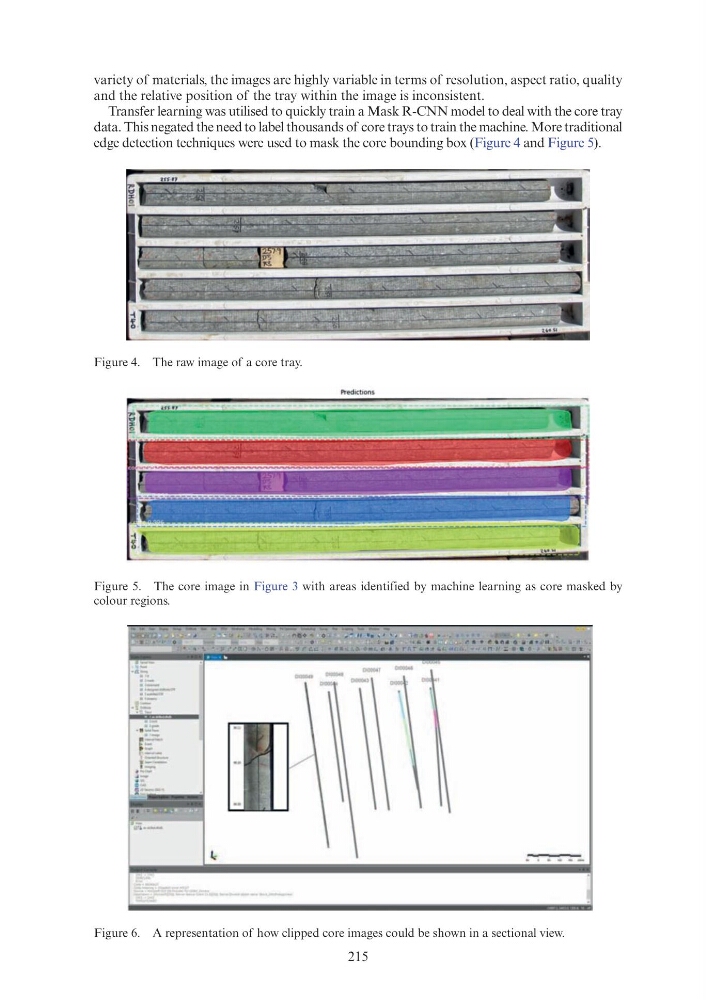
Transfer learning was utilised to quickly train a Mask R-CNN model to deal with the core tray
data. This negated the need to label thousands of core trays to train the machine. More traditional
edge detection techniques were used to mask the core bounding box (Figure 4 and Figure 5).
Figure 4. The raw image of a core tray.
Figure 5. The core image in Figure 3 with areas identified by machine learning as core masked by
colour regions.
Figure 6. A representation of how clipped core images could be shown in a sectional view.
variety of materials, the images are highly variable in terms of resolution, aspect ratio, quality
and the relative position of the tray within the image is inconsistent.
Transfer learning was utilised to quickly train a Mask R-CNN model to deal with the core tray
data. This negated the need to label thousands of core trays to train the machine. More traditional
edge detection techniques were used to mask the core bounding box (Figure 4 and Figure 5).
Figure 4. The raw image of a core tray.
Figure 5. The core image in Figure 3 with areas identified by machine learning as core masked by
colour regions.
Figure 6. A representation of how clipped core images could be shown in a sectional view.