

166
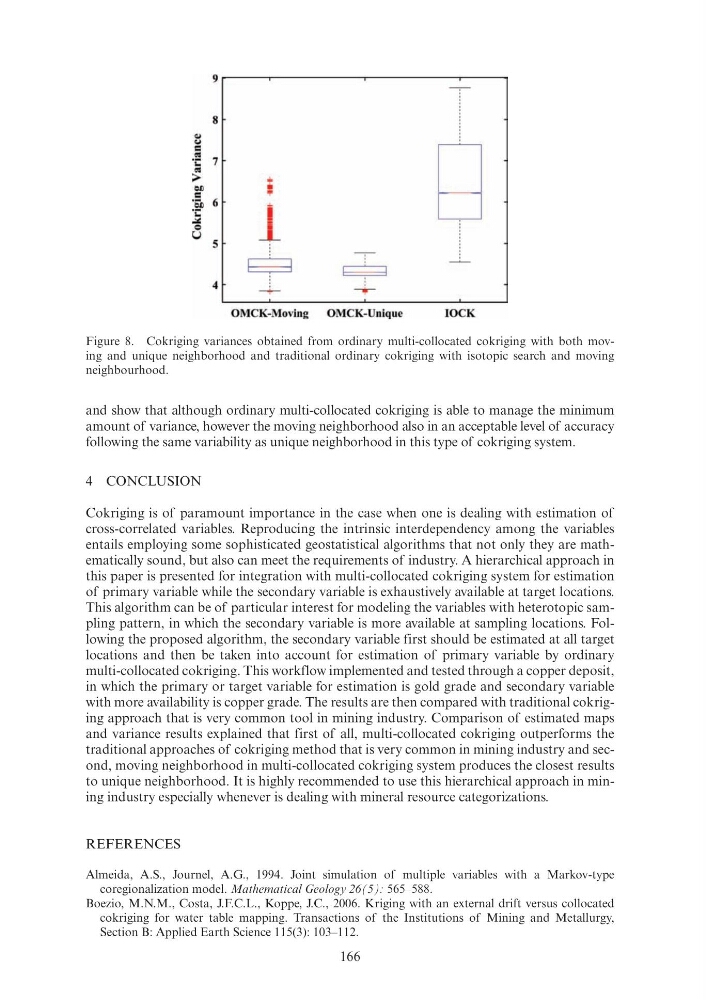
and show that although ordinary multi-collocated cokriging is able to manage the minimum
amount of variance, however the moving neighborhood also in an acceptable level of accuracy
following the same variability as unique neighborhood in this type of cokriging system.
4 CONCLUSION
Cokriging is of paramount importance in the case when one is dealing with estimation of
cross-correlated variables. Reproducing the intrinsic interdependency among the variables
entails employing some sophisticated geostatistical algorithms that not only they are mathematically sound, but also can meet the requirements of industry. A hierarchical approach in
this paper is presented for integration with multi-collocated cokriging system for estimation
of primary variable while the secondary variable is exhaustively available at target locations.
This algorithm can be of particular interest for modeling the variables with heterotopic sampling pattern, in which the secondary variable is more available at sampling locations. Following the proposed algorithm, the secondary variable first should be estimated at all target
locations and then be taken into account for estimation of primary variable by ordinary
multi-collocated cokriging. This workflow implemented and tested through a copper deposit,
in which the primary or target variable for estimation is gold grade and secondary variable
with more availability is copper grade. The results are then compared with traditional cokriging approach that is very common tool in mining industry. Comparison of estimated maps
and variance results explained that first of all, multi-collocated cokriging outperforms the
traditional approaches of cokriging method that is very common in mining industry and second, moving neighborhood in multi-collocated cokriging system produces the closest results
to unique neighborhood. It is highly recommended to use this hierarchical approach in mining industry especially whenever is dealing with mineral resource categorizations.
REFERENCES
Almeida, A.S., Journel, A.G., 1994. Joint simulation of multiple variables with a Markov-type
coregionalization model. Mathematical Geology 26(5): 565–588.
Boezio, M.N.M., Costa, J.F.C.L., Koppe, J.C., 2006. Kriging with an external drift versus collocated
cokriging for water table mapping. Transactions of the Institutions of Mining and Metallurgy,
Section B: Applied Earth Science 115(3): 103–112.
Figure 8. Cokriging variances obtained from ordinary multi-collocated cokriging with both moving and unique neighborhood and traditional ordinary cokriging with isotopic search and moving
neighbourhood.
9
8
...
"'
g
=
..
·;: 7
..
;;..
*
OJ)
=
"& 6
1
·;:
~
0
u 5
~
- , -
~
~
4
--++
OMCK-Moving
OMCK-Unique
lOCK
and show that although ordinary multi-collocated cokriging is able to manage the minimum
amount of variance, however the moving neighborhood also in an acceptable level of accuracy
following the same variability as unique neighborhood in this type of cokriging system.
4 CONCLUSION
Cokriging is of paramount importance in the case when one is dealing with estimation of
cross-correlated variables. Reproducing the intrinsic interdependency among the variables
entails employing some sophisticated geostatistical algorithms that not only they are mathematically sound, but also can meet the requirements of industry. A hierarchical approach in
this paper is presented for integration with multi-collocated cokriging system for estimation
of primary variable while the secondary variable is exhaustively available at target locations.
This algorithm can be of particular interest for modeling the variables with heterotopic sampling pattern, in which the secondary variable is more available at sampling locations. Following the proposed algorithm, the secondary variable first should be estimated at all target
locations and then be taken into account for estimation of primary variable by ordinary
multi-collocated cokriging. This workflow implemented and tested through a copper deposit,
in which the primary or target variable for estimation is gold grade and secondary variable
with more availability is copper grade. The results are then compared with traditional cokriging approach that is very common tool in mining industry. Comparison of estimated maps
and variance results explained that first of all, multi-collocated cokriging outperforms the
traditional approaches of cokriging method that is very common in mining industry and second, moving neighborhood in multi-collocated cokriging system produces the closest results
to unique neighborhood. It is highly recommended to use this hierarchical approach in mining industry especially whenever is dealing with mineral resource categorizations.
REFERENCES
Almeida, A.S., Journel, A.G., 1994. Joint simulation of multiple variables with a Markov-type
coregionalization model. Mathematical Geology 26(5): 565–588.
Boezio, M.N.M., Costa, J.F.C.L., Koppe, J.C., 2006. Kriging with an external drift versus collocated
cokriging for water table mapping. Transactions of the Institutions of Mining and Metallurgy,
Section B: Applied Earth Science 115(3): 103–112.
Figure 8. Cokriging variances obtained from ordinary multi-collocated cokriging with both moving and unique neighborhood and traditional ordinary cokriging with isotopic search and moving
neighbourhood.
9
8
...
"'
g
=
..
·;: 7
..
;;..
*
OJ)
=
"& 6
1
·;:
~
0
u 5
~
- , -
~
~
4
--++
OMCK-Moving
OMCK-Unique
lOCK