

154
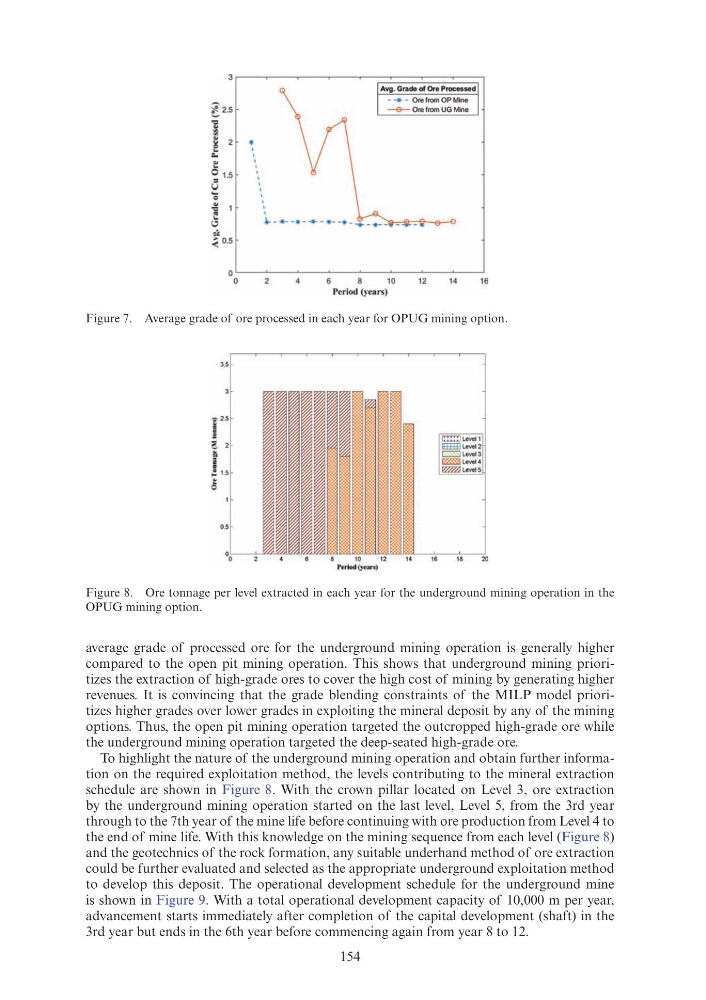
average grade of processed ore for the underground mining operation is generally higher
compared to the open pit mining operation. This shows that underground mining prioritizes the extraction of high-grade ores to cover the high cost of mining by generating higher
revenues. It is convincing that the grade blending constraints of the MILP model prioritizes higher grades over lower grades in exploiting the mineral deposit by any of the mining
options. Thus, the open pit mining operation targeted the outcropped high-grade ore while
the underground mining operation targeted the deep-seated high-grade ore.
To highlight the nature of the underground mining operation and obtain further information on the required exploitation method, the levels contributing to the mineral extraction
schedule are shown in Figure 8. With the crown pillar located on Level 3, ore extraction
by the underground mining operation started on the last level, Level 5, from the 3rd year
through to the 7th year of the mine life before continuing with ore production from Level 4 to
the end of mine life. With this knowledge on the mining sequence from each level (Figure 8)
and the geotechnics of the rock formation, any suitable underhand method of ore extraction
could be further evaluated and selected as the appropriate underground exploitation method
to develop this deposit. The operational development schedule for the underground mine
is shown in Figure 9. With a total operational development capacity of 10,000 m per year,
advancement starts immediately after completion of the capital development (shaft) in the
3rd year but ends in the 6th year before commencing again from year 8 to 12.
Figure 7. Average grade of ore processed in each year for OPUG mining option.
Figure 8. Ore tonnage per level extracted in each year for the underground mining operation in the
OPUG mining option.
c2.s
1l
~
e •
...
~ 1.5
~
u
-
0
"'
"" ..
25
"'
< 0.5
0
0
Avg. Grade of Ore Processed
- ..._ - Ore from OP Mine
-e-- Ore from UG Mine
10
12
14
Period (years)
16
18
Perlod(Jcan)
16
20
average grade of processed ore for the underground mining operation is generally higher
compared to the open pit mining operation. This shows that underground mining prioritizes the extraction of high-grade ores to cover the high cost of mining by generating higher
revenues. It is convincing that the grade blending constraints of the MILP model prioritizes higher grades over lower grades in exploiting the mineral deposit by any of the mining
options. Thus, the open pit mining operation targeted the outcropped high-grade ore while
the underground mining operation targeted the deep-seated high-grade ore.
To highlight the nature of the underground mining operation and obtain further information on the required exploitation method, the levels contributing to the mineral extraction
schedule are shown in Figure 8. With the crown pillar located on Level 3, ore extraction
by the underground mining operation started on the last level, Level 5, from the 3rd year
through to the 7th year of the mine life before continuing with ore production from Level 4 to
the end of mine life. With this knowledge on the mining sequence from each level (Figure 8)
and the geotechnics of the rock formation, any suitable underhand method of ore extraction
could be further evaluated and selected as the appropriate underground exploitation method
to develop this deposit. The operational development schedule for the underground mine
is shown in Figure 9. With a total operational development capacity of 10,000 m per year,
advancement starts immediately after completion of the capital development (shaft) in the
3rd year but ends in the 6th year before commencing again from year 8 to 12.
Figure 7. Average grade of ore processed in each year for OPUG mining option.
Figure 8. Ore tonnage per level extracted in each year for the underground mining operation in the
OPUG mining option.
c2.s
1l
~
e •
...
~ 1.5
~
u
-
0
"'
"" ..
25
"'
< 0.5
0
0
Avg. Grade of Ore Processed
- ..._ - Ore from OP Mine
-e-- Ore from UG Mine
10
12
14
Period (years)
16
18
Perlod(Jcan)
16
20