

parameters: n e = 10
19−20 cm
−3 and electron temperature T e = 20 eV (see details in
Refs. [28, 42]). For comparison there are also listed the data by Ivanov et al.,
obtained within the RMPPT approach (without the shielding effect) [28, 41, 42].
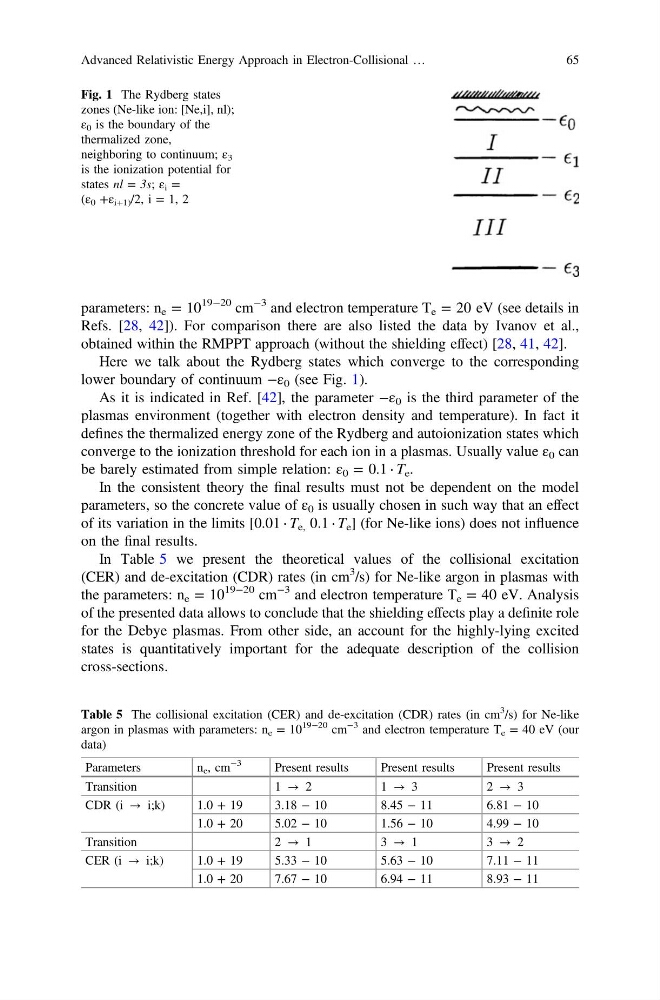
Here we talk about the Rydberg states which converge to the corresponding
lower boundary of continuum −ε 0 (see Fig. 1).
As it is indicated in Ref. [42], the parameter −ε 0 is the third parameter of the
plasmas environment (together with electron density and temperature). In fact it
defines the thermalized energy zone of the Rydberg and autoionization states which
converge to the ionization threshold for each ion in a plasmas. Usually value ε 0 can
be barely estimated from simple relation: ε 0 = 0.1 ⋅ T e .
In the consistent theory the final results must not be dependent on the model
parameters, so the concrete value of ε 0 is usually chosen in such way that an effect
of its variation in the limits [0.01 ⋅ T e, 0.1 ⋅ T e ] (for Ne-like ions) does not influence
on the final results.
In Table 5 we present the theoretical values of the collisional excitation
(CER) and de-excitation (CDR) rates (in cm
3 /s) for Ne-like argon in plasmas with
the parameters: n e = 10
19−20 cm
−3 and electron temperature T e = 40 eV. Analysis
of the presented data allows to conclude that the shielding effects play a definite role
for the Debye plasmas. From other side, an account for the highly-lying excited
states is quantitatively important for the adequate description of the collision
cross-sections.
Fig. 1 The Rydberg states
zones (Ne-like ion: [Ne,i], nl);
ε 0 is the boundary of the
thermalized zone,
neighboring to continuum; ε 3
is the ionization potential for
states nl = 3s; ε i =
(ε 0 +ε i+1) /2, i = 1, 2
Table 5 The collisional excitation (CER) and de-excitation (CDR) rates (in cm
3
/s) for Ne-like
argon in plasmas with parameters: n e = 10
19−20 cm
−3 and electron temperature T e = 40 eV (our
data)
Parameters
n e , cm
−3
Present results
Present results
Present results
Transition
1 → 2
1→ 3
2→ 3
CDR (i → i;k)
1.0 + 19
3.18 − 10
8.45 − 11
6.81 − 10
1.0 + 20
5.02 − 10
1.56 − 10
4.99 − 10
Transition
2 → 1
3→ 1
3→ 2
CER (i → i;k)
1.0 + 19
5.33 − 10
5.63 − 10
7.11 − 11
1.0 + 20
7.67 − 10
6.94 − 11
8.93 − 11
Advanced Relativistic Energy Approach in Electron-Collisional …
65
19−20 cm
−3 and electron temperature T e = 20 eV (see details in
Refs. [28, 42]). For comparison there are also listed the data by Ivanov et al.,
obtained within the RMPPT approach (without the shielding effect) [28, 41, 42].
Here we talk about the Rydberg states which converge to the corresponding
lower boundary of continuum −ε 0 (see Fig. 1).
As it is indicated in Ref. [42], the parameter −ε 0 is the third parameter of the
plasmas environment (together with electron density and temperature). In fact it
defines the thermalized energy zone of the Rydberg and autoionization states which
converge to the ionization threshold for each ion in a plasmas. Usually value ε 0 can
be barely estimated from simple relation: ε 0 = 0.1 ⋅ T e .
In the consistent theory the final results must not be dependent on the model
parameters, so the concrete value of ε 0 is usually chosen in such way that an effect
of its variation in the limits [0.01 ⋅ T e, 0.1 ⋅ T e ] (for Ne-like ions) does not influence
on the final results.
In Table 5 we present the theoretical values of the collisional excitation
(CER) and de-excitation (CDR) rates (in cm
3 /s) for Ne-like argon in plasmas with
the parameters: n e = 10
19−20 cm
−3 and electron temperature T e = 40 eV. Analysis
of the presented data allows to conclude that the shielding effects play a definite role
for the Debye plasmas. From other side, an account for the highly-lying excited
states is quantitatively important for the adequate description of the collision
cross-sections.
Fig. 1 The Rydberg states
zones (Ne-like ion: [Ne,i], nl);
ε 0 is the boundary of the
thermalized zone,
neighboring to continuum; ε 3
is the ionization potential for
states nl = 3s; ε i =
(ε 0 +ε i+1) /2, i = 1, 2
Table 5 The collisional excitation (CER) and de-excitation (CDR) rates (in cm
3
/s) for Ne-like
argon in plasmas with parameters: n e = 10
19−20 cm
−3 and electron temperature T e = 40 eV (our
data)
Parameters
n e , cm
−3
Present results
Present results
Present results
Transition
1 → 2
1→ 3
2→ 3
CDR (i → i;k)
1.0 + 19
3.18 − 10
8.45 − 11
6.81 − 10
1.0 + 20
5.02 − 10
1.56 − 10
4.99 − 10
Transition
2 → 1
3→ 1
3→ 2
CER (i → i;k)
1.0 + 19
5.33 − 10
5.63 − 10
7.11 − 11
1.0 + 20
7.67 − 10
6.94 − 11
8.93 − 11
Advanced Relativistic Energy Approach in Electron-Collisional …
65