

calculation of the energy shifts ΔE (cm
−1 ) for 2s
2 -[2s 1/2 2p 1/2,3/3 ] 1 transitions and
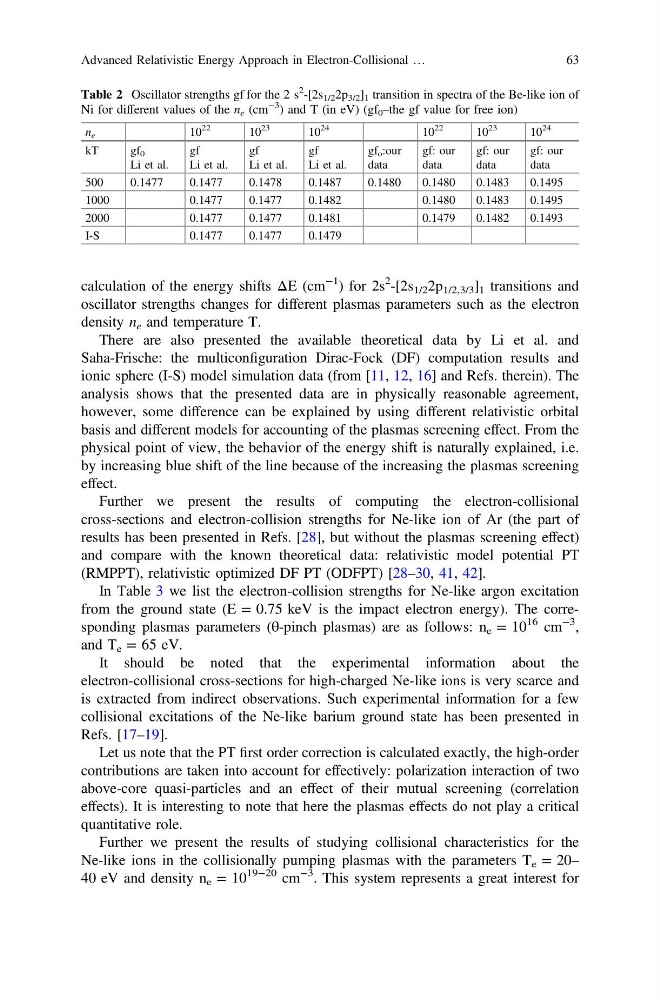
oscillator strengths changes for different plasmas parameters such as the electron
density n e and temperature T.
There are also presented the available theoretical data by Li et al. and
Saha-Frische: the multiconfiguration Dirac-Fock (DF) computation results and
ionic sphere (I-S) model simulation data (from [11, 12, 16] and Refs. therein). The
analysis shows that the presented data are in physically reasonable agreement,
however, some difference can be explained by using different relativistic orbital
basis and different models for accounting of the plasmas screening effect. From the
physical point of view, the behavior of the energy shift is naturally explained, i.e.
by increasing blue shift of the line because of the increasing the plasmas screening
effect.
Further we present the results of computing the electron-collisional
cross-sections and electron-collision strengths for Ne-like ion of Ar (the part of
results has been presented in Refs. [28], but without the plasmas screening effect)
and compare with the known theoretical data: relativistic model potential PT
(RMPPT), relativistic optimized DF PT (ODFPT) [28–30, 41, 42].
In Table 3 we list the electron-collision strengths for Ne-like argon excitation
from the ground state (E = 0.75 keV is the impact electron energy). The corresponding plasmas parameters (θ-pinch plasmas) are as follows: n e = 10
16 cm
−3 ,
and T e = 65 eV.
It should be noted that the experimental information about the
electron-collisional cross-sections for high-charged Ne-like ions is very scarce and
is extracted from indirect observations. Such experimental information for a few
collisional excitations of the Ne-like barium ground state has been presented in
Refs. [17–19].
Let us note that the PT first order correction is calculated exactly, the high-order
contributions are taken into account for effectively: polarization interaction of two
above-core quasi-particles and an effect of their mutual screening (correlation
effects). It is interesting to note that here the plasmas effects do not play a critical
quantitative role.
Further we present the results of studying collisional characteristics for the
Ne-like ions in the collisionally pumping plasmas with the parameters T e = 20–
40 eV and density n e = 10
19−20 cm
−3 . This system represents a great interest for
Table 2 Oscillator strengths gf for the 2 s
2
-[2s 1/2 2p 3/2 ] 1 transition in spectra of the Be-like ion of
Ni for different values of the n e (cm
−3
) and T (in eV) (gf 0 –the gf value for free ion)
n e
10
22
10
23
10
24
10
22
10
23
10
24
kT
gf 0
Li et al.
gf
Li et al.
gf
Li et al.
gf
Li et al.
gf o :our
data
gf: our
data
gf: our
data
gf: our
data
500
0.1477
0.1477
0.1478
0.1487
0.1480
0.1480
0.1483
0.1495
1000
0.1477
0.1477
0.1482
0.1480
0.1483
0.1495
2000
0.1477
0.1477
0.1481
0.1479
0.1482
0.1493
I-S
0.1477
0.1477
0.1479
Advanced Relativistic Energy Approach in Electron-Collisional …
63
−1 ) for 2s
2 -[2s 1/2 2p 1/2,3/3 ] 1 transitions and
oscillator strengths changes for different plasmas parameters such as the electron
density n e and temperature T.
There are also presented the available theoretical data by Li et al. and
Saha-Frische: the multiconfiguration Dirac-Fock (DF) computation results and
ionic sphere (I-S) model simulation data (from [11, 12, 16] and Refs. therein). The
analysis shows that the presented data are in physically reasonable agreement,
however, some difference can be explained by using different relativistic orbital
basis and different models for accounting of the plasmas screening effect. From the
physical point of view, the behavior of the energy shift is naturally explained, i.e.
by increasing blue shift of the line because of the increasing the plasmas screening
effect.
Further we present the results of computing the electron-collisional
cross-sections and electron-collision strengths for Ne-like ion of Ar (the part of
results has been presented in Refs. [28], but without the plasmas screening effect)
and compare with the known theoretical data: relativistic model potential PT
(RMPPT), relativistic optimized DF PT (ODFPT) [28–30, 41, 42].
In Table 3 we list the electron-collision strengths for Ne-like argon excitation
from the ground state (E = 0.75 keV is the impact electron energy). The corresponding plasmas parameters (θ-pinch plasmas) are as follows: n e = 10
16 cm
−3 ,
and T e = 65 eV.
It should be noted that the experimental information about the
electron-collisional cross-sections for high-charged Ne-like ions is very scarce and
is extracted from indirect observations. Such experimental information for a few
collisional excitations of the Ne-like barium ground state has been presented in
Refs. [17–19].
Let us note that the PT first order correction is calculated exactly, the high-order
contributions are taken into account for effectively: polarization interaction of two
above-core quasi-particles and an effect of their mutual screening (correlation
effects). It is interesting to note that here the plasmas effects do not play a critical
quantitative role.
Further we present the results of studying collisional characteristics for the
Ne-like ions in the collisionally pumping plasmas with the parameters T e = 20–
40 eV and density n e = 10
19−20 cm
−3 . This system represents a great interest for
Table 2 Oscillator strengths gf for the 2 s
2
-[2s 1/2 2p 3/2 ] 1 transition in spectra of the Be-like ion of
Ni for different values of the n e (cm
−3
) and T (in eV) (gf 0 –the gf value for free ion)
n e
10
22
10
23
10
24
10
22
10
23
10
24
kT
gf 0
Li et al.
gf
Li et al.
gf
Li et al.
gf
Li et al.
gf o :our
data
gf: our
data
gf: our
data
gf: our
data
500
0.1477
0.1477
0.1478
0.1487
0.1480
0.1480
0.1483
0.1495
1000
0.1477
0.1477
0.1482
0.1480
0.1483
0.1495
2000
0.1477
0.1477
0.1481
0.1479
0.1482
0.1493
I-S
0.1477
0.1477
0.1479
Advanced Relativistic Energy Approach in Electron-Collisional …
63