

bonds and ρ c can subsequently narrow down the candidates whose BDEs can then
be calculated to pinpoint the trigger bond among them. This can really reduce the
amount of work drastically.
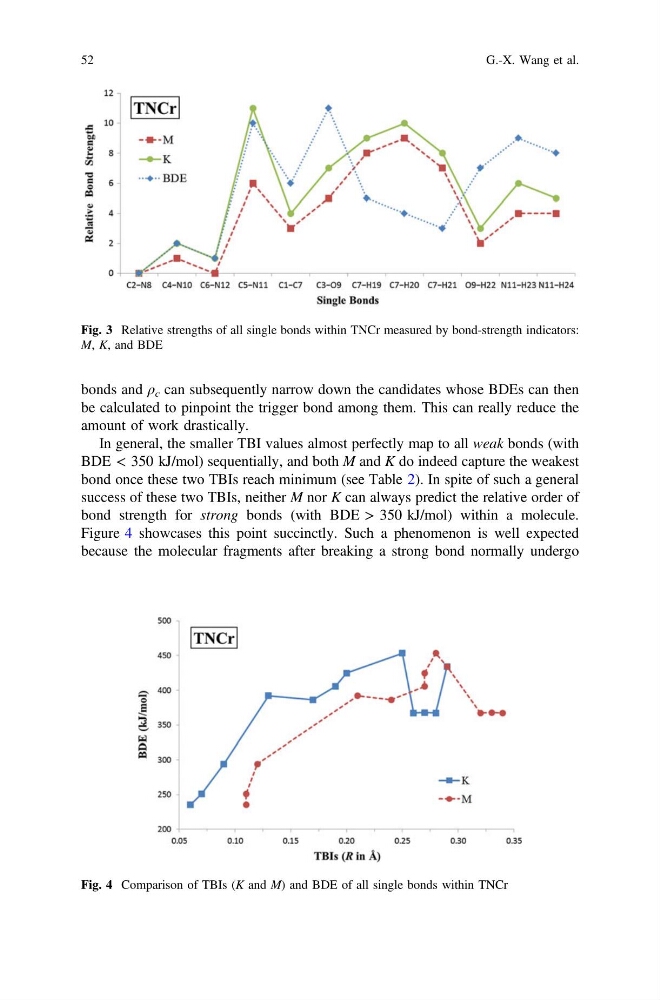
In general, the smaller TBI values almost perfectly map to all weak bonds (with
BDE < 350 kJ/mol) sequentially, and both M and K do indeed capture the weakest
bond once these two TBIs reach minimum (see Table 2). In spite of such a general
success of these two TBIs, neither M nor K can always predict the relative order of
bond strength for strong bonds (with BDE > 350 kJ/mol) within a molecule.
Figure 4 showcases this point succinctly. Such a phenomenon is well expected
because the molecular fragments after breaking a strong bond normally undergo
Fig. 3 Relative strengths of all single bonds within TNCr measured by bond-strength indicators:
M, K, and BDE
Fig. 4 Comparison of TBIs (K and M) and BDE of all single bonds within TNCr
52
G.-X. Wang et al.
be calculated to pinpoint the trigger bond among them. This can really reduce the
amount of work drastically.
In general, the smaller TBI values almost perfectly map to all weak bonds (with
BDE < 350 kJ/mol) sequentially, and both M and K do indeed capture the weakest
bond once these two TBIs reach minimum (see Table 2). In spite of such a general
success of these two TBIs, neither M nor K can always predict the relative order of
bond strength for strong bonds (with BDE > 350 kJ/mol) within a molecule.
Figure 4 showcases this point succinctly. Such a phenomenon is well expected
because the molecular fragments after breaking a strong bond normally undergo
Fig. 3 Relative strengths of all single bonds within TNCr measured by bond-strength indicators:
M, K, and BDE
Fig. 4 Comparison of TBIs (K and M) and BDE of all single bonds within TNCr
52
G.-X. Wang et al.